My heart goes out to the family and friends of the kids who were murdered or injured at the latest school shooting.
I think that the time has come to admit that we are more violent people than citizens of other countries. We need gun control. We need everyone to have to have a background check before they purchase a gun from any source, and these background checks should be much more comprehensive and stringent.
I think if someone has ever been in a psychiatric hospital, or in rehab for any addiction, they should not be allowed to have a gun.
I believe that guns make it easy to commit murder, because they are less personal and the shooter feels more removed from his victim(s). The FBI has said that many fewer people die from stabbings, as an example, than from shootings, in part because stabbing is a deeply immediate and personal act which requires touching the victim. It is not an act that can be done easily, divorcing oneself from ones action, as one can when shooting a gun.

Here’s What Actually Reduces Gun Violence
Guns aren’t going away in America. But studies have found several ways to reduce the current annual toll of 30,000 gun deaths — from universal background checks to smart policing.
posted on Oct. 2, 2015, at 11:35 a.m. at Buzzfeed.com
Peter Aldhous
BuzzFeed News Reporter
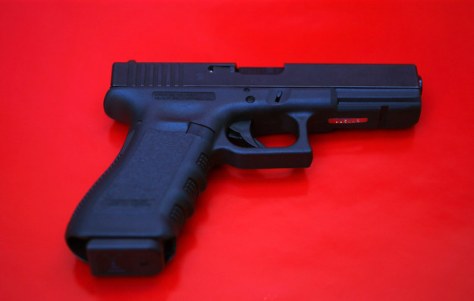
Joe Raedle / Getty Images
Roseburg, Oregon, has become the latest community to have its heart torn out by a mass shooting. And in its wake everyone is asking, once again: What can be done to reduce the toll of gun violence?
BuzzFeed News asked researchers who have devoted their careers to studying gun violence. Their answers were encouraging: Saving thousands of lives every year is an achievable goal. But meeting that challenge will require both conservatives and liberals to look beyond their usual knee-jerk reactions. It’s not a simple question of gun rights versus gun control.
Here’s what the experts had to say.
America’s problem with gun violence is bigger than most people realize.
Here is a sobering fact: The number of Americans who died from gunshot wounds in the last decade — more than 300,000 — exceeds the nation’s total combat fatalitiesin World War II.
Gun deaths in the U.S. today are almost as frequent as deaths from traffic accidents, as this graph shows. Yet the United States isn’t an especially violent country, judged by statistics on general assaults. It’s the rate of gun deaths, specifically, that outstrips that of any other developed nation.
But let’s be realistic about what gun control could achieve.
When you look across rich countries, those with higher rates of gun ownership tend to have higher gun homicide rates. Put simply, people with guns seem to kill people at higher rates than people armed with less efficient killing machines.
The big problem is that no policy that stands any chance of being implemented in the United States is likely to make a big dent in the huge numbers of guns that are already in circulation — as many as 310 million, or nearly one for every U.S. resident. The Second Amendment is a reality, and the Supreme Court has ruled that the right to bear arms operates at the level of the individual, not just the “well regulated militia.”
So whatever gun control advocates would like to do, the government is not going to come and take away people’s guns en masse.
What’s more, some of the gun controls that are often proposed probably wouldn’t achieve very much. After the Newtown School shooting in December 2012, President Barack Obama called for a reinstatement of a federal ban on the sale of semi-automatic assault weapons that lasted for a decade, ending in 2004.
Congress did not oblige. And while that decision had more to do with the influence of the gun lobby than the scientific evidence, studies of the earlier ban’s effects by Christopher Koper of the University of Pennsylvania found no strong indication that it reduced gun deaths. If anything, he concluded in a report to the Department of Justice, “gun attacks appear to have been more lethal and injurious since the ban.”
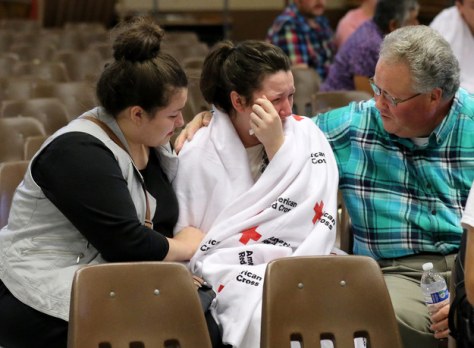
A family reunites after the shooting at Umpqua Community College in Roseburg, Oregon. Ryan Kang / AP / Via apimages.com
Mass shootings can’t tell us much about how to reduce the overall death toll.
Enthusiasm for bans on the sale of especially lethal weapons stems from the context in which the debate over gun violence comes to the fore — in the wake of mass shootings like Roseburg, where shooters arm themselves to inflict maximum casualties.
Even though mass shootings come around with distressing regularity — and seem to be getting more frequent — they barely register in the overall statistics on gun deaths in America.
In 2012, the deadliest year for mass shootings in three decades, according to data compiled by Mother Jones, 72 people died in incidents including the Newtown massacre and the movie theater shooting in Aurora, Colorado. Every one of those deaths was a personal tragedy, but in the context of some 30,000 annual fatalities from gunshots across the nation, they are just drops in a vast ocean of suffering.
The best evidence on how to prevent mass shootings comes from Australia. In 1996, after 35 people were killed in a massacre in Tasmania, Australia banned a range of weapons including semi-automatic and pump-action rifles and shotguns. Income tax was hiked so the government would have the money to buy back the now-illegal weapons, and the results were striking: There had been 13 mass shootings in 18 years before the new controls, but no similar incident in the decade that followed.
The Second Amendment makes it unlikely that the Australian experiment could ever be repeated in the United States. “It is so far beyond anything that is going to happen,” Philip Cook, a gun violence researcher at Duke University in Durham, North Carolina, told BuzzFeed News.
But background checks can work.
Among the gun violence experts consulted by BuzzFeed News, the most popular policy was the introduction of universal background checks, intended to keep guns out of the hands of people disqualified through their criminal records or mental health issues.
Under federal law, these checks are required each time a registered dealer sells a gun. But they’re not required for private sales, which may account for 40% of the trade. It’s a loophole that you can drive busloads of firearms through.
Eight states, including California and New York, have implemented universal background checks, including for private sales. But it’s been hard to judge the success of these moves, because changes to gun laws tend to be introduced in packages, making it difficult to know which policy, if any, was responsible for any subsequent changes in gun violence.
However, legislative changes in Connecticut and Missouri, which went in opposite directions, have provided a clearer picture. Until 2007, Missouri required people buying a gun to have a permit issued by law enforcement, which was contingent on passing background checks. Over the five years that followed without this requirement, the state’s annual gun murder rate rose by 16%, according to a study from a team led by Daniel Webster of Johns Hopkins University in Baltimore, Maryland. Neighboring states saw no similar spike.
Connecticut introduced a similar permit-to-purchase law, again with background checks, in 1995. In this case, Webster’s team estimated that the law reduced gun homicides by 40%.
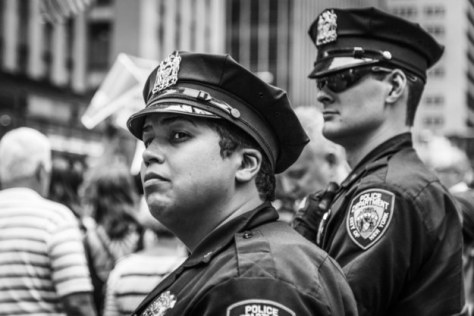
Andrew Parker / Getty Images
Smart policing reduces urban gun violence.
Some of the strongest evidence on reducing gun violence comes not from controls on gun purchases, but from an approach to policing called “focused deterrence.”
Pioneered in the 1990s in Boston, where it was called “Operation Ceasefire,” this involves police and community leaders meeting with members of criminal groups and delivering the message that their identities are known and that gun crime won’t be tolerated. Then come efforts to help people out of criminal activity, with the clear understanding that law enforcement will crack down hard on the targeted individuals if they use their guns.
Since rolled out in dozens of other cities, repeated studies have shown that the approach can reduce urban gun violence — typically by between 20 and 40%.
More good guys with guns aren’t the answer.
In the wake of almost every mass shooting — especially if it occurs in a location where people aren’t supposed to carry guns — gun lobbyists tell us that the only thing that can stop a bad guy with a gun is a good guy with a gun. And over the years, the main reason given for gun ownership in surveys of the U.S. public has shifted from hunting to personal protection.
But the evidence suggests that gun ownership actually does little to make people safer. Analyzing 14,000 incidents involving personal contact between perpetrator and victim from the National Crime Victimization Survey (NCVS), David Hemenway of the Harvard School of Public Health and economist Sara Solnick of the University of Vermont found that a gun was brandished in self-defense on only 127 occasions. And doing so didn’t reduce the likelihood that the victim would be injured — although it did lessen the chance of property loss.
The idea that gun ownership deters crime also looks shaky when subjected to close scrutiny. Again using data from the NCVS, Cook found in an earlier study that burglary rates tend to be higher in counties with higher rates of gun ownership. The reason for the relationship wasn’t clear, but one possibility is that guns themselves are valuable commodities, motivating criminals to steal them.
People with guns are more likely to kill themselves than to kill others.
The conversation about how to reduce gun deaths tends to focus on homicides. But for every gun murder, there are almost two gun suicides. And while gun homicides have been in decline since the early 1990s, firearm suicides are on the rise.
The demographics of these two categories of gun deaths are very different. Young black men are disproportionately likely to be both victims and perpetrators of gun murder. Those who turn firearms on themselves are again mostly male, but are typically older and white.
“Firearm violence is increasingly becoming an old white guy problem,” Garen Wintemute, an emergency room doctor at the University of California, Davis, told BuzzFeed News.
So any attempt to seriously reduce gun deaths needs to keep firearms out of the hands of people who are most vulnerable to self-harm. If they can’t get their hands on a gun, chances are that someone desperate enough to consider killing themselves will survive: The fatality rate for suicide attempts overall is around 9%; but where a firearm is used, that rises to 85%.
Encouragingly, background checks seem to help prevent gun suicides, as well as reducing gun murders. Webster and his colleagues have calculated that Connecticut’s permit-to-purchase law reduced firearm suicides by 15.4%, while Missouri’s repeal of its law increased its gun suicide rate by 16.1%.
Forget mental illness; think risky behavior.
It’s easy to blame gun violence on mental illness, especially in the wake of a mass shooting by a highly disturbed individual. But this is based on a misunderstanding of the wider problem.
Epidemiological studies have found that people with serious mental illnesses such as schizophrenia and bipolar disorder are somewhat more likely to be violent than healthy people. But the vast majority of mentally ill people are never violent to others — and even if the risk posed by mentally disturbed people could be reduced to the average level for the general population, about 96% of the violent crime in America would still occur.
Far more powerful is the link between mental illness and gun suicide. “If we were to cure mental illness, the suicide rate would go down by 50 to 75%,” Jeffrey Swanson, a gun violence researcher at Duke University, told BuzzFeed News.
The federal Gun Control Act, passed in 1968, prohibits gun ownership by people who have been involuntarily committed for treatment for psychiatric illness, and those judged to be “mentally defective.” The problem is that these restrictions are both too broad and too narrow. In particular, many people at high risk of harming themselves have never been committed involuntarily for treatment.
Another problem is that the federal mental health restrictions on gun ownership are lifelong. This fails to recognize that suicidality comes in episodes — which usually pass, if the urge is not acted on.
What we should do, according to Swanson, is to recognize when people’s behaviour indicates that they are at immediate risk of harming themselves or others, and temporarily restrict their access to guns until they have recovered.
Some states have introduced laws that try to do this. In California, people who are deemed to pose a risk to themselves or others can be held in a mental health facility for 72 hours, and since 1990 this has triggered a five-year ban on possessing guns — which can be curtailed earlier though a court petition.
We’re still waiting for conclusive studies on the effectiveness of such restrictions, Swanson said. “It will be a while before there’s enough experience with these laws to say whether they’ve worked.”

 On October 1, the first day of Domestic Violence Awareness Month, California Gov. Jerry Brown (D) signed into law a bill granting domestic violence survivors the legal right to transfer their cell phone numbers out of accounts controlled by their abusers.








 Jan. 9, 2013: A man stands on top of a water tank as clouds roll over the Al Zataari refugee camp in Mafraq, Jordan. | (AP Photo/Mohammad Hannon)
 Aug. 12, 2012: Boys carry water for their family at Al Zataari, Mafraq. | (REUTERS/Ali Jarekji)
 Sept. 2, 2013: A woman bathes her child at Domiz refugee camp in Dohuk, Iraq. | (REUTERS/ Haider Ala)
 Feb. 15, 2014: A girl washes her family’s clothes at Bab Al-Hawa refugee camp near the Syria-Turkey border. | (REUTERS/Mouaz Al Omar)
 Aug. 21, 2013: Women wait in line for food at Kawergosk refugee camp in Irbil, Iraq. | (AP Photo/Hadi Mizban)
 Dec. 11, 2012: A woman cooks food for her family outside their tent at Atmeh refugee camp in Atmeh, Syria. | (AP Photo/Muhammed Muheisen)
 Dec. 23, 2013: Children attend classes at an unofficial camp near Amman, Jordan. A teacher-turned-refugee set up the makeshift school because the Jordanian schools are too far away. | (REUTERS/Muhammad Hamed)
 March 2, 2014: A girl gets a snuggle and a smooch from a puppy at Kilis refugee camp in Kilis, Turkey. | (REUTERS/Nour Kelze)
 Nov. 21, 2013: Children play on a makeshift swing at Harmanli refugee camp in Harmanli, Bulgaria. | (AP Photo/Valentina Petrova)
 Sept. 17, 2013: Children participate in taekwondo training at Zaatari refugee camp near Mafraq, Jordan. | (AP Photo/Bela Szandelszky)
 March 25, 2013: Friends cut a young man’s hair at Bab Al-Salam camp near the Syria-Turkey border. | (REUTERS/Giath Taha)
 Oct. 28, 2013: A family eats a meal inside their makeshift room in a mosque, which is being used as an unofficial refugee camp, in Shebaa, Lebanon. | (REUTERS/Jamal Saidi)
 Sept. 2, 2013: A woman applies makeup to a soon-to-be bride at a makeshift beauty parlor in the Domiz refugee camp in Dohuk, Iraq. | (REUTERS/ Haider Ala)
 May 6, 2013: An obstetrician holds a baby after delivery at a field hospital in Zaatari refugee camp near the Syrian border in Mafraq, Jordan. | (AP Photo/Mohammad Hannon)

 idealisticrebel