The next afternoon, at 3:10 p.m., McKinney started banging loudly on the door. Harris ran into the bathroom and called 911. McKinney kicked the door down, pulled out a knife, and started stabbing her.
He yelled “You want to play games? You gonna see!” as he attacked. He knocked her unconscious with the blunt edge of a knife, leaving a cross-shaped mark between her eyebrows.
“I woke back up and he was still stabbing me,” she says, telling the story slowly and methodically. But McKinney’s knife got lodged in the bone near her elbow and the handle snapped off. He left to go look for another knife.
Harris says she took that opportunity to spring into action, pulling the blade out of her elbow and running out of the bathroom to escape. She started reciting Psalm 23 in her head, “The Lord is my shepherd,” as she felt her body going numb.
McKinney pounced. He stabbed her again on her arm, her hip, her thigh—anywhere he could land his blade. “You trying to leave me?” he asked. She kicked him. She fought back. But she also thought about how she was never going to see her children again.
Less than two minutes after McKinney broke in, three police officers pulled up with flashing lights and blaring sirens. One policeman recalls McKinney trying to flee and then running back inside the house. Colonel Dustin Strickland was approaching the carport door when, according to the police report, he heard a “blood-curdling scream for help.”
SHE STARTED RECITING PSALM 23 IN HER HEAD, “THE LORD IS MY SHEPHERD,” AS SHE FELT HER BODY GOING NUMB.
He ran in and immediately saw someone coming at him, a 12-inch-long kitchen knife covered in blood whizzing by his face. Strickland instructed McKinney to drop the knife—instead, McKinney doubled back into the hallway, dove onto Harris, who was laying in a fetal position, and continued to stab her.
“Drop it!” screamed Strickland, before shooting him four times.
Finally McKinney let go of the black-handled knife as he slumped to the floor and died.
Harris was stabbed 42 times in total—on her left arm, her chest, her back, her hip, her stomach, her thigh, and her face. She lost three pints of blood and her heart stopped multiple times in the hospital.
“I started crying,” a then-19-year-old Nathan remembers of seeing his mother, bloodied and bandaged on a hospital bed. As her next of kin, he had to be in charge of making all of Harris’ medical decisions. He listened to what the doctors recommended, which was to put his mother on life support. She remained on a ventilator for three and half weeks.
When Harris finally woke up last October, she began a long period of physical and emotional recovery.
Harris felt conflicted about McKinney’s death—about the way he died but also lingering trauma from such horrific abuse at the hands of someone she loved. “I didn’t know what emotions to really have,” she says. “This is the man I loved. How could he do this to me? Evidently, he didn’t really love me.”
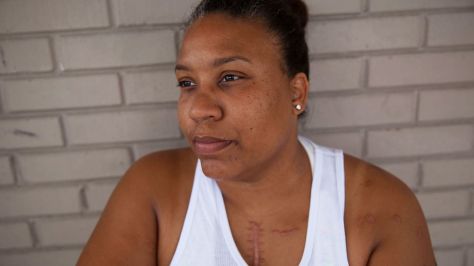
Harris outside the hotel near New Orleans where she’s currently living
Lorena O’Neil
For many months, Harris blamed herself, wondering why she hadn’t paid attention to the warning signs, or hadn’t left him earlier. She still feels like some members of his family blame her for his death.
Nearly a year later, she has a metal plate in her chest, and the wounds near her spine and her hip have weakened her ability to walk. She has difficulty breathing and sleeping, and in March she was diagnosed with congestive heart failure.
But Harris is, above all, a survivor. She says her children motivate her to keep fighting—for her health, for her life, and for her home. The Baton Rouge flooding has been tough on her psychological state; she’s since started two new types of medication to battle her depression, which she says was threatening to swallow her up completely.
“It’s just hard to get started over and over again,” she says from the motel near New Orleans where she currently lives. And yet, she’s in an optimistic mood. On August 25, her first grandson, Zechariah, was born.
Harris with her new grandson, Zechariah, and her sons, Johnathan (left) and Nathan (right), at the Woman’s Hospital in Baton Rouge
Lorena O’Neil
“I’m a proud Mimi and a proud Mommy,” she says, beaming about Nathan starting at Louisiana State University next year.
Harris has made plans to relocate with Johnathan to Kansas to live with a family friend, and hopes to become a domestic violence advocate for other survivors. Despite her struggles, she’s tried to motivate other women at the disaster relief shelters, sharing her own story of resilience. As she tells people what happened to her, she proudly shows off her scars—emblems of her strength, of her powerful will to live.
“When you see that first sign, it’s time to get out,” Harris says. “Grab your bag, get in your car, leave, and don’t come back. When a person shows you who they are, believe them.”
Special thanks to Save the Children for their assistance in sourcing this story, and for outfitting Harris’ family with items like diapers and baby blankets after they lost everything in the flood.
If you or someone you know is being abused, you can seek anonymous, confidential help at the National Domestic Violence hotline: 1-800-799-7233 (SAFE).
Domestic violence survivors have been left particularly vulnerable after the Louisiana floods. You can donate to the Louisiana Domestic Violence Disaster Relief fund here or contribute to organization aiding Louisiana flood victims like Save the Children and American Red Cross.
This woman was lucky to survive this abuse. if he hits you once, he will again. There is a Domestic Violence Shelter in every ton. There you will find answers, assistance, woman who understand who you have been through. Don’t stay because you think no one cares. We do care and are here to help.


 Former Serbian president