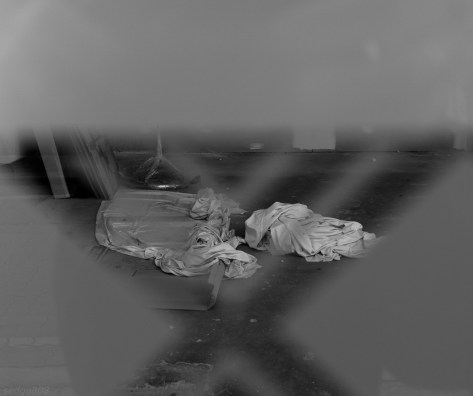
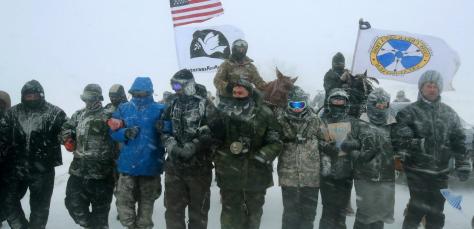
Just north of the Standing Rock Sioux reservation, water protectors set their makeshift and traditional structures ablaze in a final act of prayer and defiance against Energy Transfer Partner’s Dakota Access Pipeline, sending columns of black smoke billowing into the winter sky above the Oceti Sakowin protest camp.
The majority of the few hundred remaining protesters marched out, arm in arm ahead of the North Dakota authorities’ Wednesday eviction deadline. An estimated one hundred others refused the state’s order, choosing to remain in camp and face certain arrest in order to defend land and water promised to the Oceti Sakowin, or Great Sioux Nation, in the long-broken Fort Laramie Treaty of 1851.
On these hallowed grounds, history tends to repeat itself. In 1890, police murdered Sitting Bull on the Standing Rock reservation out of suspicion that he was preparing to lead the Ghost Dance movement in an uprising. Two weeks later the United States Cavalry massacred more than three hundred Lakota at Wounded Knee. Over 126 years later, the characters and details of the stories that animate this landscape have changed, but the Cowboys and Indians remain locked in the same grim dance.
The first whirlwind month of Donald Trump’s presidency has brought the injustices of racism, capitalism, and patriarchy long festering beneath the surface of American society out into the open. The eviction of Oceti Sakowin from their treaty lands forces us to confront another foundational injustice, one rarely if ever discussed in contemporary politics – colonialism.
For many, it is contentious and even laughable to suggest that colonialism endures in the present. In the American popular imagination, colonialism ended either when the 13 colonies declared independence from Britain in 1776, or when John Wayne and the 6th Cavalry blasted away Geronimo and the Apaches in Stagecoach.
Advertisement
Colonialism, according to these narratives, is history.
The eviction of Oceti Sakowin suggests otherwise. But in order to see the big picture in all its unjust and ghastly detail, we must take in the full shame of America’s treatment of the Standing Rock Sioux and the first people of this land.
At Standing Rock, 41% of citizens live in poverty. That is almost three times the national average. The reservation’s basic infrastructure is chronically underfunded. Schools are failing. Jobs are few and far between, and 24% of reservation residents are unemployed. Healthcare is inadequate. Many depend on unsafe wells for water. Roads are often unpaved. Housing is in short supply, substandard and overcrowded. If the people of Standing Rock did not take-in their beloved family and friends, there would be mass homelessness.
Dakota Access Pipeline’s price tag of $3.8bn is nearly $1bn more than the entire budget of the Bureau of Indian Affairs. Energy Transfer Partners CEO Kelcy Warren is said to be worth $4.2bn. The pipeline will pour even more wealth into his pockets.
Meanwhile, Standing Rock will remain in poverty on the margins. The most expensive piece of infrastructure in their community will not be the schools, homes or hospitals they desperately need. Instead it will be a pipeline that they have vehemently opposed.
This is how the first people of this land live in the forgotten Bantustans of the American West.
This system, an essential foundation of the United States, is rooted in the theft of indigenous land and the ongoing disavowal of indigenous sovereignty. Indigenous presence must be confined, erased and then forgotten, so that the United States may continue to live upon and profit mightily from lands taken from indigenous people.
The erasure of indigenous people explains why Dakota Access was rerouted from upstream of Bismarck south to Standing Rock. It explains why pipelines can be hammered through Native communities without regard to their treaties and indigenous, constitutional and human rights. It explains why a multi-billion dollar pipe can be drilled through Standing Rock before long-needed basic infrastructure is built. It explains how, after months of unprecedented protests and visibility, Trump can claim that he received no complaints about the pipeline. It explains how Oceti Sakowin can be wiped off the map.
It is impossible to describe the totality of this picture of land theft, containment, poverty, oppression, policing and extraction as anything other than colonialism.
But from the moment that colonialism ensnared land and life, indigenous people fought it – none more than Sitting Bull and his kin, the Oceti Sakowin.
They have lit a fire on the prairie in the heart of America as a symbol of their resistance, a movement that stands for something that is undoubtedly right: water that sustains life, and land that gave birth to people. In its ashes there is the potential for a more just future for this land, this water, and all the nations and people who share it.
Dakota pipeline camp raided after protesters defy deadline, refuse to leave
CANNON BALL, N.D. – Police in riot gear began arresting the last remaining protesters at a makeshift camp in North Dakota on Thursday after they defied several orders to leave the area.
It’s unclear if any protesters remained at the camp after the police officers raided it.
The raids came after the eviction orders were unenforced for at least a day. Hundreds left peacefully on Wednesday after the 2 p.m. deadline, and 10 were arrested hours later after they taunted cops. But out of the tens of thousands that once called this prairie home, Gov. Doug Burgum said late Wednesday that 50 remained.
But hours later, 18 National Guardsmen and dozens of law officers entered the camp from two directions, along with several law enforcement and military vehicles. A helicopter and airplane flew overhead.
Officers checked structures and began arresting people, putting them in vans to take to jail. About two dozen people were arrested in the first half hour of the operation, according to Levi Bachmeier, a Burgum adviser.
North Dakota originally offered protesters a carrot. If they agreed to leave peacefully, they would receive a hotel room and bus ticket to anywhere in the U.S. As of Wednesday night, none had taken it. They also offered a courtesy or ‘ceremonial arrest’ for anyone needing a picture for their Facebook page. Again, no takers.
A 17-year-old girl and 7-year-boy old were burned after protesters set fire to the last remnants of the camp. They both required medical attention and one was air lifted to Minneapolis because her injuries were severe.
Now the cleanup efforts begin. The camps span more than 1,000 acres, which had been, according to state officials, sensitive wildlife habitat. Now, because of an early thaw and thousands of “water protectors” it is a wet, muddy cesspool of human waste and hazardous fuels after protesters turned the native grassland into a dumping ground.
According to the Col John Henderson of the US Army Corp of Engineers, crews have already removed some 250 truckloads of trash, but his agency plans to spend upwards to $1.2 million of taxpayer money to rehabilitate the area.
“To ensure that none of this garbage and waste and debris and structures and vehicles ended up in the reservoir. That would be an absolute environmental catastrophe,” Henderson said.
Most of the protesters who spoke to Fox News said fighting the pipeline was a life-changing experience. They didn’t want the moment to end.
“I went home for a little bit but I came right back because I missed all of the people here. I missed the feeling.” said protestor Clarence Rowland, bundled up in a red sweater and purple hat as he walked around the few remaining tents in one of protestor camps.
Fellow protestor Genevieve Hock said she learned so much by being part of the demonstrations.
“We don’t have to all have our own houses and cars…” Hock said. “We can work together and share resources and honestly live better and work less.”
Includes reporting by The Associated Press.
Border Wall Would Cut Across Land Sacred To Native Tribe

Laurel Morales
Tohono O’odham Vice Chairman Verlon Jose says “over my dead body will we build a wall” on the reservation.
The proposed border wall between the U.S. and Mexico would run right through Native lands, and tribal leaders in the region say it would desecrate sacred sites.
“Over my dead body will we build a wall,” says Verlon Jose, vice chairman of the Tohono O’odham Nation. “It’s like me going into your home and saying ‘You know what? I believe in order to protect your house we need some adjusting.’ And you’re going to say, ‘Wait a minute, who are you to come into my house and tell me how to protect my home?’ ” he says.
The Tohono O’odham reservation straddles the U.S.-Mexico border about an hour south of Tucson. Tohono O’odham means people of the desert.
On a recent drive through the Sonoran desert — where rain has made the palo verde trees even greener and the saguaro stand a little taller — Jose points to a cactus plant. He says every living thing has a story and each story comes with a teaching.
“And I always tell people that every stick and stone is sacred. The rocks that you see along the road have meaning. Sometimes you refer to them as ‘the grandfathers,’ ” he says.
The Tohono O’odham people believe their creator lives in the holiest of rocks, Baboquivari Peak; President Trump’s wall would cut across this mountain range — as well as sacred burial ground.
Jose says they’re not asking the Trump administration to get out. The tribe is asking them to collaborate.
“We’re not your enemy. We’re your ally. We want to work with you in protecting America,” he says.
‘Legal Limbo’
The Tohono O’odham agreed to a vehicle barrier along the border a decade ago. But it hasn’t prevented people from crossing, and the tribe is overwhelmed by the number of border-crossers.
Before the Obama administration ramped up border enforcement, the tribe saw 1,500 people a day trying to cross the desert illegally. That number has since dropped significantly, but it’s still high for a tribe with few resources. In 2010, half of Arizona’s migrant deaths occurred on the Tohono O’odham Nation.
The Tohono O’odham feel like outsiders. Tribal members are U.S. citizens who can cross onto the Mexico side of the reservation. But since Sept. 11th and an influx of people from the south, the Tohono O’odham are restricted to one entry point on the reservation or U.S. ports of entry hours away. Trump says his plan to build a wall and to hire significantly more federal agents will stop border crossings.
“As I’ve said repeatedly to the country, we are going to get the bad ones out — the criminals and the drug dealers and gangs and cartel leaders. The day is over when they can stay in our country and wreak havoc,” Trump said last month.
It’s still an open legal question how much authority the president has through executive order to build a wall on Native land.
“We’re really in legal limbo, and I think that’s a cause of great anxiety on the part of tribal peoples,” says Rob Williams, a professor at University of Arizona’s Indigenous Peoples Law and Policy Program.
However, Williams says Congress would have the power.
“Congress can basically condemn Indian land as long as it pays fair market value,” Williams says. “Any tribe that would seek to resist — particularly congressional legislation that would take that land or appropriate that land for a wall, for example — would have very few avenues opened to it.”
The Tohono O’odham Tribe has invited Trump to visit the reservation. They believe only then, when sitting amidst an army of saguaros and on the sacred mountain Baboquivari, will the president understand that he needs to work with the tribe to secure the U.S.-Mexico border.

Here is an update on what is happening with our Native peoples. As I am sure you noticed, now there is another tribe fighting against the American government.The Tohono O’odham Tribe is fighting Trump because his wall goes straight through their sacred lands. They will need our help and support.
I asked 8 experts if we’re in a constitutional crisis. Here’s what they said.
Are we in a constitutional crisis?
Well, no. As silly as the president declaring “SEE YOU IN COURT” in all caps on Twitter is, it’s not exactly a sign that he’s willing to bypass the judiciary altogether, which really would portend a crisis.
So I decided to ask eight leading experts — six constitutional law professors and two political scientists — for their thoughts. They were unanimous that the situation as it exists now doesn’t count as a constitutional “crisis”; some cast doubt on whether that term, which has no firm definition, is even useful.
“Trash-talking the federal courts on Twitter does not create a constitutional crisis,” Yale’s Jack Balkin explained. “It’s a really bad idea, but there are many really bad ideas that are not constitutional crises.”
But most experts said that if Trump were to start defying court edicts, that would very possibly qualify, and even his mere rhetoric ramps up conflict with the judiciary in a counterproductive and perhaps dangerous way.
And they were sure to add that even if we’re not in a constitutional crisis, that doesn’t at all imply that what is happening is normal, or moral, or fair, or decent. “I don’t like the phrase ‘constitutional crisis’ because it has this contention that unless the whole system is up for grabs, we shouldn’t care about an 18- or 19-year-old kid in Chicago who is so anxious about being deported he takes his own life,” Aziz Huq, a constitutional law professor at the University of Chicago, noted. “Crises happen everywhere on a micro scale. Just because they are happening to people on the margins doesn’t make them less important.”
There are two major papers in the American constitutional law literature on the concept of a “constitutional crisis.” The first, from Princeton political scientist Keith Whittington, was written in the wake of the impeachment of President Clinton and the contested 2000 election, both of which provoked fears that the US was either in, or barely avoided, a constitutional crisis. Whittington argued that neither came close to qualifying.
“Constitutional crises arise out of the failure, or strong risk of failure, of a constitution to perform its central functions,” he wrote. That didn’t happen in the impeachment (which unfolded according to the procedures laid out in Articles 1 and 2) or in the 2000 election (in which decisions of executive branch officials in Florida were challenged through normal legal channels and all actors respected the ultimate decision of the US Supreme Court, whether or not they thought it was rightly decided).
So what would qualify? Whittington divided constitutional crises into two categories. Operational crises occur “when important political disputes cannot be resolved within the existing constitutional framework.” That is, the Constitution itself is failing, and is allowing people engaged in a political conflict to each behave in ways that together can result in calamity. A “crisis of constitutional fidelity,” by contrast, occurs when, “important political actors threaten to become no longer willing to abide by existing constitutional arrangements or systematically contradict constitutional proscriptions.” That’s when what the Constitution prescribes is clear, but one or more politician or branch of government willfully defies it.
The secession crisis of 1860 was, Whittington argues, both an operational and a fidelity crisis. It was a fidelity crisis because some political actors — namely the seceding Southern states — refused to obey the dictates of the Constitution and explicitly rejected its power over them. But it was an operational crisis too, because, “the text of the Constitution was silent on the question of secession, and it provided no clear mechanism for resolving the contested question of whether and how states could secede from the Union.”
Whittington told me via email that he doesn’t think the current standoff between Trump and the judiciary qualifies as either a fidelity or operational crisis. While Trump’s comments are, he says, “certainly disquieting,” he adds that “disagreements between the executive and the courts are not uncommon, and are sometimes expressed rather strongly.”
What would change matters is if Trump were to receive an unfavorable ruling from the Supreme Court — and ignore it. “If the president were really to contemplate ignoring a decision by the U.S. Supreme Court, we’d be in nearly uncharted waters,” Whittington adds. He noted that the US has come close to that scenario in the past, but that in just about every case either the president or the Court backed down before an explicit violation occurred. For instance, in 1974 the Supreme Court ruled that Richard Nixon had to hand over the Watergate tapes to the special prosecutor’s office, and Nixon briefly considered not complying, as he strongly felt the president should not be subject to judicial proceedings outside of impeachment. But strong pressure from congressional Republicans and the threat that he would be impeached anyway caused him to back down and comply.
Balkin agrees that open defiance of clear court dictates could qualify as a crisis. He and UT Austin’s Sanford Levinson published the other widely cited article besides Whittington’s categorizing and analyzing constitutional crisis. In addition to Whittington’s two categories, they add a third: when two or more political actors each strongly believe the other is violating the Constitution or constitutional norms. In fidelity crises, it’s clear that only one side is violating the Constitution. In operational crises, it’s clear both sides are obeying the Constitution. In type three power struggle crises (“power struggle” is my term, not theirs, but it’s clearer than “type three”), each side has a real argument that it’s obeying and the other isn’t.
Balkin and Levinson offer a number of examples of power struggle crises, including the Nullification Crisis (in which South Carolina claimed it had the constitutional right to not enforce a federal tariff, Andrew Jackson claimed it didn’t, and each had arguments for why they were right), the conflict between Andrew Johnson and Congress over each one’s role in Reconstruction, and the Little Rock Crisis in 1957 between the government of Arkansas and the Eisenhower administration.
“We are not having a constitutional crisis, at least not yet,” Balkin told me via email, elaborating on a blog post he published on the topic. “Trump has not announced that he is going outside the Constitution, and he has not openly defied a judicial order. … If he does either of these things, and he won’t back down, then we would be in a constitutional crisis.”
Maybe not a crisis, but “hardball”?
No expert I talked to, including Whittington and Balkin, characterized the current situation as a constitutional crisis. “As far as we know, the executive is complying” with court orders, Yale’s Heather Gerken says. “That’s not a constitutional crisis. That’s a constitution working.”
Luckily, the legal literature has developed other, arguably clearer, categories for talking about heated conflict like this. In 2004, Mark Tushnet, now at Harvard Law, introduced the concept of “constitutional hardball”: when political actors are clearly acting within their legal and institutional limits, but are violating past practices or norms in a way that feels unprecedented and provides advantage to their side.
For example, he argues that Republican efforts to redistrict congressional seats in Texas and Colorado in 2003, after they had already redistricted for the census, count as constitutional hardball, as does the impeachment effort against Bill Clinton, as does Democrats’ obstruction of appellate nominees in the early George W. Bush administration. In none of those cases was anybody acting outside their prerogative per the Constitution. But in every case, they were using those powers in new and tough ways that caught their opponents off guard.
“In the current spat, if there is hardball going on, it takes the form of White House people bypassing the established systems for vetting executive orders,” Tushnet told me. “Not submitting them to career people in the Office of Legal Counsel, but sending it apparently only to the political, shadow person they sent over there. They can say, ‘We did send it to OLC,’ but the person who got it is not the kind of person who’d ordinarily be used to vet these issues.”
But he was open to the idea that Trump’s rhetoric against the judiciary could count too. “The more or less formal definition of constitutional hardball is that it consists of actions that are inconsistent with settled ways of doing things. In a political context, statements and rhetoric count as actions,” he explained. “I want to say I didn’t draw that distinction when I initially developed the idea. Now that we’ve had more examples, rhetoric can count as a form of constitutional hardball.”
Constitutional “showdowns” are important, but not crises
Certainly one way to avoid a constitutional showdown.Bill Pierce/The LIFE Images Collection/Getty Images
The University of Chicago’s Eric Posner and Harvard’s Adrian Vermeule introduced the parallel concept of “constitutional showdowns,” in 2008. The idea is similar to the idea of hardball, but focuses more on the precedents that such conflicts can create. A constitutional showdown, Posner and Vermeule wrote, is a “a disagreement between branches of government over their constitutional powers that ends in the total or partial acquiescence by one branch in the views of the other and that creates a constitutional precedent.”
They cite, as examples, the conflict between Nixon and the Supreme Court over the Watergate tapes (in which Nixon totally acquiesced and a new precedent was created limiting the president’s powers), the conflict between the Court and Harry Truman over seizing a steel mill (Truman backed down, creating another precedent limiting presidential powers), Abraham Lincoln’s refusal to obey an order from Chief Justice Roger Taney to release a man arrested by Union troops in 1861 (which created a new precedent enhancing the president’s war powers), and Andrew Jackson’s refusal to help enforce a Supreme Court ruling in 1832 that Georgia’s laws did not apply in Indian territory (which set a precedent, since contradicted by events like the Little Rock Crisis in 1957, of presidents not always acting to enforce federal rulings against state governments).
But for now we’re in a constitutional showdown of a more ordinary variety. “I think showdowns are unavoidable because constitutional rules do not necessarily keep up with the times (while amendment has proven to be too difficult to revise them in a timely fashion), and government depends on cooperation among different institutions,” Posner said. And who is right in each showdown can vary. You can think it was right of Lincoln to claim the power to suspend habeas corpus in wartime, but not for Jackson to decline to use federal force to protect Indian rights (and then to use it to commit ethnic cleansing).
“But,” he added, “the rule that the president obeys a judicial order in peacetime is ancient, and it is well established to be a good one except if the judiciary goes haywire, which is certainly not the case here.” Violating that norm would go further than Nixon, Truman, Lincoln, or even, arguably, Jackson went. And Trump ordering border agents to enforce his executive order when judges are telling them not to would violate that norm.
Suppose we get into a crisis. Could Trump then be stopped?
While no one I talked to declared the situation rightnow a crisis, many expressed concern that President Trump is all too willing to provoke one.
“Remember Trump’s statement before the election: ‘I’ll accept the results, if I win’?” Alice Ristroph, a law professor and political theorist at Seton Hall who has written about constitutional crises, says. “I think this administration will accept and preserve the basic structure of the American constitutional system if that system can be manipulated to give the administration what it wants. If Trump is overruled by the courts, who knows what will happen. Maybe a crisis.”
So what happens then? A lot depends on how institutional actors respond. Aníbal Pérez-Liñán, a comparative political scientist at the University of Pittsburgh who studies presidential democracies in Latin America, including constitutional crises experienced there, notes, “Many countries modeled their constitutions after the US, but most presidential regimes have experienced much more turbulent histories. The reason for American stability lies in the fact that politicians in both parties historically exercised civility and reached deals to process their disagreements.” That norm, of course, would take a major battering if Trump rejected a Court edict.
In that case, there would be two broad possibilities. One is that Trump, despite an initial rejection, somehow backs down. For that to happen, someone would have to persuade or force him. It could be his close advisers telling him he’s gone too far. It could be his own vice president and Cabinet, who could threaten to remove him by invoking the 25th Amendment. But institutionally, the people who are supposed to keep him in check in a case like that are members of Congress.
“The crucial thing for both the Court and the president is how Congress, and particularly the congressional Republicans, position themselves on a potential conflict,” Whittington says. “If the Republicans make it clear that they would not support presidential defiance of the Court, it would strengthen the hand of the judiciary. … It would seem unlikely that congressional Republicans, or even the president’s own Cabinet, would be willing to do lasting damage to the courts over these sorts of normal policy disagreements.”
But what if no one stops him?
A protest in front of the Polish Constitutional Tribunal in 2016.Mateusz Wlodarczyk/Pacific Press/LightRocket via Getty Images
And what if no one keeps him in check? Then you get the possibility that the Court will be duly chastened, a new precedent will be set where its powers are greatly reduced, and the president emerges more powerful than before. “Purges of supreme courts or constitutional tribunals have been a common affair in Latin America, where many presidents have little tolerance for dissent,” Pérez-Liñán notes. Poland’s governing party has recently been cracking down on its Constitutional Tribunal in similar ways, raising serious concerns that the rule of law is eroding and democracy is backsliding.
Tushnet argues that a move like this by Trump, unchallenged, needn’t necessarily amount to democratic backsliding. It would usher in a new “constitutional order,” in Tushnet’s words, but such transitions can be either good or bad and aren’t always harbingers of democratic collapse.
“It might be that what the president is on the way to doing is becoming an authoritarian unconstrained by law entirely,” he explains. “But it could be that the president’s position is, ‘With respect to border control and national security, the courts have overstepped their bounds, I’m acting to make sure we have an appropriate relationship with the courts in that domain, and I don’t have a general quarrel with the rule of law.’ … It could be a component of a new settlement of relations among the branches that would not be a departure from core notions of the rule of law.”
“I don’t like what Trump is doing,” he clarifies, “but I’m willing to present it in a conceptual or constitutional theory framework that is independent of my particular views of this particular president.”
Huq, of the University of Chicago, notes that it’s hardly unusual for executive branch officials to drag their feet in implementing court decisions. Think of state officials failing to desegregate after Brown v. Board of Education, or the aftermath of Boumediene v. Bush, a 2008 Supreme Court decision that ruled Guantanamo detainees had a right to federal court review of their detention but that did not result in many detainees getting that review or being released, due, Huq argues, to “internal bureaucratic resistance.”
“But,” he also notes, “it’s hard to think of examples when the resistance starts off before the cases have been fully litigated. Where there’s zero willingness, up front, to comply. I can’t think of cases where resistance and refusal to comply have been coupled with an attack on the judiciary and an attempt to offset blame for bad political outcomes on the judiciary. That’s another example of a norm with respect to the Constitution that we’ve just blown apart.”
That’s what makes Trump’s case so different. In a recent paper titled “How to Lose a Constitutional Democracy,” Huq and his University of Chicago colleague Tom Ginsburg argue that a wholesale “authoritarian reversion,” along the lines of Hitler’s rise to power in 1933 or Gen. Sisi’s coup in Egypt in 2013, is unlikely in the US, for a variety of reasons. But “constitutional retrogression” — the slow erosion of democratic norms and institutions — is becoming more common abroad, and poses a real risk for the US. That’s the process by which Vladimir Putin’s Russia, Hugo Chávez’s Venezuela, Recep Tayyip Erdoğan’s Turkey, and Viktor Orbán’s Hungary have moved away from democracy and toward authoritarianism.
In other countries, constitutional amendments to bolster incumbent leaders’ power have played a significant role. But Huq and Ginsburg don’t think that’s likely, not least because Article 5 of the Constitution makes amendments extremely difficult to pass. Instead, they write, “The most likely motor of antidemocratic dynamics in the American political system is the presidency, acting with the acquiescence of a co-partisan Congress.” Helping along a presidency-driven retrogression would be an acquiescent judiciary (perhaps chastened by a president who doesn’t obey Supreme Court rulings he doesn’t like) and an erosion of electoral competition due to, say, voter ID laws and partisan districting.
“What I would count as democratic backsliding is a substantial negative change along three different elements or institutions happening at the same time,” Huq says. “Those three elements are the necessary institutional foundations of democracy, such that if you don’t have those institutional features, you can’t really have democracy. One is the possibility of political competition. The second is the rule of law. The third is the quality of liberal rights of speech and association that are necessary to the democratic process.”
Trump ignoring a court order would harm the rule of law but not necessarily the other two; in itself, it might not constitute backsliding. It could just be a rearranging of power between the branches, as Tushnet suggests. But Trump’s past actions and statements suggest the other two criteria could be in danger too.
Huq doesn’t think we’re in a constitutional crisis (“I don’t know what the term ‘constitutional crisis’ means, which I feel like is a very law professor thing to say,” he jokes) or that we’re engaged in democratic backsliding. But he thinks the danger is real and worth considering.
“My view,” he says, “is that we’re very vulnerable.”
I firmly believe that the Senate will protect our Democracy. There are GOP members who will also help to prevent the destruction of Democracy. I would to hear your thoughts and would encourage good natured debate. I hope you will consider sharing your thoughts.
Here’s the thing. I’ve lived in Chicago my entire life. MY Chicago is very different from the Chicago of some OTHERS, simply because I’m WHITE and was raised on the Northwest side. I was raised to NOT see the differences in people but to be accepting and open to everyone. That was great but it blinded me to the different treatment others were forced to endure. I thought everyone’s life was like mine. I didn’t know anything about racism, or discrimination, when I was growing up. I didn’t know people in our neighborhood hated my grandparents because they were Italian. I didn’t know anything and my friends came from everywhere, so I was uninformed and innocent. I believed everyone was the same and that everyone was okay. I didn’t know people were struggling, poor, or sad. Maybe no one explained those things to kids, I’m not sure.
I leave the home of a lifetime
Like any son
I have hope and good intentions
And wandering into the daybreak
I learn as I go
To fall laughing into the water
Sticks and the stones are your broken promises
We wait too long to go from rags to riches
I am in love, I am in love with a feeling
A wild wild sky, a wild wild sky
Fences and tumble down bridges surround and divide
I wear a coat of many colours, of many colours
The sticks and the stones, our broken promises
I wait no longer to go from rags to riches
People are leaving the squalor
They’re leaving the houses and fires
And starting out
We find the waiting country
Sticks and the stones are your broken promises
I wait no longer, I go from rags to riches
From rags to riches I go from rags…
How The Blood of Emmett Till Still Stains America Today
A new history of the most famous lynching in the country provides context on how racism continues to work in the present.
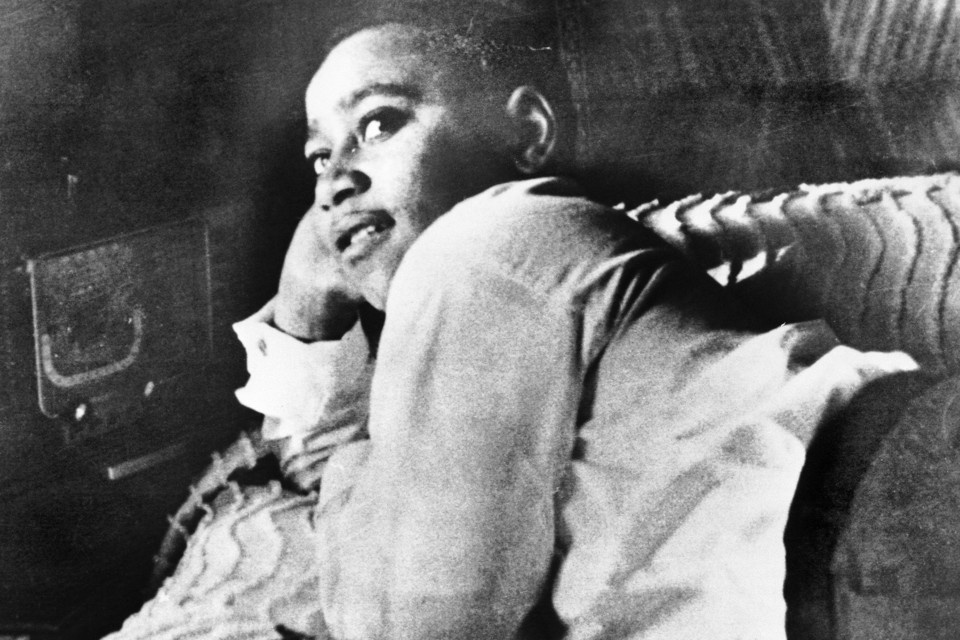
Emmett Till is shown lying on his bed.Bettmann / Getty
What does American tyranny look like? In the past few months, fears about the collapse or degradation of the American democratic system have led many to engage in the grim exercise of game-planning the endgame of tyranny. For some, dystopian novels ground that exercise. Some take stock of the rise of authoritarian powers in the past. Others rely on expert realpolitik analysis from political minds like my colleague David Frum. Regardless of the source, we have arrived at Belshazzar’s feast. The writing is on the wall: It could happen here.
Or, it could happen here again. After all, it wasn’t too long ago in American history that millions of Americans were trampled under the heel of a repressive, anti-democratic kleptocracy and faced economic reprisals, violence, or death for any dissent. And nowhere was the iron grip of that system—known as Jim Crow to some of us—stronger than in Mississippi. That grip manifested itself most notoriously in the murder of Emmett Till, a 14-year-old black boy, in 1955. That year, Till was tortured and lynched by white men after allegedly making lewd comments toward a white woman. His mutilated corpse became one of the first mass-media images of the violence of Jim Crow, and the trial of his killers became a pageant illuminating the tyranny of white supremacy. And through protests across the country, Till’s broken body became a powerful symbol of the civil-rights movement.
In his new book, The Blood of Emmett Till, the historian Timothy B. Tyson revisits the circumstances of Till’s death, and brings to bear a wide scope of reporting, historical research, and cultural analysis. It’s not a definitive history of the Till case; other works have synthesized more primary sources and firsthand accounts. Rather, The Blood of Emmett Till is focused on the historicity of race in America: It posits that Till’s death is an emblem of the ways in which American tyranny works. To that end, the climax of his book comes not in the death of Till, in the ensuing sweltering court proceedings, or in the backwoods thriller of the black Mississippi Underground that investigated the case, but in the present.Tyson tells the story of how a young Chicago boy’s summer sojourn in Mississippi ended with him kidnapped, beaten, shot, and tossed into a river by Roy Bryant, J.W. Milam, and a group of others. The historical context Tyson provides often dwarfs the actual tick-tock of the case: An account of Mamie Till-Mobley’s childhood and her close bond with her son is wrapped in a narrative about the Great Migration of black people from the South to the West and North in the mid-20th century. Till’s lynching is backgrounded by an instructive history of the genteel and intellectually racist Citizens’ Councils and how they fueled the raw violence of a white proletariat. The surfeit of contextualization verges on digression at times, but serves the ultimate purpose of giving Till’s life weight six decades after his death.The effect of Tyson’s wide-angled framing is especially pronounced in the bombshell revelation that Carolyn Bryant—the white woman who originally claimed Till grabbed and sexually harassed her in her husband’s store—lied about those claims. Media coverage has focused on that explosive admission and the conversation around redemption that it seems to spark, but Tyson’s book, in the end, is largely unconcerned with that line of inquiry. Bryant’s testimony on the stand and her later admission have little to do, in this narrative, with her own battle with guilt; rather, they serve to advance Tyson’s thesis that culpability for Till’s death rests on millions of shoulders. The unlikely thing, he argues, was not that Emmett Till was lynched, but that his lynching actually stirred a national response.Tyson takes great pains to illustrate how the mechanisms working in Jim Crow Mississippi in 1955 still animate life today, and how America has never really found justice for Till. He details the rise of the civil-rights movement and how Till’s death helped to forge a common purpose for the wide-ranging and often contentious factions of black activism. He describes how white supremacist organizing arose in direct response to that mobilization. And he examines how school desegregation and black suffrage undergirded the social tensions of the Jim Crow era.Perhaps most importantly, Tyson considers all the ways in which an American populace was complicit in its acceptance of violence against black people—and then considers all the ways in which it is still complicit in the deaths of people of color today. For instance, in his examination of the Citizens’ Councils’ literature, which fomented mass fears of black criminality and fantasies of rampant black sexual deviancy, Tyson also shows how poor white “peckerwoods” were loathed by wealthier white people, and manipulated into doing the bloody business of physical violence. In this, he provides a thinly veiled parable for today’s politics in how the rhetoric of white supremacy—even in its subtlest dog-whistle form—is used to radicalize people, and how the uneasy detente between classes of white people is often maintained by propaganda built around the threat of the other, even as the culpability is passed to the lowest rungs. “We blame them,” Tyson writes about those radicalized perpetrators of physical violence, “to avoid seeing that the lynching of Emmett Till was caused by the nature and history of America itself and by a social system that has changed over the decades, but not as much as we pretend.”In service of his analysis of the present, Tyson also compares the “Emmett Till generation” of civil-rights leaders that developed after Till’s death to the Black Lives Matter movement that gathered force after the killings of Trayvon Martin and Michael Brown. In The Blood of Emmett Till, that comparison is not just a coincidence, but, rather, the end result of a social system that continues to perpetuate injustice today. “America is still killing Emmett Till,” Tyson writes, “often for the same reasons that drove the violent segregationists of the 1950s and 1960s.”The Blood of Emmett Till is a critical book not just because it provides a good reason to revisit a foundational moment in American history—though it manages that feat in spades—but also because it manages to turn the past into prophecy and demands that we do the one vital thing we aren’t often enough asked to do with history: learn from it. In firmly tying Till’s legacy to protests over black bodies, re-segregation, voting-rights struggles, hate crimes, and the creeping reemergence of bigotry today, Tyson implores readers to learn that American tyranny already has a face, has already left millions of victims in its wake, and doesn’t take a whole lot of imagination to fathom. Perhaps the dystopia we envision isn’t some far-off future, but simply a return to the past.
It is still Black History Month and I feel that this is an important subject. America is racist and many Americans are racist. We all, despite color, need to read and be honest with ourselves when we take a closer look at who we are and what we believe. Many Americans do not think they are racist, the society that they were raised in often hides racism as jokes, small glitches and not being understood by another race of people.
People have begun to trash the concept of “being politically correct” and there are many reasons to be politically correct. If you look back perhaps three decades or more, you hear words being used that are hurtful and fuel buried feelings of inadequacy and fear. You used to hear: wop, spic, mick, jungle bunny and an assortment of others. White people who tend to enjoy using labels that are not politically correct are afraid of others. They are not afraid in the sense of physical fear but if this black man or that Asian, or those Muslims can come to America and accomplish that great job, the huge home and the brand new Lincoln Town Car, why am I in this dead end job? Why do I drive a used Ford? Why do I live in a nice middle class neighborhood but wish that I lived in an exclusive area?
When a racist type of person compares themselves to other people of color, they feel anger if the others have accomplished more in life than they have. The average white middle class male goes to work, comes home and lets the dog out. He eats the dinner his wife has prepared, sprawls out on the couch to drink beer and watch TV. Mindless TV that does not challenge him mentally or morally. Beer is the perfect anesthesthetic to forget he saw a guy he went to high school with today and he is black. Not a bad guy but he now has the job he always wanted. It makes him feel very bad about his own life.
His job could be done by anyone, though he would never admit it to another living soul. He is comfortable in his middle class life because it asks nothing further of him. He never talks about the future or plans anything. To do that he would have to look at his life and admit that there had to be something more. Perhaps he should go back to school. What is he good at now? Could he get an online college? No, he’d have to give up Thursday bowling with the guys and Sundays at the Sports Bar to watch the game with his buds and drink beer. These are his social activities. He thinks maybe he should get a motorcycle. That would be cool and he’d be the envy of all his friends.
Does he do any of this? No because it would take effort and he probably couldn’t get the grades if he went back to school. People would laugh at a guy almost fifty going back to school. It could be very embarrassing and he sure doesn’t need that. Maybe the wife should go back work full-time. Yeah, that’s a good idea. She is putting on weight anyways. She could take some of the burden off of his shoulders of supporting this family. Then he would feel better. He is just overwhelmed with too much responsibility. He could get the motorcycle with the money she earns. Yep this is a good plan. He’ll tell her tomorrow. Right now, he needs another beer. Survivor is coming on…
The successful person of color who accomplishes all that the American dream promises, is a threat to this man. A serious threat to his sense of entitlement. His Dad had a good life and he didn’t have to go to school. The president is the problem. They are shipping too many jobs overseas. The president isn’t doing enough for the real Americans. Guys like him. America is for guys like him. The people of color are taking the really good jobs. Next election, he plans to vote for a no nonsense candidate. Someone who will shake up Washington and get things back where they used to be. And get rid of that Affirmative Action stuff, those jobs belong to the real Americans.
Well, he’s done that: voted for the “outsider”, the guy who promised to get rid of political correctness, promised to keep out all the “others” and talked about watching “certain areas” for voter issues.
And now, that white man on his couch is watching, and waiting, with a growing sense of dread, most likely, as he looks around and sees that things aren’t getting better, that the swamp isn’t being drained, and that the rights of his wife, his friends, and neighbors are being slowly eroded.
Perhaps by the next election — in 2018, not 2020 — he’ll realize being politically correct wasn’t the problem.
Lady Liberty has her say about The Wall: Mitch Albom
“You know, for centuries, I’ve been the image of our nation’s borders. You thought of coming here? You thought of me.”
I went to visit the Statue of Liberty. I missed the last boat back. As I gazed at the American shoreline, I heard a voice.
“So, what do you think?”
I turned. Lady Liberty was talking to me.
“I think I’m hallucinating,” I said.
“Don’t be shy. I don’t often get to speak. It’s hard to talk with people crawling up your robe.”
“Well …” I said. “What’s on your mind?”
“What do you think? About the symbol?”
“You? I think you’re amazing. Inspiring. Incred–”
“Not me. The new symbol. The Wall.”
“Oh.”
Lady Liberty sighed. “You know, for more than a century, I’ve been the image of our nation’s borders. You thought of coming here? You thought of me.
“But now? Now when people around the world think of America, they’re going to picture a wall — a really long, ugly wall.”
She shook her crown. “It won’t even be green.”
“No, no,” I insisted. “We’re much more than that. We’re a huge nation. Rich. Diverse.”
Muslim-Mexican scapegoats in Trump’s America: Voices
Messing with Mexico is a dangerous idea: David Andelman
“So is China,” she said. “But what’s the first structure you think of with that country?”
She had me there.
“What’s the purpose of this wall?” she asked.
“To keep people out.”
“Hmm.” She pointed her torch down to her base.
“See those?”
“Your really big feet?”
“No. The broken chains I’m stepping out of. They stand for freedom from oppression. Aren’t people coming here seeking freedom from oppression?”
“Some,” I said. “Some just want jobs.”
“So they’re poor?”
“Many of them, yes.”
“See that?” She pointed down with her tablet.
“Your toenails?”
“Lower. On the base. The sonnet. Read it.”
“Give me your tired, your poor, your huddled masses yearning to breathe free. The wretched refuse of your teeming shore. Send these, the homeless, tempest-tost to me, I lift my lamp beside the golden door!”
Will Trump’s America be a nation of ugly self-interest and ignorance? Column
Trump’s refugee order delivers on Obama’s broken promise: James Robbins
“Pretty good, huh?” she said.
“Pretty good,” I replied.
“I’ll bet The Wall doesn’t have a golden door.”
She had me there.
“It’s complicated,” I tried to explain. “Back when you were built, people came to follow their dreams.”
“Aren’t today’s immigrants doing that?”
“But they’re not going through proper channels.”
“How long do proper channels take?”
“Depends on the country. In some cases, 20 years.”
“Hmm.” She looked off to Ellis Island. “Did your family come through there?”
“Yes. Early last century.”
“Did they have to wait 20 years?”
“No.”
“Maybe the laws need more fixing than the borders.”
She stared at me. I think she raised an eyebrow.
“Some illegal immigrants commit crimes,” I said.
“More than citizens commit crimes?”
“Actually,” I mumbled, “most data show it’s less.”
“Hmm,” she said. She had a way of saying that.
“And when these ‘illegals’ come, do they work?”
“Yes. They work so cheap. They take our jobs.”
“Who’s hiring them?”
“Factories. Small business. Households.”
“Are you punishing the employers? Are you building a wall around the factories?”
“Don’t be silly,” I said.
“Hmm,” she said.
She adjusted her crown, with its seven spikes to symbolize seven seas and continents. “Do you know my original name? It was ‘Liberty Enlightening the World.’ ”
She looked south. “Will they say that about a wall?”
“The big fight now is who’s gonna pay for it.”
“I was paid for by foreigners.”
“Hey. That’s exactly what our president wants!”
“I was a gift.”
“Oh, yeah.”
The sun began to rise. “Well, bon voyage,” Lady Liberty said, lifting her arm. “I must get back to work.”
“Work?” I said. “But you’re a statue.”
“No,” she said, sternly, “I’m a symbol. I stand for something. And you know what? Standing for something, every day and night, is really hard work.”
“Hmm,” I said. And I thought I saw her smile.
Mitch Albom is a columnist for the Detroit Free Press, where this column first appeared. Follow him on Twitter @MitchAlbom.
Artist Captures Striking Portraits Of Refugee Children Trump Would Turn Away
Children make up more than half of the world’s refugee population.
A new exhibit, titled “Refuge,” brings this juxtaposition to light by showcasing the refugee children who stand to lose the most from Trump’s policies.
Visual artist Claire Salvo conceptualized the project last fall as a way to de-politicize the conversation around refugee resettlement. In particular, she wanted to highlight the fact that more than half of the world’s refugees are children, and many of them have only known life inside a refugee camp.
CLAIRE SALVO
Ashe, an eleven year old refugee from Somalia, now living in Lancaster with her family.
“I wanted to remove the political aspect and just make it human,” Salvo told The Huffington Post. “There’s something about kids everyone can relate to. Everyone can agree it’s not a child’s choice ― it’s no one’s choice ― to be a refugee. They have no say in the matter.”
Salvo worked with her local branch of Church World Service, a refugee aid organization, to locate families that would be interested in participating. In Lancaster, Pennsylvania, where the artist lives, it wasn’t hard.
Lancaster is known for being “America’s refugee capital.” The city takes in roughly 20 times more refugees per capita than any other city in the U.S. In 2016, Church World Service Lancaster helped resettle more than 400 refugees, nearly half of whom were children under the age of 18.
“These are the people that President Trump wants to close our doors to. They are some of the world’s most vulnerable people,” Stephanie Gromek, community resource coordinator for Church World Service Lancaster, told HuffPost.
The organization connected Salvo with three families who expressed interest in participating, and the artist spent the last few months photographing, interviewing and sketching fifteen children from the families. Salvo shot the photographs on an iPhone and did the drawings with charcoal. She’ll be auctioning the pieces off starting in May, and a portion of the proceeds will be donated back to the participating families, the artist said.
All three of the families arrived in the U.S. speaking only their native language and “with little more than clothes on their back,” said Gromek.
One was a Muslim family from Somalia ― one of the banned countries included on Trump’s initial refugee order ― who just arrived in the U.S. in December. The other two families are related and living under one roof. They hail from Ethiopia and are members of the Anuak tribe, a persecuted ethnic minority.
The process of resettlement is an arduous one. Refugees recommended for resettlement in the U.S. by the U.N. undergo a stringent, two-year long vetting process that includes various security and medical clearances as well as cultural orientation.
Once they’re cleared for the journey, refugees have their tickets and travel booked through the International Organization for Migration on loan with no interest charged.
“It’s their first line of credit once they get into the U.S., and they’re expected to pay that travel loan back,” Gromek said. “It’s a way for them to establish themselves with credit.”
But Gromek added it can take years for refugees to pay back the loan, especially if they have a large family.
“Refugees are some of the hardest working people I’ve ever met,” Salvo said. “Many are supporting families of upwards of ten people on minimum wage, but they’re just so grateful to be here.”
During her interviews with the families, Salvo said she asked them: “What’s your greatest hope for life in America.” The language barrier made it difficult for her to get across the broader scope of the question, Salvo said. But one of the mothers, named Faduma, was able to communicate that what she wanted most was a washer and dryer.
One day, Salvo was leaving her house when she saw that a neighbor had left a washer out on the curb. The photographer said she called a friend to help her lift the washer into her car, and she drove it down to the CWS office with a note that it was for Faduma.
“The things many refugees want are so basic,” Salvo said, “and they’re things we take for granted, like not having to walk a mile to laundromat.”
Refugee children have their own basic tasks to attend to once they arrive in the U.S., Gromek said. These include learning English, getting various immunizations and enrolling in school. Within a month, most refugee children have started their classes and are on their way to becoming everyday American kids.
“Children are resilient in their own right, and refugee children are even more so I believe because they’ve been through so much,” Gromek told HuffPost. “They end up thriving.”
Like Many Americans, A Judge On The Court Weighing Trump’s Refugee Ban Was A Refugee
Judge Alex Kozinski’s family fled communism when he was a child.
Judge Alex Kozinski isn’t assigned to the three-judge panel considering a federal court’s halt of the travel ban.
LOS ANGELES ― A federal judge who sits on the U.S. 9th Circuit Court of Appeals, which is set to rule on a block of President Donald Trump’s refugee ban, came to the United States as a refugee when he was a boy.
Alex Kozinski, one of the most well-respected judges on the 9th Circuit, based in San Francisco, fled with his parents, Moses and Sabine, from communist Romania in 1962. Kozinski has spoken publicly about his immigration experience for years, even joking that he went from being a committed communist as a boy to an “instant capitalist” after his first trip outside of the Iron Curtain to Vienna ― on his way to the United States ― where he was introduced to “bubble gum, chocolate and bananas.”
COURTESY OF ALEX KOZINSKI
Alex with his father, Moses, and his mother, Sabine, about a year before the Kozinskis left Romania.
But his journey came full circle on Monday when HIAS ― a refugee agency that has been assisting Jews and others fleeing persecution since 1881 ― filed a legal brief with the 9th Circuit in strong opposition to Trump’s travel ban. HIAS was the same group that helped to resettle the Kozinski family, eventually helping them get all the way to the United States.
Until contacted by The Huffington Post, HIAS officials were unaware that one of the children it helped decades ago was now serving on the court to which it was appealing.
Officials at HIAS searched their records and found official documentation of arrival for the Kozinski family. HIAS provided it to The Huffington Post, and it is printed here with the permission of Judge Kozinski.
The Kozinski family arrived in Baltimore in late October 1962. Alex was just 12, Moses was 47 and Sabine 43.
HIAS
“[HIAS] was very generous and kind to us in all respects,” Kozinski told The Huffington Post of his journey to America. Kozinski recalled that the paperwork, all arranged and prepared by HIAS, was completed in Vienna around 1962. The agency then supported the Kozinskis while Moses and Sabine sought employment.
“Then we came to the U.S. on a Sabena four-propeller airliner ― it took about 18 hours to cross the Atlantic, with one stop somewhere in Newfoundland,” Kozinski said. The Kozinskis landed in New York, where they passed through customs, like so many immigrants before them and after them. They briefly settled in Baltimore, where HIAS continued to support the family until Moses and Sabine found steady work.
“Our caseworker was named Mrs. Friedman,” Kozinski said. “I remember her quite well. She smoked Parliaments.”
After about five years in Baltimore, the Kozinskis moved to California in search of warmer weather. They’d settle in the Los Angeles area, where Moses would open a grocery store and Alex would eventually graduate from UCLA’s law school. After several years of private practice and then clerking for Supreme Court Justices Warren Burger and Anthony Kennedy (while Kennedy was appointed to the 9th Circuit), President Ronald Reagan appointed Kozinski first to U.S. Claims Court and then, in 1985, to the 9th Circuit.
That HIAS helped Kozinski’s family escape totalitarianism doesn’t disqualify him from ruling on the case. “They’re an amicus, not a party, and any association I had with them ended half a century ago,” Kozinski said. (Indeed, judges routinely rule on cases that involve organizations they previously had involvement with. But Kozinski isn’t assigned to the 9th Circuit motions panel of three judges who will hear the case. The panel consists of William C. Canby Jr., Michelle Friedland and Richard Clifton. As the case progresses, the court may grant a hearing before an 11-judge panel.)
Along the way, Kozinski may or may not get to express his views on the ultimate legality of Trump’s travel ban. But even if he doesn’t, the judge has already given the public a taste of how he feels about the federal government’s power over immigration ― and how it can have a profound effect no matter who is in power.
“We may soon find ourselves with new conflicts between the President and the states,” Kozinski wrote last week in an impassioned dissent to an order by the full 9th Circuit declining to hear a challenge by the state of Arizona to President Barack Obama’s policy aimed at helping young undocumented immigrants. His colleagues had declined to take up the case again, leaving in place a ruling that more or less forces Arizona to grant driver’s licenses to those covered by the policy.
But that result, under the Constitution, left Kozinski uneasy ― perhaps because of who is now the nation’s chief executive.
“Executive power favors the party, or perhaps simply the person, who wields it,” Kozinski warned his own court. “That power is the forbidden fruit of our politics, irresistible to those who possess it and reviled by those who don’t. Clear and stable structural rules are the bulwark against that power, which shifts with the sudden vagaries of our politics. In its haste to find a doctrine that can protect the policies of the present, our circuit should remember the old warning: May all your dreams come true.”
COURTESY OF ALEX KOZINSKI
Moses Kozinski and his son, Alex, at age 10.
Trump’s controversial executive order temporarily bans all refugees and indefinitely bars Syrian refugees from entering the U.S. The order also suspends travel to the U.S. by citizens of seven countries: Iraq, Iran, Libya, Sudan, Somalia, Syria and Yemen. The policy, which covers 200 million people, sparked chaos and protests at many U.S. airports last week as travelers from the targeted countries were detained and lawyers were denied access to the detainees.
The order was soon challenged in court by multiple states. On Friday, a nationwide restraining order was issued by U.S. District Judge James Robart, who ruled that the order was likely to cause immediate and irreparable harm to the states of Washington and Minnesota to education, business, family relations and the freedom to travel. Over the weekend, the Justice Department filed an appeal to immediately restore the ban, but the U.S. Court of Appeals for the 9th Circuit denied that request. The appeals court is now preparing to hear full arguments in the case.
On Monday, HIAS filed in support of the stay of the executive order. HIAS argued that Trump’s executive order has “fractured many refugee families” and “risks the lives of many who relied on the promises of the United States when they received their visas.” The order, HIAS argues, closes the door to avoiding “immense dangers” they currently face in their home countries.
Trump has made a habit of smearing the judicial system and specifically attacking judges who challenge his authority or who issue rulings that unravel his plans. Over the weekend Trump blasted U.S. District Judge James Robart after he issued a temporary restraining order in Seattle last week, blocking Trump’s immigration order for the time being.
Just cannot believe a judge would put our country in such peril. If something happens blame him and court system. People pouring in. Bad!
As a candidate, Trump also attacked Gonzalo Curiel, a federal judge who presided over lawsuits against Trump University. Trump accused the judge of an “absolute conflict” in the case because of the judge’s Mexican heritage. He repeatedly referred to Curiel as “Mexican” and said he couldn’t be an impartial judge because of Trump’s proposal to build a wall along the Mexican border. Curiel is a U.S. citizen, born in Indiana.
Kozinski is American, too.
ALEX KOZINSKI
Moses Kozinski at his store in Hollywood in 1971. His son went to UCLA and became a lawyer, then a judge.
CORRECTION: This article previously suggested that Kozinski was the only former refugee on the 9th Circuit. Judge Jacqueline Nguyen is also a former refugee.
Harvard Law Prof: Trump’s Handling of Immigration Order Could be Grounds for Impeachment
Constitutional Law Professor Laurence Tribe, a renowned professor at Harvard Law School, believes that President Donald Trump‘s handling of the litigation surrounding his controversial executive order on immigration could end up being grounds for impeachment.
Trump officials slow-walked court orders on travel ban
Customs officials blocked immigrants from seeing lawyers at Dulles Airport, despite judge’s order.
politico.com
Tribe is specifically referring to allegations that the Trump administration purposely slow walked a Virginia judge’s order to provide travelers detained at Dulles airport last weekend with lawyers. The report alleges that guards were instructed to give phone numbers of legal services organizations, instead of providing the travelers access to the dozens of immigration lawyers who had showed up the airport. The State of Virginia is attempting to hold the immigration officials, and perhaps even Donald Trump himself, in contempt of court for failing to comply with the order.
The Department of Homeland Security’s Office of the Inspector General is reportedly also investigating after complaints that Customs and Border Protection defied court orders.
So how could all of this be grounds for impeachment? “This could well be deliberate and knowing failure by the President to comply with a facially lawful court order,” Professor Tribe explained to LawNewz.com. He continued:
There is no modern example of this – Nixon turned over tapes, as ordered, leading to the introduction of articles of impeachment against him and his resignation. Deliberately disobeying the order of a federal court could amount to criminal contempt of court, which might be found by the House to be a high crime or misdemeanor. Likewise, if, as reported, officials utilized conference calls instead of written documents they otherwise would have, in order to implement the plan of disobedience to the court’s order, that might amount to obstruction of justice as defined by the federal statute which, again, the House might determine is a high crime or misdemeanor.
According to the Politico report, at least four hours after the Virginia judge’s order came down, Todd Owen with Customs and Border Protection, had a conference call to deliver guidance on how to implement the order.
Tribe pointed to the landmark 1966 desegregation case, Griffin v. Prince Edward County, where the 4th circuit court ruled that “secret government manipulation of the status quo (there, involving school vouchers rather than visas) designed to undercut the full efficacy of a not-yet-issued injunction may be prosecuted as criminal contempt of court.”
As for the latest order by a federal judge in Seattle, the Trump administration so far appears to be complying, though the President has made some pointed remarks blasting the Seattle judge on Twitter which have drawn scrutiny, including calling James Robart a “so-called” judge. Some have surmised that Trump is “testing the waters” to see if there is enough national support for him to defy the judge’s nationwide temporary restraining order altogether. So far, the Trump administration has given no indication that they plan to do that. The Justice Department is scheduled to file briefs with the 9th Circuit appealing the TRO this afternoon.
According to the Constitution, the House must bring formal charges against the federal official, and then the procedure moves to the Senate, which acts as the trier of fact. They ultimately make the decision on whether to remove Trump, which requires a two-thirds majority of the Senate.
I know that most of you have heard the news that DeVoss was confirmed to the Cabinet as Secretary of Education. She was certainly not the pick of the liberals and progressives, due to her lack of experience with the Public School System. We did a really awesome job of calling, writing, and letting our Senators know that we did not want her to be confirmed.
We must not look at this as a loss. For a first time effort, we did well. We forced a tie in the Senate, forcing Pence to cast the tie vote. We came close, closer than projected.
There are two things they say we need to be doing: 1) We cannot stop contacting our Senators and Representatives, letting them know how angry you are, and that you appreciate their votes, and that your vote in the next election is tied to their votes now. 2) We need to write and call Vice President Pence. We’ve put pressure on both houses of Congress, and on Trump; now we need to put pressure on the Vice President. Pressure enough that, in the event of another tie, he may vote the people’s conscience, not his unduly elected boss’s.
The Resistance Continues, but only so long as we do. One good resource is the Women’s March Movement on Facebook (another march is reportedly being planned); and I, of course, will continue the fight here as best I can.
It’s easy to miss amid Donald Trump’s frenetic pace of activity and nonstop media coverage, but the most important story in American politics right now isn’t about what Trump is doing: It’s that the opposition is working.
The millions of people who marched in Washington and other cities around the world on inauguration weekend and then demonstrated again at airports the following weekend are making a concrete difference in the world. So are the tens of thousands who’ve called members of Congress or showed up in person at their events.
Trump is getting things done, but all presidents do that. Look at what he’s not getting done. A Republican-controlled Congress bowed to public outrage over an attempt to water down an ethics office. Trump dramatically downscaled his own executive order barring entry to the United States from seven Muslim-majority countries. He’s having unprecedented difficulty getting his Cabinet nominees confirmed, even though the Senate’s rules have changed to make confirmations easier than ever. Conservatives in Congress have put their big plans to privatize Medicare and public lands on hold. And the drive to repeal the Affordable Care Act is running into very big trouble.
None of this is based on the discipline and self-restraint on the part of the White House. It’s thanks to bold acts of resistance. The result is lives have been saved, many more lives have been demonstrably improved, and the proven template for future success has been created.
Not only have the resisters already markedly altered the trajectory of public policy, they have also begun to make a difference in each other’s lives and their own conceptions of themselves. And this is the greatest threat to the Trump movement.
For the moment, Trumpism holds the vast preponderance of political power despite its thin electoral base. That means Trumpism will make progress, even in the face of effective resistance. But for the positioning to hold, Trump needs to convince his opponents that they are failing, so the prophecy will become self-fulfilling.
That is why it’s crucial for Trump’s opponents to be aware that protesters’ efforts are not futile. We know they can succeed, because they are already succeeding. What’s needed is for Trump’s critics to continue to resist the siren song of sectarianism and keep at it. If they do, Trumpism will be buried.
Trump has retreated enormously in the face of pressure
So far, the highest-profile blow to Trump has come from a federal judge who has temporarily stayed key elements of Trump’s crackdown on travel and immigration to the United States. News has been coming so hard and fast in 2017 that many Americans are not yet aware of the remarkable amount of ground that Trump has already given in the face of sustained public pressure. This popular mobilization lacks the clear-cut victories of a judicial process, but also constitutes a more durable form of anti-Trump activism than counting on the judiciary.
Niki Renee covered much of the news in an excellent tweetstorm Wednesday morning, but the list of progressive successes is actually so long that she left a few things off it.
Those walkbacks do not, unfortunately, change the reality that Trump’s cruel new approach to immigration will continue to hurt people. The threat to the health insurance of millions remains real.
But this is still a remarkable amount for a new president to need to walk back in his first 10 days in office.
Even the rollout of Neil Gorsuch to fill the Supreme Court vacancy is, despite its success, a sign of Trump’s underlying weakness. The original plan was to fill a whole week with executive orders. But the massive resistance to Trump’s actions on refugees forced the administration to scramble, moving the low-hanging Gorsuch fruit forward and leaving a number of additional orders hanging on the vine unissued.
Resistance is making a difference on undecided issues
Jack Taylor/Getty Images
It is telling that in most of these cases, the Trump administration is committed to pretending that resistance isn’t the cause of the reversals. Trump has attempted to argue that he — rather than public outcry — is responsible for the OGE reversal. And the administration has tried to sell the public on the idea that his orders were never meant to apply to green card holders, and that the “confusion” around this and other subjects is the fault of the media.
Those of us who lived through these events owe it to ourselves and to others to remember them correctly. In all cases, Trump acted in response to public outcry, not in advance of it. Things changed because people paid attention, spoke up, and made a difference.
None of that means progressives should feel complacent about the Trump administration — just the opposite. But recognition that mass mobilization is making a real difference is critical to keeping up the pressure on fights to come, especially the looming battles over Obamacare repeal and the fate of the DREAMers protected from deportation by the Obama administration.
Two crucial issues hang in the balance
Republicans control the White House, the Senate, and the US House of Representatives, and liberals will find that on many issues there is simply nothing they can do to halt the advance of conservative policy. But there are two big battles underway where activism is already making a difference and where success or failure is important in its own right and freighted with broader implications.
The Republican strategy is to try to pull the wool over people’s eyes, leveling accurate complaints about the shortcomings of ACA plans and then replacing them with something worse while pretending to be replacing them with something better. An active, engaged citizenry that shows up at protests and town halls and makes phone calls signals to Republicans that the deception won’t work and they ought to tread cautiously.
The other is the fate of the DREAMers, undocumented immigrants who were brought to the United States as children and were granted relief from deportation under Obama’s Deferred Action for Childhood Arrivals (DACA) initiative. The Sessions/Bannon/Miller faction of the Trump administration has written a draft executive order rescinding this protection, but Trump seems cautious about actually promulgating it, fearing the massive blowback that would surely result from deporting a large, visible, sympathetic, and well-integrated group of immigrants.
If opposition to Trump is demobilized and demoralized, these initiatives will be vulnerable. If it is sustained and active, they can be preserved.
Democrats do not have the power, on their own, to win either of these key battles. But citizens do have the power to win them, by making Republicans scared. All the evidence of 2017 thus far is that Republicans are, in fact, scared. The question is whether people will stay mobilized and ensure that the GOP stays nervous.
Protest is the new brunch
Political action can be habit-forming. Once you’ve already made a sign and taken it to a protest, it’s easier to just bring it along again in the future. Once you know which of your friends might be interested in going with you, it’s easier to reconnect and do it again.
Trump fans, meanwhile, are going to face the natural demobilization and disappointment that comes with actual governance. He will be less of an orthodox free marketer than some of the people who voted for him are hoping, and he will be less of a heterodox populist than some of the other people who voted for him are hoping.
The Republican Party is in a position of enormous power but also tremendous vulnerability. Its central economic policy objective — steep reductions in the taxation of high-income families — is unpopular. Trump’s central policy idea — that trade wars and deportations can make America safer and more prosperous — is simply incorrect. Trump revels in the adulation of his core supporters and will continue to do so no matter what happens — even an incumbent as thoroughly discredited as Herbert Hoover got 40 percent in his reelection bid. But a political strategy of lies and contradictions is a recipe for disappointment and failure. Trump triumphed over divided and demoralized opposition in 2016. He will lose if his opponents stay energized and united.
There’s a lot of time between today and the New Jersey and Virginia elections in November that will be Trumpism’s first test at the polls. But so far, the anti-Trump movement is succeeding — perhaps much better than its foot soldiers realize.
Despite what the conservatives want to believe on Twitter, we are making a difference. The marching, the calling Representatives and Senators, the fundraising and volunteering for the DNC is working. We have become a thorn in the side of the GOP. What should we do now? Keep doing what you have been doing. If you haven’t done anything yet, consider if you can do something. Perhaps if you just encourage your friends to do what you can’t or donate to the ACLU so they can keep up the important suits against Trump and the government. These are important in the effort to protect humanity from Trump and his followers who would have you believe that people who are not rich, white and male don’t matter.
We are the anti-Trump movement, known to us as the Women’s March Movement. I am proud to have found the political fire to get out there and begin marching and protesting again. Talking to friends, I have found that friends that never were activists before and are retirees, as am I, are breaking in new walking shoes marching and calling Senators and Representatives.
Not everyone I know agrees with my militancy. Or they support Trump. I believe that at my age it is better to go out speaking up and fighting to protect those that Trump would marginalize than to sit and play bingo and read magazines. At least for me, it is the right thing to do. Just think for what is the right thing for you to do in this place in your life and in America’s life.
The Doobie Brothers said it best:
You don’t know me but I’m your brother
I was raised here in this living Hell
You don’t know my kind in your world
Fairly soon, the time will tell
You, telling me the things you’re gonna do for me
I ain’t blind and I don’t like what I think I see
Takin’ it to the streets
Take this message to my brother
You will find him everywhere
Wherever people live together
Tied in poverty’s despair
You, telling me the things you’re gonna do for me
I ain’t blind and I don’t like what I think I see
Takin’ it to the streets
Takin’ it to the
You, telling me the things you’re gonna do for me
I ain’t blind and I don’t like what I think I see
Takin’ it to the streets
This is more important than a few executive orders signed by President Donald Trump. It’s more important than his nominations for positions in his administration. It’s even more important than who gets appointed to the Supreme Court, or whether Obamacare gets repealed.
Nothing in the headlines these days is more important than this: The President of the United States is divorced from reality, unable to tell the difference between the truth and what he wants to be true. In August, much of the American press finally broke out the word “lie” to describe many of Trump’s statements, but that’s not enough. Reporters must now press the president to explain if he believes these statements to be true and why. Plenty of politicians deceive, but one who cannot discern reality from fiction is dangerous.
Lies, Lies, Lies
On January 21, Trump demanded that White House press secretary Sean Spicer inform the public they could not believe their lying eyes about the size of the crowd at his inauguration because photographers were intentionally deceptive, the reporting was deliberately false, magnetometers kept people out of the back areas (they weren’t used there), white grass-protectors that gave false impressions of the size of the crowd had never been used before (they have been), and on and on. That same day, Trump brought an applause team with him to the CIA’s Memorial Wall, which honors 117 CIA officers who died in the line of duty, where they clapped and whooped in a desecration of that sacred place as Trump spun more fantasies: that he had been on the cover of Time magazine more than anyone else (not even close: He’s been on the cover 11 times; Richard Nixon was on 55 times; Barack Obama was on it 12 times in 2008 alone); that God looked down and said He wasn’t going to let it rain when Trump gave his inaugural speech (it did); and, again, about the size of the inaugural crowd. On Meet the Press the next day, White House Advisor Kellyanne Conway explained that, in analyzing the size of the inaugural crowd, the Trump team had “alternative facts”—just a small step away from an alternative reality.
Then Trump made it worse. In a private meeting with congressional leaders, he continued complaining about the press reports on the attendance for his inaugural. Then, as part of his effort to deny he lost the popular vote in November (he did, by nearly three million votes), Trump spent 10 minutes complaining that up to five million undocumented immigrants cast ballots in that election. Two days later, after a deluge of criticism that he was lying about that, Trump announced he was ordering a national, taxpayer-funded investigation into voter fraud.
U.S. President Donald Trump listens to remarks at the National Prayer Breakfast February 2 in Washington,
The following week brought more such moments. The most discombobulating came after Trump’s executive order banning travel for 90 days into the United States by people from seven predominantly Muslim countries. As immigration officials detained legal residents and people traveling with valid visas, as major corporations such as Google issued emergency orders for executives from those countries who were traveling for business meetings to come back to the United States immediately, as protesters swarmed airports across America, Trump tweeted that “all was going well” with the ban.
The irrationality of Trump’s statements is astonishing. On the voter fraud claims, for example, government data shows there are 11 million undocumented immigrants in the United States. By Trump’s five million voter estimate, that means undocumented immigrants had a huge turnout rate in the 2016 elections, and every one of them voted for Hillary Clinton. For all voters, the turnout was 57 percent.
So, in Trump’s world, close to half of all undocumented immigrants in the United States risked being caught and deported by turning up at polling places at a rate close to that of Americans whose only risk was they might be late for dinner.
Can Trump Acknowledge Reality?
No rational person could believe this. That leaves two possibilities: Trump intentionally dispenses falsehoods any smart person knows will be detected as lies, or worse, he cannot discern between reality and what he wishes was true. During his first White House interview, Trump told ABC News that two people were shot in Chicago as former President Barack Obama gave his farewell speech; the Chicago Tribune proved there were no such shootings. Then there are his statements of undeniable falsity, such as when he asked in a tweet on December 12 why no one had brought up the issue of Russian interference in the presidential election until after he won. But he stood on a stage 54 days earlier dismissing the intelligence community’s assessment of the Russian hacking. Was he knowingly lying? Or is Trump’s memory so poor that he could not remember a statement he made—or even that a discussion had taken place—about whether America was under cyberattack by a foreign power? Or, worst of all, did he not know what he said and tweeted was untrue?
As Newsweek reported during the campaign, Trump has made innumerable false statements under oath. That’s obviously important—former President Clinton was impeached because he lied under oath once to hide an affair; Trump did it numerous times, and usually just to puff himself up. He testified to Congress in 1993 that he had never tried to arrange any business deals with Indian casino operators; Newsweekdiscovered phone records, memos and an affidavit proving that was a lie. He said in a sworn deposition he had been paid $1 million for a speech when he had only received $400,000—he attempted to explain away the falsehood by saying the pre-speech publicity was worth $600,000 to him. He told Deutsche Bank in loan applications in 2004 he was worth billions; the bank concluded that was a lie and set his net worth at $788 million.
Of Trump’s many past fantasies, two stand out for what they reveal about how his mind works. He claimed to own 50 percent of a real estate project although he owned only 30 percent. When asked about the discrepancy in a deposition, he did not say he’d simply made a mistake; instead, he said, “I’ve always felt I owned 50 percent.” In another instance, he said that he knew companies had decided not to bring proposals to him after a journalist publicly questioned his net worth; when asked under oath what businesses had declined to deal with him, he said he could not name them because none of them had told him they’d made this decision, but he just knew they had snubbed him.
Think about that: the President of the United States said under penalty of perjury that he knew people had refused to bring him business even though he did not know who they were, had no facts to confirm they existed, and could not explain what deals their decisions involved. And he said that a contractual ownership of 30 percent was in fact 50 percent because that was how he felt.
Motives to Lie
This is not normal. This kind of story-telling does not fit with what scholarly, peer-reviewed studies have concluded are the motives and methods of lying. “To be told, a lie must be certain to achieve some valuable end,’’ Dr. Dale Hample, an associate professor at the University of Maryland wrote in a 1980 study on liars. “The liar knows that lies should not be told at all and so lies only when rewards are both assured and large.”
Barack Obama, Hillary Clinton, Ronald Reagan, Dwight Eisenhower and probably every politician ever has used spin or told some whoppers to achieve a specific goal. But the benefit from the stories Trump has spun recently was not only zero, it harmed him. No rational person could possibly have cared how many people attended Trump’s inauguration; anyone could see the same photographs and read the same data about television viewership and Washington’s mass transit usage as everyone else. None could have reasonably believed that the most incredible voter fraud campaign in American history had just taken place, with millions of illegal votes cast for Democrats, particularly when Republicans won most of the key Senate races in that election and maintained control of the House. He could have said nothing about those two topics and no one would have thought the worse of him. But if he knows he is lying, he not only accomplishes nothing, he harms himself by showing he will lie over irrelevant trivialities. And that raises the question of whether he knows when he is lying.
“Although deception is in almost everyone’s social repertoire, it is generally employed as a tactical or strategic option of last resort,’’ said Dr. Timothy R. Levine, a communications professor at Michigan State University who co-authored a 2010 report on experiments about lying. ”Absent psychopathology, people do not deceive when the truth works just fine.”
NIGHTMARE
President Chaos Collides With Reality
The first two weeks smelled and felt utterly ad-hoc, with Trump and his team calling audibles, fumbling, and racing toward the next play rather than looking back at the wreckage of the first.
RICK WILSON
02.04.17 1:05 PM ET
The first two weeks of Donald Trump’s Presidency made it clear: Trump’s Gonna Trump. No newfound dignity for him. It was instead, as the rules of Reality TV Presidency demand, quite a show: an ongoing street brawl with the media; post-truth “alternate facts” about voter fraud; a jealous hissy fit befitting a tween girl about inaugural crowd sizes, a graceless and weird performance in the CIA’s most sacred space. And, of course, our low impulse-control President is still up to his old tweeting tricks.
We had topsy-turvy Head-of-State calls where Trump insulted and demeaned our allies, executive orders that essentially pissed off 1-billion-plus Muslims, not-so-subtly threatened to invade Mexico (boosted by his threatened domestic invasion of Chiraq). Steve Bannon displaced Generals on the National Security Council, a disastrous special-ops hit on Yemen that would have been attacked as ‘Benghazi 2’ if hatched by Hillary. And a Supreme Court nominee received the Rose from Bachelor Trump.
On the upside, White Nationalist Richard Spencer became a permanent meme for getting cold-cocked on a DC street corner while talking about Pepe. In the age of Trump, we thank God for small moments of hope and humor.
Reading the two dense paragraphs above reminds me I barely scratched the surface of the Trump Show’s opening act. Obviously, President Bannon and Vice President Trump wanted the shock-and-awe phase to break the spirit of the media while throwing out a lot of candy to conservatives to amp them up in advance of the coming collision with reality.
His leadership rests on showmanship over substance, fear of the “other” over faith in our fellow Americans, and a revanchist politics like that puts the bully in bully pulpit like we’ve rarely seen.
That’s a problem; the world is coming at Trump’s White House, and fast. For those who have opposed Trump from the start, or those on both the right and left who still find him ideologically, politically, and morally repugnant, take heart. No Administration can run at this pace for long, and the Cat 5 Chaos Hurricane of the first two weeks is unsustainable.
As transgressive (and lucky) as Trump the campaigner proved to be, as President he faces something to which he’s never been accustomed to in his personal, business, or political life; accountability. That accountability comes not only in the awesome power to send men and women into war, but to the promises he made, to the people he now leads, and to the oath he swore.
We know he’s not good with promises, and we know he’s not good with commitments, but he’s not just Donald Trump, alleged-billionaire playboy and smack-talker. He’s now the President of the United States. The proverbial buck stops on his desk, and can’t be erased with a quickie divorce, a convenient bankruptcy filing, or racing to some new gimcrack casino opening or golf course ribbon-cutting.
Tweeting, insults, bluster, and bullshit aren’t going to substitute for promises kept and success demonstrated beyond the Two Minutes Signing of the daily Executive Order show. They’re not going to replace steady, outwardly-directed, mature leadership when crises hit…and crises will always, eternally, and inevitably hit. Externalities in foreign affairs, the economy, shifting approval numbers, natural disasters, scandals (and oh, what scandals we’ll have), the complexities of repealing Obamacare and an avalanche of other issues can’t all be blamed on duh liburl media or Barack Obama. As President, there will be plenty of retrospective blameshifting, just as Obama did to excess with George W. Bush, but Trumpian promises of miracles tailored to his base aren’t going to live or die based on Obama’s legacy.
The first two weeks smelled and felt utterly ad-hoc, with Trump and his team calling audibles, fumbling, and racing toward the next play rather than looking back at the wreckage of the first. As the SEALS say, the only easy day was yesterday. Overseas, our allies are in a rising state of panic at Trump’s willful destruction of the West’s global security alliance in favor of the Bannon-Flynn-Putin version of the Molotov–Ribbentrop Pact in their war against Islam.
Congress — for now — has largely abandoned its role as a check against the onrushing chaos and inevitable abuses of Donald Trump. As Trump’s mistakes pile up, Congress will be left on cleanup detail. They’re already quietly chafing over it, but publicly they continue to live in abject terror of a Mean Tweet. As he leaves them holding the fecal end of the stick, expect the quiet mutterings to grow. Trump won’t have his town halls filled with angry seniors this Spring and Summer, but our Republican congressmen sure will.
The media is slowly – agonizingly, almost painfully – trying to find its way in the storm of Trump. In the election they played a dangerous game and lost. They helped select and elect Trump, played by his rules, on his tempo, and largely ignored the blazing alarms about his background, character, business entanglements, and mental fitness to serve as President until it was too late. They loved — and profited from — the spectacle of Trump. They assumed (as did every pollster in the known universe) he would inevitably lose to Hillary Clinton. Now, they’re facing a man who loves hagiographers with the same intensity he hates journalists, who has turned the White House press room into a pillory for professional reporters. They’ve finally learned to use the word “lie” to describe the mouth-hole movements of almost all Trump surrogates.
The right’s media long fought to promote conservative ideals, polices, and thinkers. And while it desperately wants to use Trump as a singular weapon against the mainstream media, many know Trump is utterly contemptuous of conservative policy, indifferent to ideas, and operates on a calculus of how lavishly he has been praised. For outlets chasing the Hannity/TrumpBart front-runners in the Sucking-Up Olympics, they are utterly blind to the fact that in a race to see who can more vigorously stroke Trump’s colossal ego they will lose, and lose badly to the weaponized elements of the propagandistic nationalist populist “media” Steve Bannon and Donald Trump prefer.
It will be interesting to see how long the click-friendly posture many have taken will hold up against the reality that Trump’s handlers are (white and otherwise) nationalists. They’ll have to ignore the missteps, the personal weirdness, the lack of rigor, and look politely away from whatever authoritarian tendencies he displays, no matter how many statist economic absurdities he proposes, and no matter how he thoughtlessly compromises our national security for talk-radio solutions of complex problems.
The tensions are building. The collision with reality is coming. Welcome to week three.
From afar, the future of the Standing Rock struggle looks bleak.
President Donald Trump is pushing the Dakota Access pipeline project through. And some tribal leaders, who are asking protesters to leave Standing Rock, are turning their attention to demanding further environmental reviews.
But the fight on the ground isn’t over. The water protecters are there, and leaders in the Lakota Sioux community are still asking people to come help with obstructing construction and join the peaceful struggle against the pipeline.
“People can come — we’re going to need it,” Chase Ironeyes, a leading Lakota activist and member of the Lakota People’s Law Project, said in a phone interview Friday. “They fully plan to drill, and we’ll need bodies.”
The mixed messaging about whether people should arrive in droves to Standing Rock comes from the conflicting approach of the Standing Rock organizers and the local tribal government. David Archambault II, the tribal chairman of the Standing Rock Indian Reservation, has repeatedly called for evacuation of protest sites.
Yet according to Ironeyes, many indigenous groups with potential claims to the Standing Rock treaty lands and the water protecters on site intend to stick it out with civil disobedience and peaceful protest.
Around the country, people have shown solidarity and support for the Standing Rock struggle through donations, local protests and supplies.
There are still hundreds of people holding the front line at the Oceti Sakowin and Sacred Stone camps. Just this week, a contingent of veterans like the group that came to the site’s rescue in December raised another round of at least $130,000 to send another group to the site.
But the vast majority of that land is on a plain that could be totally flooded by the end of the month. So on Thursday, water protecters marched up a hill above the Oceti Sakowin encampment to establish a new site called Last Child’s Camp.
Within an hour of establishing a new sacred fire to consecrate the site, law enforcement in military vehicles raided the camp. Over 70 were arrested, including Ironeyes and water protecter Vanessa Castle, who were both charged with inciting a riot, a felony that could put them behind bars for 5 years.
Still, the water protecters will keep trying to establish a safer encampment.
“We’re going to continue getting people to higher ground,” Ironeyes said.
Ironeyes stressed that anyone who comes should be prepared to be self-sufficient. Temperatures on the North Dakota plains during this time of year are brutally cold — the Lakota people wouldn’t typically inhabit the area during the winter if not for the resistance movement. The water protecters on site can help provide warm shelter and food for visiting protesters.
Ironeyes said his organization is still helping to make housing arrangements for would-be protesters who want to travel to North Dakota. Otherwise, there are ways to support the demonstrators from home, including donating money to alleviate legal funds and supplies to keep keep people warm.
After all, winter is here, and — like Trump — it’s not going away any time soon.
I have questions about what the law enforcement officers are doing at Standing Rock. The native reservations are sovereign territory with their own law enforcement and laws. How can it be legal for White law enforcement to go onto their land and burn their tipis down?
I continue to admire to determination of the water protectors to follow their inner truth. Not even the cold winter temperatures can deter them from their stated mission to protect their land and to protect the water. The water protectors. How can we say thank you for the huge gift they are giving to the American people? When you pray, however you pray, ask for protection for the water protectors and good health, ask that the white law enforcement run into many problems that will keep them from hassling the native people.
For those of you who have already donate money or goods or who may have gone to Dakota, thank you and may God bless you in a special way. It is 2017 and America and indeed the world seems to be challenged about what our values really are. What our ethics and moral are. Are we willing to give them up for money or power? I say from the numbers of us who have marched, postcarded, called the Senate and the House and plan to do more in the days and weeks ahead that we are willing to fight and to stand up for all Americans. We stand up for the native people, the Muslims, the African Americans, the disabled, the Jewish people, women and the LGBT community. All of these wonderful Americans have terrific families that we are fighting to save. Here is to all American families. No exclusions.
Mensen maken de samenleving en nemen daarin een positie in. Deze website geeft toegang tot een diversiteit aan artikelen die gaan over 'samenleven', belicht vanuit verschillende perspectieven. De artikelen hebben gemeen dat er gezocht wordt naar wat 'mensen bindt, in plaats van wat hen scheidt'.