To Stay or Go from Pipeline?


Stay or go? Tribe gives conflicting messages to protest camp

Stay or go? Tribe gives conflicting messages to protest camp

Stay or go? Tribe gives conflicting messages to protest camp

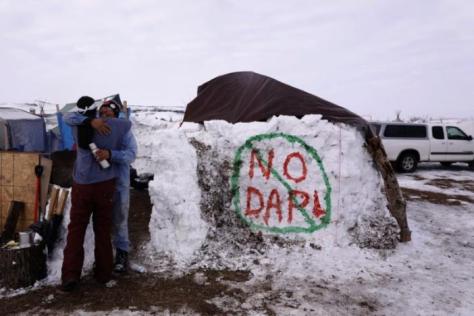
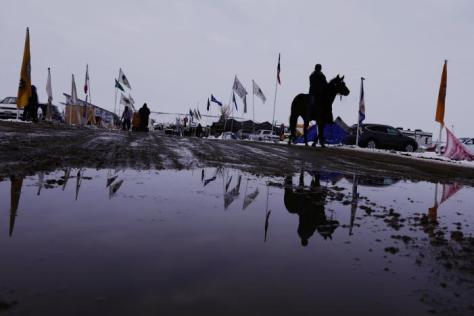
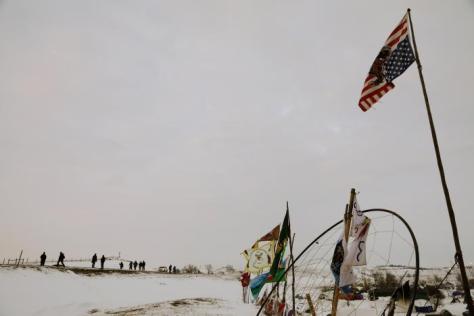
Campers shovel out an exit ramp at the Oceti Sakowin camp where people have gathered to protest the Dakota Access oil pipeline in Cannon Ball, N.D., Tuesday, Dec. 6, 2016. Many Dakota Access oil pipeline opponents who’ve gathered for months in the camp are committed to staying despite wintry weather and demands that they leave. An overnight storm brought several inches of snow, winds gusting to 50 mph and temperatures that felt as cold as 10 degrees below zero. (AP Photo/David Goldman)

Pipeline opponents ride out storm in shelters, casino

Ray Franks, of New York, carries a case of water into a mess hall at the Oceti Sakowin camp where people have gathered to protest the Dakota Access oil pipeline in Cannon Ball, N.D., Tuesday, Dec. 6, 2016. An overnight storm brought several inches of snow, winds gusting to 50 mph and temperatures that felt as cold as 10 degrees below zero. (AP Photo/David Goldman)


Pipeline opponents ride out storm in shelters, casino

Pipeline opponents ride out storm in shelters, casino

A motorist checks the condition of an exit ramp before attempting to drive out of the Oceti Sakowin camp where people have gathered to protest the Dakota Access oil pipeline in Cannon Ball, N.D., Tuesday, Dec. 6, 2016. An overnight storm brought several inches of snow, winds gusting to 50 mph and temperatures that felt as cold as 10 degrees below zero. (AP Photo/David Goldman)

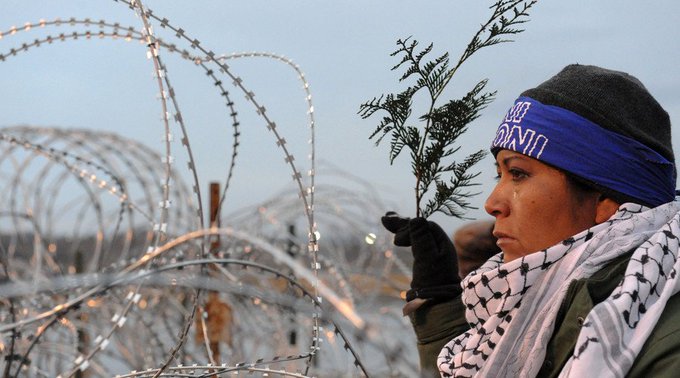
For protesters fighting the Dakota Access pipeline, the messages from the Standing Rock Sioux reservation are confusing: The tribal chairman tells demonstrators that it’s time to leave their camp and go home. Another leader implores them to stay through the bitter North Dakota winter.

The conflicting requests show how the camp’s purpose has widened beyond the original intent of protecting the tribe’s drinking water and cultural sites into a broader stand for Native American rights.

Camp occupants are working through the confusion, said Jade Begay, an organizer with the Indigenous Environmental Network. “The rest of the world just needs to hold tight and be patient,” he said.

Since August, the camp on federal land near the reservation and the pipeline route has been home to thousands of people protesting the four-state $3.8 billion pipeline designed to carry oil to a shipping point in Illinois.

After the camp endured two recent severe storms, Standing Rock Chairman Dave Archambault declared this week that it’s time for the demonstrators to disband.

Archambault said there’s no reason for people to put their lives at risk because no additional pipeline work is expected for months. The company building the project, Energy Transfer Partners, and the Army Corps of Engineers are battling in court over permission to dig under the Missouri River reservoir that provides the tribe’s drinking water. It’s the last big unfinished segment of the 1,200-mile pipeline.

“We understand this fight is not over,” Archambault said. “But the fight is not here, at this moment.”

Native American rights activist Chase Iron Eyes, an enrolled Standing Rock tribe member who made an unsuccessful bid for Congress this fall, implored pipeline opponents to stay in a social media post this week.

The camp rejoiced Sunday when the Army announced that it would not issue an easement for the pipeline to cross under Lake Oahe, but it’s unclear what might happen when pipeline supporter Donald Trump enters the White House in January. The dispute also could be decided by a federal judge.

“We are not in the clear by any means whatsoever,” Iron Eyes said. “This is not a time for celebration. If it’s a time for anything … it’s a time to honor all the sacrifices that have been made” by camp occupants. More than 500 have been arrested since August.

The camp began as a peaceful, prayerful protest of the pipeline. It has since drawn in people who believe the dispute represents an overall stand for American Indian rights.

Iron Eyes said protesters need to stand up for other tribes and treaty rights. “We don’t stand in a place to tell people to leave,” he said.

State Emergency Services spokeswoman Cecily Fong said the state isn’t surprised by the competing messages, noting the “different agendas” of people in camp.

Camp occupants are “working on finding a middle ground and some sort of compromise” through informal discussions, according to Begay, who lives in Tesuque, New Mexico.

“These kinds of decisions don’t happen in just a day or two,” she said. “We need to consider everybody’s safety, everybody’s goals, the different points of view.”

The Corps recently declared the camp area closed to public access and said those who remain are trespassing, but the agency is not issuing citations. North Dakota Gov. Jack Dalrymple has also called on camp occupants to leave, and Sen. John Hoeven issued a similar plea Wednesday from the floor of the Senate.

Iron Eyes said he believes the calls for people to leave the camp are aimed at limiting liability, and he said those who stay do so at their own risk. But he implored people “who understand the inherent risks of staying in a North Dakota winter to stand with us, because this pipeline is not finished, and we have to stand strong and stay vigilant.”

Archambault acknowledged the efforts of people who came from around the world to support the tribe. But, he said, “their purpose has been served.”

bjwordpressdivider-1

The native people have a huge decision to make. They have a huge and difficult decision and must consider everyone’s opinion as well as the big picture. Our opinion doesn’t count because we are not there living in the winter conditions and being freezing cold. We aren’t trying to decide if we can trust the federal government. I am very proud of them for standing by their principles. They have had more integrity than many white people have.

The European whites who came to America and killed them and robbed them and marched them to reservations proved they  could not be trusted.  I stand with the native people but I am here in my warm house. I respect them tremendously and will be the first to say they have accomplished a great deal.


Whatever, the people decide, they have shown the rest of America that they are the kind of Americans that we should be. I hope they begin to be proud of themselves and to take good care of each other. They are the real heroes of America.


Namaste,

Barbara

Kennedy Op-ed for Washington Post


Kennedy Family Writes Anti-Trump Op-Ed In Washington Post That EVERYONE Should Read

If there is one family in America that is qualified to speak on the issue of hatred and violence, it is the Kennedys. John F. Kennedy was shot and killed in 1963 followed by Robert F. Kennedy in 1968.

Written by William Kennedy Smith and Jean Kennedy Smith

On April 4, 1968, the day the Rev. Martin Luther King Jr. was shot and killed, Robert Kennedy was campaigning for the presidency in Indianapolis. Bobby conveyed the news of King’s death to a shattered, mostly black audience. He took pains to remind those whose first instinct may have been toward violence that President John F. Kennedy had also been shot and killed. Bobby went on, “What we need in the United States is not division; what we need in the United States is not hatred; what we need in the United States is not violence and lawlessness, but is love, and wisdom, and compassion toward one another, and a feeling of justice toward those who still suffer within our country, whether they be white or whether they be black.”

That speech has crystallized into the single most enduring portrait of Bobby’s candidacy. Because it was extemporaneous, it conveyed directly, and with raw emotion, his own vulnerability, his aspirations for his country, and a deep compassion for the suffering of others. Bobby concluded his remarks that night by urging those listening to return home and say a prayer for our country and for our people. Those words mattered. While there were riots in cities across the nation that night, Indianapolis did not burn.

Today, almost 50 years later, words still matter. They shape who we are as a people and who we wish to be as a nation. In the white-hot cauldron of a presidential campaign, it is still the words delivered extemporaneously, off the cuff, in the raw pressure of the moment that matter most. They say most directly what is in a candidate’s heart. So it was with a real sense of sadness and revulsion that we listened to Donald Trump, the Republican nominee for president, as he referred to the options available to “Second Amendment people,” a remark widely, and we believe correctly, interpreted as a thinly veiled reference or “joke” about the possibility of political assassination.

Political violence is a terrible inherent risk to any free society. Dictators and strongmen like Vladimir Putin have an answer. They are surrounded and shielded by force at all times. They do not brook dissent. In democracies, we expect our leaders to be accessible and, by and large, they want to be. Inevitably, that makes them vulnerable and the loss of a leader at a crucial time impacts family, country, and even the world, for generations. Anyone who loves politics, the open competition of ideas and public participation in a free society, knows that political violence is the greatest of all civic sins. It is not to be encouraged. It is not funny. It is not a joke.

By now, we have heard enough dark and offensive rhetoric from Trump to know that it reflects something fundamentally troubled, and troubling, about his candidacy. Trump’s remarks frequently, if not inevitably, spark outrage, which is followed by a clarification that, in lieu of an apology, seeks to attribute the dark undertones of his words to the listener’s twisted psyche. This fools no one. Whether you like what he is saying or, like a growing segment of the electorate, you reject it, it is easy to grasp Trump’s meaning from his words. But what to make of a candidate who directly appeals to violence, smears his opponents and publicly bullies a Gold Star family, a decorated prisoner of war, and a reporter with a disability, among others? To borrow the words of Army Counsel Joseph Welch, directed at another dangerous demagogue: “Have you no sense of decency, sir, at long last? Have you left no sense of decency?”

The truth remains that words do matter, especially when it comes to presidential candidates. On that basis alone, Donald Trump is not qualified to be president of the United States.

bjwordpressdivider-1


I wish the Kennedy family had written their opinion piece before the election. It might have prevented Trump from being elected. I still believe in the Kennedys despite the traumas and scandals they have gone through. Losing John and Bobby to assassination was not an easy experience for a family to survive. It left scars and trauma that took tolls on the children of both men and their Kennedy cousins.


It took tolls on the rest of America. I remember being in school when the student body president got on the PA system and told us President Kennedy had been killed in Dallas. I had worked for his campaign. I had worked to “Get out the Vote.” Now he was dead. Later, at home, I watched the news and Walter Cronkite over and over and could not grasp how a good man could be lost like this. Years later in Dallas, I went to the Grassy Knoll and the book repository and tried to make sense of it all. Two innocuous spots in the great state of Texas that will remain in infamy the site of horrible and unnecessary carnage.


I knew then that Kennedy wasn’t perfect and know it now. But you hold up a John Kennedy or a Robert Kennedy against a Donald Trump and the comparison is like weak tea.  They wanted to change America by building her up and bring a better life to all her people black or white. They believed in equality. They believed in giving less fortunate people a hand up and the entire family has done that.

If both had lived, America today would be an entirely different country. They would have accomplished all of their platforms and the black people would be much better off. We would have gotten out of Vietnam sooner. The middle class would have been shored up and vocational training and /or college would have been promoted. If one or the other had survived, they would have carried on. I watched Bobby die on TV. I heard him give his speech and walk off stage. They decided to take him out through the hotel kitchens. As I sat there, a bullet cut down his life. A scream died on the lips of liberal America and our tears flowed like the great Mississippi.


Donald Trump cannot stand up against these beloved icons. He wants to tear America apart with hate and so far he has done a pretty good job. He is trying to take America from being the home of the brave to being a playground for the ultra rich. One where each of the rest of us will have to kiss their boots and kowtow to their wants. I refuse to do that. Many will refuse. In what is supposed to be my golden years, I will do everything I am capable of to ruin Trump’s plans and to help Americans see what an infantile loser he really is.


So, I stand with the UCLA and with black people, women, refugees, Muslims, the disabled, the disenfranchised, the unwashed masses that came to America when my grandparents came and began a new life with hard work and a stubborn drive to succeed  in this great land of America.  I stand up to Trump for my grandparents who traveled here in steerage for a new life, learned English and became citizens. Who taught us to work hard and to be proud of who we are. We, the first and second generations born here from those immigrants, must fight Trump and all he and his cronies stand for. I look forward to the coming years, after this administration is gone, beginning in 2020.

The tireless women of Standing Rock


'Miracles Are Happening': Photos of the Tireless Women of Standing Rock

ALL PHOTOS BY CELINE GUIOUT

‘Miracles Are Happening’: Photos of the Tireless Women of Standing Rock

DEC 7 2016

Thanks to the efforts of Standing Rock protesters, the controversial Dakota Access Pipeline has been diverted. Photographer Celine Guiout went to Standing Rock to shoot the women who made it happen.

Over the weekend, the US Army Corps of Engineers finally delivered some good news to the thousands of protesters camped out at the Standing Rock Sioux Reservation: Construction of the Dakota Access Pipeline would be halted.

The proposed pipeline would have carried crude oil underneath Lake Oahe, a dammed-up part of Missouri River and the main water source for the reservation. The Sioux tribe has repeatedly expressed concerns that the pipeline could lead to contamination of their water supply and threaten its water and treaty rights.

After months of the stand-off involving protesters (who call themselves Water Protectors) and police, the Army Corps announced on Sunday that it would not grant permission for Dakota Access LLC (DPL) to drill under the river. In a statement, it said that it would instead “explore alternate routes for the pipeline crossing.”

For the thousands of protesters—comprising of members of the Sioux Tribe, indigenous people from across America, non-indigenous allies, and veterans—camped out at the Standing Rock Indian Reservation, the news came as welcome relief in the biting cold. It was the culmination of an intense struggle that involved shocking levels of police brutality.

Photographer Celine Guiout photographed and interviewed the women of Standing Rock a week before the Water Protectors were told that their months-long test of endurance and activism had paid off. “Women are definitely a driving force in this massive gathering,” she tells Broadly. “All the women I had the chance to meet throughout my stay were incredibly optimistic about the outcome and peaceful resolution of the current situation. These women were completely unmovable in their faith.”

All photos and interviews by Celine Guiout

Beatrice Menasekwe Jackson from the Tsimshian tribe in Ketchikan, Alaska, now living in Michigan

We are here because as women, we are caretakers of the water and caretakers of the earth. We want the Earth to be in good condition so the water that goes through our bodies helps our children to be healthy and grow up strong in mind, body, and spirit. We want them to have the balance that they need here in creation, so they won’t be torn apart by political parties by color, race, or gender. We’re going to make a more beautiful world for them.

I’m here also because my children can’t be here. I’m going to go home and tell them everything I’ve seen, so that when my time of not-travelling comes they will be able to go out and do that for me. Even though I’m a great grandmother, I took my own pension [from being a] retired teacher and made the journey. It’s all worth it, being here and sharing with the women our songs and the water prayers.

Bibi, from the Juaneño tribe in San Juan Capistrano, California

Why am I here? Oh my gosh, it starts way back when I was a little girl—it was born in me. You can’t take what’s in you away, and that’s your spirit, [knowing] your ancestors and your families have suffered enough. I have suffered enough. Natives are not going to take it anymore because you can’t take from us no more. You take away our land, you take away our pride, you try to take away everything. They have stripped us of everything, [but] not no more. We’re here till the end, and I have hope that we’re going to beat this. Ever since I was a little girl I knew I had a big important purpose in life and when it came time for this I knew it was it. Ever since I’ve been here there hasn’t been [anything] but good things happening. Miracles are happening at Standing Rock, and it’s not going to stop.

Cortney Collia from Kalamazoo, Michigan

For my personal experience in Kalamazoo, we’ve had the largest inland oil spill in the United States. It was years ago, in 2010, and that water still isn’t clean. They said they cleaned [it], but I work right along that river teaching kids and they aren’t allowed to go into the water anymore. If they do, they end up with a rash, and you can see a sheen on the surface still—the grass is dying and so are the trees. I work at a nature center and for education purposes I take the kids canoeing down the river, [but] I can’t let them splash around or swim like kids should in water. We are trying to teach them about the importance of taking care of nature and resources. Our bodies are 70 percent made of water and it keeps us alive, and having warnings [telling kids] not to touch the water is heartbreaking. I can’t let that happen to anybody else. So I made my journey here multiple times, to make sure it doesn’t happen again.

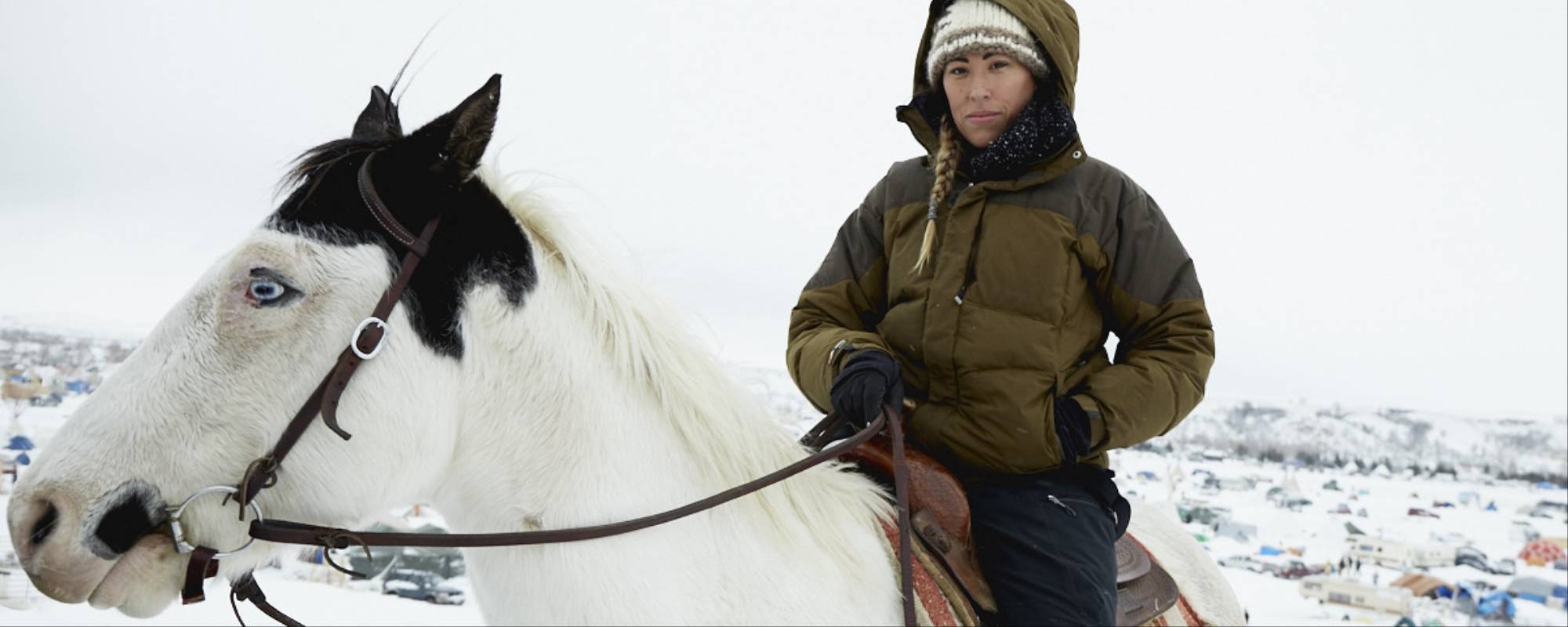
Vanessa Castle and her horse, Medicine Hat, from the Lower Elwha Klallam Tribe in Port Angeles, Washington

I got here over a month ago—drove out here for nine hours by myself. I came out here for mine and the future generations; to protect the water and also to stand up for the rights of our tribes. As indigenous peoples, we are constantly battling with prejudice and injustice, and as a woman without any children in my family it was my turn to come and stand for what we believe in. I’m here to protect the resources that we have rights to.

Melaine Stoneman, from the Sicangu Lakota (Burnt Thigh Nation) tribe in Pine Ridge Reservation, South Dakota

I have been here since day one. I run the women’s group that we have here, and my main point is to provide the women, children, and elderly [with] safety as an essential part here at Oceti Sakowin [Camp]. One of our great emphases now is to create all unity between all indigenous and non-indigenous women, and to unify in prayer to help stop the pipeline.

Faith Spotted Eagle and her daughter, Brook, from the Yankton Sioux (Ihanktonwan Dakota Oyate) tribe in Yanktown Reservation, South Dakota

Faith Spotted Eagle: I’ve been here on and off since April. I grew up along the river, I always jokingly say, “This is my river, so I’m sharing it with you.” The river has so much to teach and it has its own spirit and so we’ve been drawn to that spirit of the river water. I think that all of us had this dreams of doing what we can and we’ve been called to it in our lifetime, so the river and the land are helping us fulfill those dreams.

It really is bigger than us; it’s not even about us sometimes, it’s about my grandson’s grandchildren’s grandchildren—that’s what it comes down to. It’s so marvelous to watch him, because I think that’s my DNA, my blood, and that’s going to live on for generations. And it has to, because if we don’t stop all the oil industries and the climate change that’s going on… I can’t even imagine my grandchildren not being protected. So that’s why I’m here.

Brook: As indigenous people, we’re always thinking forward [to the next] seventh generation. The way that we understand it is that we protect our people—we’re indigenous, we’re tribal—and part of that indigeneity is that our relatives are not just human. They are also non-human. These are our rivers that have a spirit and are part of our nation, and our original mother that we all belong to. So I’m part of a women’s society. My role as a women in a women’s society I’m here to support in any way that I can with my elders. They are the original freedom fighters and they’ve always been freedom fighters, so right now we’re in training. We’re also fighting alongside them, so I’m here in service of my people.

Courtney and Amber McCornack, from Albert Lea, Minnesota

Courtney McCornack: We’ve been back and forth for months. I brought my daughter here and we have been building teepees with other women and donating them to the people that need them. I want her to stay connected to her intuitive side, which is what the Native American communities have been doing since the beginning. The sense of community here is truly amazing—true respect for each other and the most powerful prayers I have heard in my entire life from sundown to sunrise.

Urtema Dolphin, from London

I’ve arrived a couple of days ago from London—I arrived in the storm. I came because I’ve been following this issue for many months, and become more and more involved watching videos on social media. I just felt that I had to be here, and so I’m representing lots of people from all over the world. I’m bringing their prayers with me [and] spiritually they are all travelling with me. So here I am, ready to help.

Anonymous aunt and her niece, with tribal affiliations from the Desert Southwest, Apache, and Mexican tribes

We are here because Native people have been fighting for sovereignty on this land for over 500 years. This is a monumental event; unprecedented. We want to show corporate America that many people are not supportive of mineral extractions and we’re all about clean water and being healthy people. The only way to maintain that is standing up for what’s right. We have the kind of technologies to be able to have cleaner energy sources but that power is being held by the leaders and the privileged, so the rest of us get screwed in the end.

We are here to change that and support the people. It’s not only for our kids, but it’s also for the future generations. Even for the cops at the bridge, the water in me recognizes the water in them. Even if we’re on opposing sides, we still have the same communality which is our bodies are made of water. So I’m just going to keep praying and appealing to that.

Tosha Luger from the Hunkpapa tribe of the Seven Council Fires of the Lakota Sioux in Standing Rock

I was born and raised in these lands. I lost my husband and my father a year ago, very close to each other, and I was broken. I live on a ranch just south of here and I would go down to the river every day. It healed me—really, truly healed me. Being here is a very humbling experience and we must remain focused. This river goes all the way out to the Missouri River and all the way down to the ocean. That’s what we are protecting.

I was crushed when that girl’s arm got blown off… I myself ended up with a concussion, got tear-gassed and maced and stood in the freezing cold whilst they were spraying us with water cannons. They are telling us to go home, but they don’t understand that we are already home.

In order to change things, we must remain in prayer and peace. I feel so honored for all these people who have heard our prayers and have joined us in this, and I hope they will bring our healing and teachings back to where they are from and start changing the world, empower Mother Earth, and be more compassionate, kind, and empathetic.

On the road to Standing Rock.

Vanessa Castle and her horse, with other Water Protectors.

Beatrice Menasekwe Jackson leads a water ceremony.

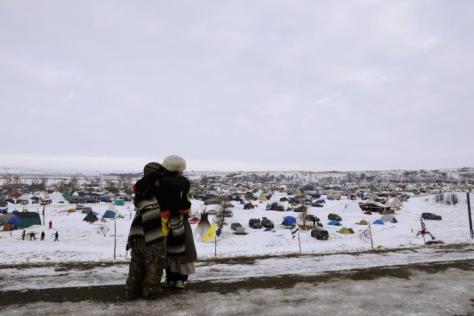
Oceti Sakowin Camp at Standing Rock.

A furry security guard at the entrance of the camp.

Makeshift directions for the camp.

Cannonball River, a tributary of the Missouri River.

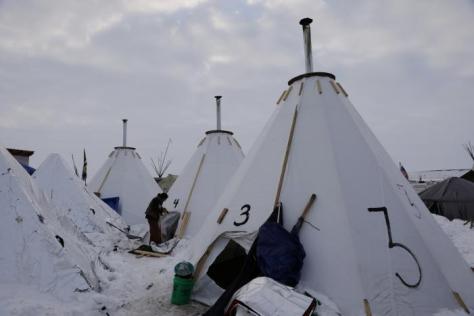
Two teepees in Oceti Sakowin camp.

Border Patrol prevents Journalist from reporting on Standing Rock


I’m a Journalist and Border Patrol Stopped Me From Covering Standing Rock


bjwordpressdivider-1


This is proof that America is being hypocritical about journalists and how they cover news stories such as Standing Rock. This will only get worse after Trump takes office. I am sure with as sensitive as he appears to be, he will be sure to limit what is covered in the press and on the TV. This is going to really challenge the First Amendment. We will have to really have keep our eyes on this. Let me know if you hear of any more incidences of censorship.


Namaste

Barbara

US Veterans build barracks for pipeline protesters


U.S. veterans build barracks for pipeline protesters in cold

Veterans have a demonstration on Backwater bridge during a protest against plans to pass the Dakota Access pipeline near the Standing Rock Indian Reservation, near Cannon Ball, North Dakota, U.S., December 1, 2016. REUTERS/Stephanie Keith

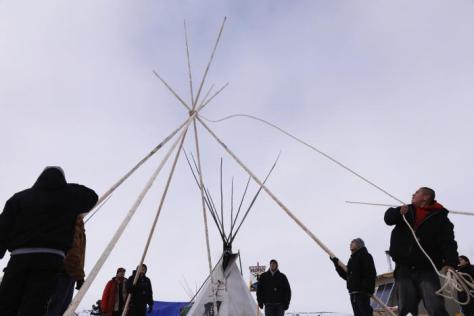
Members of the Oglala Lakota tribe erect a tipi inside of the Oceti Sakowin camp as "water protectors" continue to demonstrate against plans to pass the Dakota Access pipeline near the Standing Rock Indian Reservation, near Cannon Ball, North Dakota, U.S., December 2, 2016. REUTERS/Lucas Jackson

Members of the Oglala Lakota tribe erect a tipi inside of the Oceti Sakowin camp as “water protectors” continue to demonstrate against plans to pass the Dakota Access pipeline near the Standing Rock Indian Reservation, near Cannon Ball, North Dakota, U.S., December 2, 2016. REUTERS/Lucas Jackson


Benji Buffalo (R) greets a friend to his campsite inside of the Oceti Sakowin camp as "water protectors" continue to demonstrate against plans to pass the Dakota Access pipeline near the Standing Rock Indian Reservation, near Cannon Ball, North Dakota, U.S., December 2, 2016. REUTERS/Lucas Jackson

Benji Buffalo (R) greets a friend to his campsite inside of the Oceti Sakowin camp as “water protectors” continue to demonstrate against plans to pass the Dakota Access pipeline near the Standing Rock Indian Reservation, near Cannon Ball, North Dakota, U.S., December 2, 2016. REUTERS/Lucas Jackson


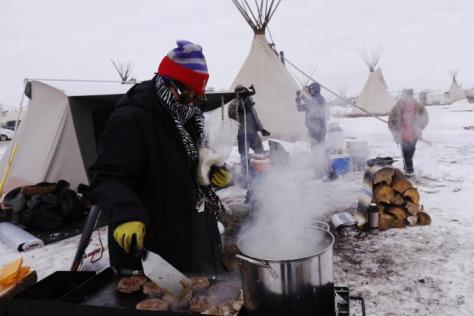
Campers cook lunch inside of the Oceti Sakowin camp as "water protectors" continue to demonstrate against plans to pass the Dakota Access pipeline near the Standing Rock Indian Reservation, near Cannon Ball, North Dakota, U.S., December 2, 2016. REUTERS/Lucas Jackson

Campers cook lunch inside of the Oceti Sakowin camp as “water protectors” continue to demonstrate against plans to pass the Dakota Access pipeline near the Standing Rock Indian Reservation, near Cannon Ball, North Dakota, U.S., December 2, 2016. REUTERS/Lucas Jackson


Demonstrators greet each other near the entrance of the Oceti Sakowin camp as "water protectors" continue demonstrations against plans to pass the Dakota Access pipeline continue near the Standing Rock Indian Reservation, near Cannon Ball, North Dakota, U.S., December 2, 2016. REUTERS/Lucas Jackson

Demonstrators greet each other near the entrance of the Oceti Sakowin camp as “water protectors” continue demonstrations against plans to pass the Dakota Access pipeline continue near the Standing Rock Indian Reservation, near Cannon Ball, North Dakota, U.S., December 2, 2016. REUTERS/Lucas Jackson


Benji Buffalo works to improve his campsite inside of the Oceti Sakowin camp as "water protectors" continue to demonstrate against plans to pass the Dakota Access pipeline near the Standing Rock Indian Reservation, near Cannon Ball, North Dakota, U.S., December 2, 2016. REUTERS/Lucas Jackson

Benji Buffalo works to improve his campsite inside of the Oceti Sakowin camp as “water protectors” continue to demonstrate against plans to pass the Dakota Access pipeline near the Standing Rock Indian Reservation, near Cannon Ball, North Dakota, U.S., December 2, 2016. REUTERS/Lucas Jackson


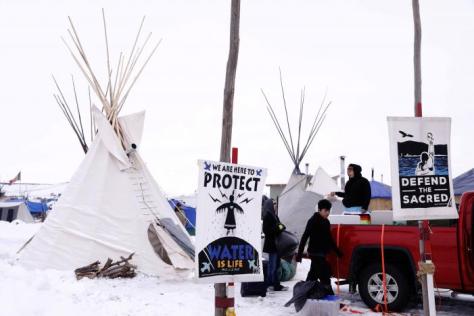
Messages of support adorn the side of a tipi inside of the Oceti Sakowin camp as "water protectors" continue to demonstrate against plans to pass the Dakota Access pipeline near the Standing Rock Indian Reservation, near Cannon Ball, North Dakota, U.S., December 2, 2016. REUTERS/Lucas Jackson

Messages of support adorn the side of a tipi inside of the Oceti Sakowin camp as “water protectors” continue to demonstrate against plans to pass the Dakota Access pipeline near the Standing Rock Indian Reservation, near Cannon Ball, North Dakota, U.S., December 2, 2016. REUTERS/Lucas Jackson


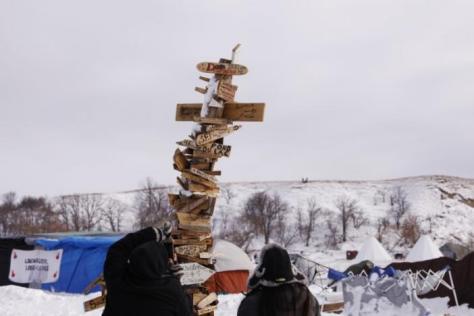
Campers photograph a signpost with the names of various tribes on it inside of the Oceti Sakowin camp as "water protectors" continue to demonstrate against plans to pass the Dakota Access pipeline near the Standing Rock Indian Reservation, near Cannon Ball, North Dakota, U.S., December 2, 2016. REUTERS/Lucas Jackson

Campers photograph a signpost with the names of various tribes on it inside of the Oceti Sakowin camp as “water protectors” continue to demonstrate against plans to pass the Dakota Access pipeline near the Standing Rock Indian Reservation, near Cannon Ball, North Dakota, U.S., December 2, 2016. REUTERS/Lucas Jackson


Members of the Oglala Lakota tribe erect a tipi inside of the Oceti Sakowin camp as "water protectors" continue to demonstrate against plans to pass the Dakota Access pipeline near the Standing Rock Indian Reservation, near Cannon Ball, North Dakota, U.S., December 2, 2016. REUTERS/Lucas Jackson

Members of the Oglala Lakota tribe erect a tipi inside of the Oceti Sakowin camp as “water protectors” continue to demonstrate against plans to pass the Dakota Access pipeline near the Standing Rock Indian Reservation, near Cannon Ball, North Dakota, U.S., December 2, 2016. REUTERS/Lucas Jackson


People donate food and equipment to campers inside of the Oceti Sakowin camp as "water protectors" continue to demonstrate against plans to pass the Dakota Access pipeline near the Standing Rock Indian Reservation, near Cannon Ball, North Dakota, U.S., December 2, 2016. REUTERS/Lucas Jackson

People donate food and equipment to campers inside of the Oceti Sakowin camp as “water protectors” continue to demonstrate against plans to pass the Dakota Access pipeline near the Standing Rock Indian Reservation, near Cannon Ball, North Dakota, U.S., December 2, 2016. REUTERS/Lucas Jackson


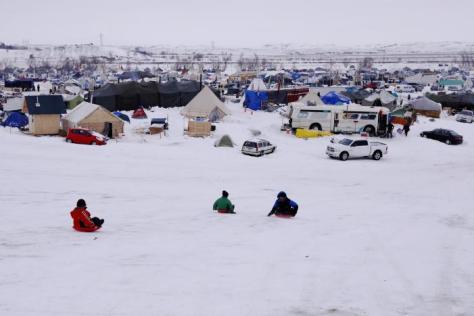
Children sled down a hill inside of the Oceti Sakowin camp as "water protectors" continue to demonstrate against plans to pass the Dakota Access pipeline near the Standing Rock Indian Reservation, near Cannon Ball, North Dakota, U.S., December 2, 2016. REUTERS/Lucas Jackson

Children sled down a hill inside of the Oceti Sakowin camp as “water protectors” continue to demonstrate against plans to pass the Dakota Access pipeline near the Standing Rock Indian Reservation, near Cannon Ball, North Dakota, U.S., December 2, 2016. REUTERS/Lucas Jackson


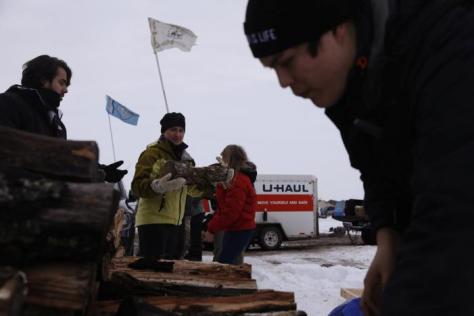
Campers unload donated wood inside of the Oceti Sakowin camp as "water protectors" continue to demonstrate against plans to pass the Dakota Access pipeline near the Standing Rock Indian Reservation, near Cannon Ball, North Dakota, U.S., December 2, 2016. REUTERS/Lucas Jackson

Campers unload donated wood inside of the Oceti Sakowin camp as “water protectors” continue to demonstrate against plans to pass the Dakota Access pipeline near the Standing Rock Indian Reservation, near Cannon Ball, North Dakota, U.S., December 2, 2016. REUTERS/Lucas Jackson


A camper works on her tent inside of the Oceti Sakowin camp as "water protectors" continue to demonstrate against plans to pass the Dakota Access pipeline near the Standing Rock Indian Reservation, near Cannon Ball, North Dakota, U.S., December 2, 2016. REUTERS/Lucas Jackson

A camper works on her tent inside of the Oceti Sakowin camp as “water protectors” continue to demonstrate against plans to pass the Dakota Access pipeline near the Standing Rock Indian Reservation, near Cannon Ball, North Dakota, U.S., December 2, 2016. REUTERS/Lucas Jackson


A man rides a horse down a road inside of the Oceti Sakowin camp as "water protectors" continue to demonstrate against plans to pass the Dakota Access pipeline near the Standing Rock Indian Reservation, near Cannon Ball, North Dakota, U.S., December 2, 2016. REUTERS/Lucas Jackson

A man rides a horse down a road inside of the Oceti Sakowin camp as “water protectors” continue to demonstrate against plans to pass the Dakota Access pipeline near the Standing Rock Indian Reservation, near Cannon Ball, North Dakota, U.S., December 2, 2016. REUTERS/Lucas Jackson


A group walks towards the entrance of the Oceti Sakowin camp as "water protectors" continue demonstrations against plans to pass the Dakota Access pipeline near the Standing Rock Indian Reservation, near Cannon Ball, North Dakota, U.S., December 2, 2016. REUTERS/Lucas Jackson

A group walks towards the entrance of the Oceti Sakowin camp as “water protectors” continue demonstrations against plans to pass the Dakota Access pipeline near the Standing Rock Indian Reservation, near Cannon Ball, North Dakota, U.S., December 2, 2016. REUTERS/Lucas Jackson


By Ernest Scheyder and Terray Sylvester | CANNON BALL, N.D.

U.S. military veterans were building barracks on Friday at a protest camp in North Dakota to support thousands of activists who have squared off against authorities in frigid conditions to oppose a multibillion-dollar pipeline project near a Native American reservation.

Veterans volunteering to be human shields have been arriving at the Oceti Sakowin camp near the small town of Cannon Ball, where they will work with protesters who have spent months demonstrating against plans to route the Dakota Access Pipeline beneath a lake near the Standing Rock Sioux Reservation, organizers said.

The Native Americans and protesters say the $3.8 billion pipeline threatens water resources and sacred sites.

Some of the more than 2,100 veterans who signed up on the Veterans Stand for Standing Rock group’s Facebook page are at the camp, with hundreds more expected during the weekend. Tribal leaders asked the veterans, who aim to form a wall in front of police to protect the protesters, to avoid confrontation with authorities and not get arrested.

Wesley Clark Jr, a writer whose father is retired U.S. Army General Wesley Clark, met with law enforcement on Friday to tell them that potentially 3,500 veterans would join the protest and the demonstrations would be carried out peacefully, protest leaders said.

The plan is for veterans to gather in Eagle Butte, a few hours away, and then travel by bus to the main protest camp, organizers said, adding that a big procession is planned for Monday.

Protesters began setting up tents, tepees and other structures in April, and the numbers swelled in August at the main camp.

Joshua Tree, 42, from Los Angeles, who has been visiting the camp for weeks at a time since September, said he felt pulled to the protest.

“Destiny called me here,” he said at the main camp. “We’re committed.”

“GO HOME”

The protesters’ voices have also been heard by companies linked to the pipeline, including banks that protesters have targeted for their financing of the pipeline.

Wells Fargo & Co (WFC.N) said in a Thursday letter it would meet with Standing Rock elders before Jan. 1 “to discuss their concerns related to Wells Fargo’s investment” in the project.

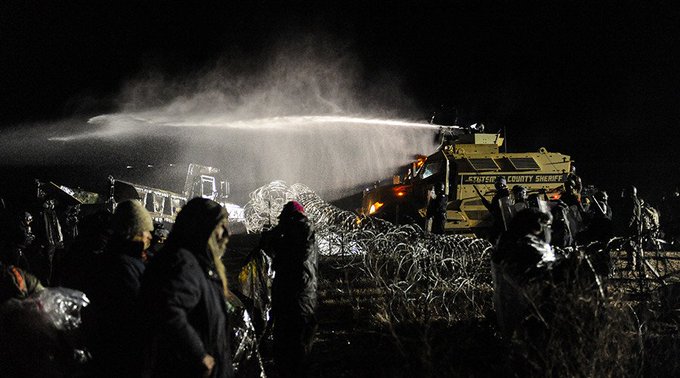
There have been violent confrontations near the route of the pipeline with state and local law enforcement, who used tear gas, rubber bullets and water hoses on the protesters, even in freezing weather.

The number of protesters in recent weeks has topped 1,000. State officials on Monday ordered them to leave the snowy camp, which is on U.S. Army Corps of Engineers land, citing harsh weather, but on Wednesday they said they would not enforce the order.

“There is an element there of people protesting who are frightening,” North Dakota Attorney General Wayne Stenehjem said on Thursday. “It’s time for them to go home.”

Morton County Sheriff Kyle Kirchmeier spoke by phone on Friday with U.S. Attorney General Loretta Lynch, but assistance for law enforcement and a timeline for a resolution to the situation were not offered, the sheriff’s office said.

Lynch said in a statement that the U.S. Department of Justice has been in communication with all sides in an effort to reduce tensions and foster dialogue. She said senior department officials will be deployed to the region as needed.

U.S. President-elect Donald Trump said on Thursday he supported the completion of the pipeline, and his transition team said he supported peaceful protests.

North Dakota Governor Jack Dalrymple said on Wednesday it was “probably not feasible” to reroute the pipeline, but he would try to rebuild a relationship with Standing Rock Sioux leaders.

On Friday, Morton County Commission Chairman Cody Schulz said his office has been working in conjunction with the governor’s office to meet with tribal leaders soon.

FREEZING COLD

Since the start of demonstrations, 564 people have been arrested, the Morton County Sheriff’s Department said.

State officials never contemplated forcibly removing protesters, and Dalrymple said his evacuation order stemmed mainly from concerns about dangerously cold temperatures.

The temperature in Cannon Ball is expected to fall to 4 degrees Fahrenheit (-16 Celsius) by the middle of next week, according to Weather.com forecasts.

The 1,172-mile (1,885-km) pipeline project, owned by Texas-based Energy Transfer Partners LP (ETP.N), is mostly complete, except for a segment planned to run under Lake Oahe, a reservoir formed by a dam on the Missouri River.

Protesters, who refer to themselves as “water protectors,” have been gearing up for the winter while they await the Army Corps decision on whether to allow Energy Transfer to tunnel under the river. The Army Corps has twice delayed that decision.


2,000 Veterans Standing up for Standing Rock


Dakota Pipeline Protesters Brave Winter’s Chill


GALLERY
DEC 2 2016, 11:45 AM ET

Dakota Pipeline Protesters Defy Winter’s Chill

Snow and biting temperatures are just a few of the challenges faced by protesters camped out near the site of the Dakota Access pipeline.

So far, those fighting the Dakota Access pipeline have shrugged off the heavy snow, icy winds and frigid temperatures that have swirled around their large encampment on the North Dakota grasslands. But if they defy next week’s government deadline to abandon the camp, demonstrators know the real deep freeze lies ahead. Life-threatening wind chills and towering snow drifts could mean the greatest challenge is simple survival.

Above: A student walks into the school at the Oceti Sakowin camp where people have gathered to protest the Dakota Access pipeline near Cannon Ball, North Dakota. The school teaches on average 20 students a day in the traditional Lakota curriculum as well as math, reading and writing.

David Goldman / AP

Loretta Reddog of Placerville, California, shovels a walkway to her tent while followed by her dog Gurdee Bean at the camp on Nov. 29.

“I’m scared. I’m a California girl, you know?” said Reddog who arrived several months ago with her two dogs and has yet to adjust to the harsher climate. Reddog has confidence in the camp community. “Everybody’s really stepping up and taking care of each other,” she said.

David Goldman / AP

Demonstrators sit on a closed bridge across from police protecting the Dakota Access oil pipeline site next to the camp on Nov. 30.

The camp is on the edge of the Standing Rock Sioux Reservation.

David Goldman / AP

Military veterans walk onto a closed bridge to protest across from police protecting the Dakota Access oil pipeline site on Dec. 1. Large groups of U.S. military veterans have said they will serve as “human shields” in any possible clashes with law enforcement at the site.

More than 525 people from across the country have been arrested since August. In a recent clash between police and protesters near the path of the pipeline, officers used tear gas, rubber bullets and large water hoses in sub-freezing temperatures.

David Goldman / AP

Beatrice Menase Kwe Jackson of the Ojibwe tribe leads a song during a traditional water ceremony along the Cannonball River at the camp on Nov. 29.

The pipeline is largely complete except for a short segment that is planned to pass beneath a Missouri River reservoir. The company doing the building says it is unwilling to reroute the project.

David Goldman / AP

A person prays along the Cannonball River during a Native American water ceremony at the camp on Nov. 29.

The government has ordered protesters to leave federal land by Dec. 5, but they insist they will stay for as long it takes to divert the $3.8 billion pipeline.

David Goldman / AP

A protester walks through a snow storm at the camp on Nov. 29.

David Goldman / AP

Grandma Redfeather of the Sioux tribe sits by the wood stove in her yurt at the camp on Nov. 29.

“I love it because I get to live my traditional way of life,” said Redfeather of living at the camp. “To see all the different tribal nations living together as a community, I would have loved my grandpa to see that.”

David Goldman / AP

A man stands inside a bus turned into a camper at the Oceti Sakowin camp on Nov. 30.

The camp covers a half square mile, with living quarters that include old school buses, fancy motorhomes and domelike yurts. Hay bales are piled around some teepees to keep out the wind. There’s even a crude corral for horses.

David Goldman / AP

Smokey, a member of the Sioux tribe, rides the horse Prophecy, a descendant of the horse belonging to war chief Crazy Horse, as he pulls a sled at the Oceti Sakowin camp on Nov. 29.

David Goldman / AP

Blackhorse Shasta, of Oregon, chops wood at the camp on Nov. 29.

Mountains of donated food and water are being stockpiled, as is firewood, much of which has come from outside of North Dakota, the least-forested state in the nation.

David Goldman / AP

Grandma Redfeather of the Sioux tribe walks in the snow to fetch water on Nov. 29.

“It’s for my people to live and so that the next seven generations can live also,” said Redfeather of why she came to the camp. “I think about my grandchildren and what it will be like for them.”

David Goldman / AP

Cat Bigney, of the Oglala tribe, waits on the shore of the Cannonball River for travelers to arrive by canoe at the camp on Dec. 1.

David Goldman / AP

Virginia Redstar, a member of the Colville tribe from Washington state, celebrates upon reaching shore by canoe at the camp on Dec. 1. Redstar and fellow tribal members traveled by canoe for 10 days down the Missouri River from Montana to reach the camp.

David Goldman / AP

Dan Nanamkin, of the Colville Nez Perce tribe in Nespelem, Washington, drums a traditional song on the shore of the Cannonball River before a group arrives by boat at the camp on Dec. 1.

David Goldman / AP

A protester is bundled against the chill at the camp on Nov. 29.


bjwordpressdivider-1


I am feeling a lot of admiration for the native people who are in the Dakotas in the freezing temperatures and the snow. They are proving that they come from a much hardier stock that those of us from European stock are. I am going to follow them all weekend because there are events unfolding that I believe warrant documenting. Say a prayer for their health and tenaciousness and say a prayer that they can find food.

Namaste

Barbara

Scientists are watching Trump on his science denial


2,300 Leading Scientists Send Trump A Clear Warning: We’re Watching You

An open letter signed by America’s top minds hopes to counter the influence of climate change deniers and oil execs.


MIKE SEGAR / REUTERS
President-elect Donald Trump’s administration needs to “support and rely on science as a key input for crafting public policy,” the scientists wrote. 

More than 2,300 scientists, including 22 Nobel Prize recipients, have a warning for Donald Trump: Respect science or prepare for a fight.

In an open letter Wednesday to the president-elect and Congress, scientists representing all 50 states called on the incoming administration to sufficiently fund scientific research as well as “support and rely on science as a key input for crafting public policy.”

Anything short of that, they stressed, is a direct threat to the health and safety of Americans and people around the world.

“The consequences are real: without this investment, children will be more vulnerable to lead poisoning, more people will be exposed to unsafe drugs and medical devices, and we will be less prepared to limit the impacts of increasing extreme weather and rising seas,” the letter reads.

The letter, organized by the Union of Concerned Scientists, comes amid growing concern about what a Trump presidency will mean for combatting today’s environmental challenges, namely climate change.

Trump and his fellow climate deniers have made it quite clear where they stand on the phenomenon and funding its continued study. Trump has dismissed climate change as “bullshit” and a Chinese “hoax,” and promised to pull the U.S. out of the historic Paris climate agreement. He has also said he would cut all federal spending on the issue, increase America’s production of coal, oil and natural gas, and do away with Obama administration regulations aimed at cutting emissions.


“Respect for science in policymaking should be a prerequisite for any Cabinet position” – .physicist Lewis Branscomb

In the weeks since the election, Trump has only added to scientists’ concerns by selecting climate change denier Myron Ebell and fossil fuel lobbyist Mike McKennato lead transition work at the Environmental Protection Agency and Department of Energy. Former Alaska Gov. Sarah Palin and oil executive Harold Hamm are front-runners to head the Interior Department, and Trump’s senior adviser on space policy wants to eliminate NASA’s research into climate change.

The letter, published Wednesday, features an impressive list of signatories, including David Baltimore, president emeritus of the California Institute of Technology; Eric Chivian, the founder and director of the Center for Health and the Global Environment at Harvard Medical School; and Wolfgang Ketterle, a German physicist and professor at Massachusetts Institute of Technology.

The scientists call on Trump and the 115th Congress to “adhere to high standards of scientific integrity and independence in responding to current and emerging public health and environmental threats.”

In a news release on the letter, Lewis Branscomb, a physicist and professor at the University of California, San Diego, said: “Americans recognize that science is critical to improving our quality of life, and when science is ignored or politically corrupted, it’s the American people who suffer. Respect for science in policymaking should be a prerequisite for any Cabinet position.”

The group also promised to keep a close eye on Trump ― and fight back if necessary.

“We will continue to champion efforts that strengthen the role of science in policy making and stand ready to hold accountable any who might seek to undermine it,” the letter states.

 bjwordpressdivider-1
It is illogical to not take care of Mother Earth. She will self-destruct without our peaceful intersession on her behalf. We have a responsibility to future generations of our families to protect and help her to heal. Don’t let Trump turn our world into a real dying planet.
Science is real. As it has been said, Science it True whether you believe it or not.  You can’t bury your head in the sand. This problem won’t go away. It will simply grow more serious.
Namaste,
Barbara

12 Ways to be an Effective Ally at Standing Rock


12 Ways to Be an Effective Ally at Standing Rock


standingrockopt2

Important Tips for Non-Natives Who Want to Support Standing Rock

A brief disclaimer: As a relatively young white man, I am not an expert in white allyship for native causes, and am in no way a spokesperson for any indigenous movement. I was inspired to write this piece only because of painful mistakes I have witnessed continuously repeated in native spaces by people like me. In fact, virtually all the actions one can unintentionally take to hamper indigenous movements, I have personally committed. I am writing this so that others can avoid common pitfalls and step into what I see as effective allyship within native movements.

1) Work towards the ultimate goal

Everyone knows that the immediate goal of the protests are to stop the pipeline, but what many outside observers seem to fail to realize is that the ultimate goal is for unified indigenous peoples themselves to stop the pipeline.

The last time that many of these tribes came together was for what the Lakota know as the Battle of Greasy Grass, and we know as Custer’s Last Stand. They are well aware of this fact at Standing Rock, as flying all over camp are exact replicas of the flag captured during that total defeat of the US army. This gathering is even more significant than that famous battle in terms of unity, because never in the history of this continent have so many tribes come together to work as one for a single goal. If this action against the pipeline is accomplished via grassroots indigenous support, native unity is gaining a track record of successfully fighting for their equal treatment.

What this means for us on the ground is that our top goal is to strengthen the peace and unity of the indigenous factions within the camp, and to support natives stepping into positions of leadership and influence in this movement. Non-indigenous individuals attempting to assist the protests by leading, organizing, and coordinating natives are actually harming the long term outlook of this movement.

The ultimate goal is for unified indigenous peoples themselves to stop the pipeline.The ultimate goal is for unified indigenous peoples themselves to stop the pipeline.

2) Understand the different ways you can help

There is a lot of need on the ground in North Dakota, and there are many ways you can support. One is by simply donating. There are several different funds for the various camps out there. If you donate in this way, the money will likely be used for legal fees, central kitchen supplies, care of the children and elderly, winter gear for the protectors, and more.

At Standing Rock, we met a lot of impoverished individuals who had been camping for weeks or months, and were prepared to spend the whole winter there, despite not even having sub-zero sleeping bags. These groups are often small, autonomous, traditional, and too proud to ask for the help they need when there are so many elderly and children present. I believe that distributing aid directly to the people who are in it for the long haul has a powerful impact on ultimately stopping the pipeline. To read more about how aid on the ground can help, please look at this document we compiled, tracking how our money was spent.

There is also need on the ground. Kitchen volunteers commonly worked up to midnight, started feeding people at the crack of dawn, and could certainly use extra help. There is a school on site that may still be looking for teachers. First aid skills, manual labor, trash clearance, minor landscaping, balanced media coverage, running errands: All were required from what I could see. If you feel comfortable contributing in these ways, are willing to navigate the complexities of race and colonialism, and are able to be self sufficient, I think your presence would be valued and appreciated onsite.

Some have been camping for weeks or months.Some have been camping for weeks or months.

3) Know how not to contribute

Since returning, I have seen a few fundraising efforts online that I thought were well intentioned but potentially problematic. One was of a Los Angeles based art director who was trying to raise $6,000 to fund her dance company to travel to Standing Rock, so that they could make an art documentary and choreograph a modern dance piece of the protests. Another was of a Brooklyn based alternative healer who had raised $1,750 to fund her travels there so she and her coworkers could give free acupuncturist sessions to the activists. Both of these funds advertised the needs of the protesters on the ground and promised that excess money would be donated to the activists.

There is a painful history of indigenous personal struggles being appropriated for someone’s artwork, personal validation, or new age experience, and they are rightly sensitive towards these forms of well-intentioned exploitation.

Native communities have a long tradition of powerful art that resonates with individuals from all backgrounds, and alternative healing that supports their people in the absence of modern medicine. From what I can tell, this movement is about strengthening indigenous culture, not diluting it. Most people who are not part of the tribes that are unifying should be paying their own way out there and fundraising for the activists.

Some people may say it’s better to donate money you would use to travel there, to the organizers. Essentially, I view simply writing a fat check as one of the downfalls of western solidarity. There is a strong tendency to donate out of guilt and then move on from the struggle. This is a budding movement and needs individuals from all walks of life in this country on the ground, interacting with, and trying to understand the complexities of the challenges facing Native Americans. The camps themselves are asking for empowered allies, willing to do the hard day-to-day labor that this space requires.

This movement is about strengthening indigenous culture, not diluting it.This movement is about strengthening indigenous culture, not diluting it.

4) Work to Build Unity

Much white activism is built around generating outrage and anger, so as to better rally support for a specific cause. This is a fine strategy for many protests, but when these habits are brought to Standing Rock they fall oddly flat. This is because there is already plenty of conviction (and anger) on these reservations whose residents are turning up in force. There are hundreds of Natives prepared to camp through the winter if need be, and Standing Rock has turned into a village at this point, with all the politics and natural divisions that a village would have.

What this group of people effectively living together needs, is to have peace amongst themselves and to celebrate what they are accomplishing, so that they have the emotional stamina to thrive for the long haul. Unleashing a bunch of dramatic agitators in this space does nothing to relieve these essential problems facing the various camps stopping the pipeline. If anything, it exacerbates them. If you are going with the assumption that this protest is a place for theatrics, costumes, ironic signs, and anger, think again. The rules of activism there are fundamentally different, and revolve around building cohesion, unity, and mutual solidarity rather than incitement and dramatic education.

5) Trust native competency

This is a particularly challenging thing for many newcomers to this struggle. First Nations do things a bit differently than we do, and at times it can feel grating. Often you may wonder if any Indian you meet will ever reference something specifically in time and space. You will even see individuals with critical jobs sitting around the whole day appearing to do nothing. Ignore your frustration and do not try to step in and save the day. If you feel the need to assist, simply ask how you can help and do whatever is asked of you, no matter how trivial. Just know that things happen on their own time out there, and remember that there is only one group to ever extract an unconditional military surrender from the Unites States of America: the Lakota nation. You are around highly competent individuals doing what they do best: protecting their lands, culture, and way of life. Take this opportunity to learn from the experts.

They need to have peace amongst themselves and to celebrate what they are accomplishing.They need to have peace amongst themselves and to celebrate what they are accomplishing.

6) Understand the cultural context of the situation

Before you go, please do yourself and everyone else a favor and read up on two things: Basic statistics on the quality of life on the reservations in South and North Dakota, and the activism of the American Indian Movement around the 70s.

You will find some things that surprise you. Alcoholism rates of up to 80%15% of high schoolers have attempted suicide in the last 12 months, and a life expectancy that is lower than any other country in the world. No you didn’t read that wrong. If your goal was to live as long as possible, you would be better off being born in Sub-Saharan Africa than on many reservations next to Standing Rock. You will encounter poverty and hear stories to rival, and likely surpass, anything else you have ever seen or heard. Brace yourself and check your privilege. You may have things stolen from you. Remember that for many youth on the reservation, a dollar is powerful, a nice pair of jeans maybe comes by once every few years, and a gallon or two of gas opens up a world of possibility. Protect yourself from theft and false promises about what offered goods will be used for, but respond to such events with compassion.

Remember that the last time serious activism was occurring on these reservations, it resulted in great loss of life. Know that despite the peaceful nature of these protests, many are prepared to die for the good of their people, and personally know people who have.

7) Be prepared to experience race as the racial minority

This is the thing I was least prepared for, which changed my life the most. I had been in other contexts where I was a racial minority (say Latin America or Nepal), where I was celebrated for my race or at least acknowledged as neutral.

This is different on “The Rez”. The reality is that most whites coming onto native land over the last 100 years have been exploiting, whether intentionally or not, these indigenous communities. Additionally, the last time there was serious activism on these reservations many of the whites trying to get involved were FBI informants. While all races are genuinely invited to all the camps at Standing Rock, as a white person you will find yourself having to prove yourself to be an exception to the rule. Ironically, this is how I imagine what it is like being a racial minority in America in general, where you have to continuously prove yourself to be the exception to stereotypes imposed on you by the majority culture. If you are paying the slightest bit of attention, you will experience what it is like to be a racial minority with an attached sense of “otherness”, and this will likely change how you view the world.

You will experience what it is like to be a racial minority.You will experience what it is like to be a racial minority.

8) Be aware of the importance of symbolism

It was commonplace for Natives to recount intimate details of some historical massacre in casual conversation. It was normal to see someone carrying around a jar of water, or other item, from a piece of land where hundreds of their people had been massacred by colonialists. Why is there this intimate connection to the past when our own culture swiftly forgets details about anything that happened to our family before our grandparents?

In my opinion, natives have a greater closeness with the history because many view themselves not as wholly individuals, but also as a part of a larger tribe, with the trials and tribulations of those communities not being completely separate from theirs. It is important to try to navigate these difficult waters so that you aren’t accidentally rubbing someone’s face into an incident that seems like ancient history to you, but might as well have been yesterday for many of your companions.

I made plenty of mistakes when I was out there. One time, I suggested to the people who I was distributing funding and materials with that perhaps we should get some old army surplus wool blankets, as these are cheap, extremely durable, can fit both needs of cold weather garb and sleeping gear. I was gently reminded that many traditionals simply wouldn’t accept blankets from a white man, as the bio-terrorism of our shared history is still remembered quite clearly.

Try and avoid obvious pitfalls like these but also know that while you are there you will make mistakes, I guarantee it. Don’t let a gentle reminder hurt your feelings, as no one is questioning your intentions. It is important to not be defensive, but simply apologize and correct whatever you can.

Many view themselves not as wholly individuals, but also as a part of a larger tribe.Many view themselves not as wholly individuals, but also as a part of a larger tribe.

9) Avoid ceremony unless you are explicitly invited

I imagine nearly everyone has the desire to participate in a Native American ceremony, held by some powerful medicine person which facilitates a unique and authentic experience. These protests are not the place to come looking for that.

Moreover, I am sure many hold a desire to gain some kind of spiritual connection with these ancient traditions, and develop a relationship with these ceremonies such that you could hold them with as much power as any Native American you come across. These protests are not the place to demonstrate that.

There is something that can only be described as a deep hunger in white people for authentic, earth-based spirituality. Unfortunately, this hunger is often combined with an unfortunate combination of feeling entitled to be taught these traditions, and a complete lack of cultural awareness. Coming into native space with charged religious symbols, attempting to participate in ceremonies uninvited, or publicly leading new age rituals, patched together from the mutilated parts of other divergent traditions, makes you as complicit in cultural genocide as the racist cops arresting activists at the checkpoint you will be going through.

On my last night camping next to the Missouri River, I was talking late past midnight with one local young man who seemed pretty traditional. I asked him if he was learning the old ways. He replied that he was trying to, but it took a lot of time. His elders and grandparents would often wait months or even years in between teaching or sharing with him aspects of his people’s religion, waiting for the moment that was just right to impart a specific piece of wisdom.

These protests are not the place to come looking for a Native American ceremony.These protests are not the place to come looking for a Native American ceremony.

10) Leave your costume at home

I am incredulous that this actually needs to be said, but apparently a bunch of people feel that they need to literally dress up at this occupation. I would like to ask these people, seriously, if they would consider wearing their sparkle pony fox-eared hat and matching mittens to the marches for women’s suffrage occurring in the 1920s. We are here to support quietly in the background, not flaunt a radical-ragamuffin style that our privilege affords us.

11) Don’t take up space

One odd but unsurprising thing I noticed was that although the protectors were ~95% native, 50% of the individuals who sat closest to the central fire were white. We have a habit of taking up inordinate amounts of space, and often can attempt to make a situation or movement about our own struggle and personal exploration.  Move back and help from the edges so that others can step into the center.

12) Check out this small recommended reading list

Neither Wolf Nor Dog, by Kent Nerburn. This book was recommended to me by my native family when I was first going to help on a reservation years ago, and I found its perspectives indispensable.

Additionally, Standing Rock Allies Resource Packet provides important information on what you need to know before going to Standing Rock. This includes guidelines on joining camp culture and Oceti Sakowin Camp Protocols.


bjwordpressdivider-1


Many of us want to be able to help the Native people out as they make this historic stand for their sacred land and to protect the water from contamination. At a time when water is getting contaminated often and it is contaminated from oil and deteriorating pipelines, this is an historically and culturally significant time.  The last time the Nations came together was to fight the White Man who was stealing their land.


If you have decided that you want to go to Standing Rock to offer your assistance, these points will help you to effectively and successfully stand shoulder to shoulder with our brothers and sisters in this historic endeavor. White people need to be careful that you don’t act on feelings of white privilege such as having the right ideas. Keep on the edge of things. The Native people need to be able to control this protest.  It is their culture that is on the line, their land, their ancestors, and their lives and water.  It is their rights being trampled, and their ways must prevail in this protest.
Namaste

Barbara


The Need to Read


I’m a reader.  That’s probably not a surprise to anybody; I suspect most of us here are.  I read non-fiction, mostly, and it’s been a great source of knowledge to me — as much an education as anything I learned in school.  I like to read slowly, to savor it, to contemplate the message.  Certain lines will always catch me, and I will ponder them for hours, pulling new meanings.

I give books to my grandchildren, for birthdays, holidays, as rewards for good grades.  It’s important to  instill in them a love of reading, I think, because readers are informed and informed people are necessary to the smooth running of this world.

Reading fosters understanding of other cultures; gives warning of things that can go wrong; gives hope in a new, better world to come.

One of my sister’s favorite authors, Neil Gaiman says “Books make great gifts because they have whole worlds inside of them.  And it’s much cheaper to buy somebody a book than it is to buy them the whole world.”

I couldn’t agree more.

Namaste,

Barbara


bjwordpressdivider-1


The Need to Read

Reading books remains one of the best ways to engage with the world, become a better person and understand life’s questions, big and small

ILLUSTRATION: BRIAN STAUFFE

We all ask each other a lot of questions. But we should all ask one question a lot more often: “What are you reading?”

It’s a simple question but a powerful one, and it can change lives.

Here’s one example: I met, at a bookstore, a woman who told me that she had fallen sadly out of touch with her beloved grandson. She lived in Florida. He and his parents lived elsewhere. She would call him and ask him about school or about his day. He would respond in one-word answers: Fine. Nothing. Nope.

And then one day, she asked him what he was reading. He had just started “The Hunger Games,” a series of dystopian young-adult novels by Suzanne Collins. The grandmother decided to read the first volume so that she could talk about it with her grandson the next time they chatted on the phone. She didn’t know what to expect, but she found herself hooked from the first pages, in which Katniss Everdeen volunteers to take her younger sister’s place in the annual battle-to-the-death among a select group of teens.

The book helped this grandmother cut through the superficialities of phone chat and engage her grandson on the most important questions that humans face about survival and destruction and loyalty and betrayal and good and evil, and about politics as well. Now her grandson couldn’t wait to talk to her when she called—to tell her where he was, to find out where she was and to speculate about what would happen next.

Other than belonging to the same family, they had never had much in common. Now they did. The conduit was reading.

We need to read and to be readers now more than ever.

We overschedule our days and complain constantly about being too busy. We shop endlessly for stuff we don’t need and then feel oppressed by the clutter that surrounds us. We rarely sleep well or enough. We compare our bodies to the artificial ones we see in magazines and our lives to the exaggerated ones we see on television. We watch cooking shows and then eat fast food. We worry ourselves sick and join gyms we don’t visit. We keep up with hundreds of acquaintances but rarely see our best friends. We bombard ourselves with video clips and emails and instant messages. We even interrupt our interruptions.

And at the heart of it, for so many, is fear—fear that we are missing out on something. Wherever we are, someone somewhere is doing or seeing or eating or listening to something better.

I’m eager to escape from this way of living. And if enough of us escape, the world will be better for it.

Connectivity is one of the great blessings of the internet era, and it makes extraordinary things possible. But constant connectivity can be a curse, encouraging the lesser angels of our nature. None of the nine Muses of classical times bore the names Impatience or Distraction.

The City Lights bookstore in San Francisco.
The City Lights bookstore in San Francisco. PHOTO: GETTY IMAGES/LONELY PLANET IMAGES

Books are uniquely suited to helping us change our relationship to the rhythms and habits of daily life in this world of endless connectivity. We can’t interrupt books; we can only interrupt ourselves while reading them. They are the expression of an individual or a group of individuals, not of a hive mind or collective consciousness. They speak to us, thoughtfully, one at a time. They demand our attention. And they demand that we briefly put aside our own beliefs and prejudices and listen to someone else’s. You can rant against a book, scribble in the margin or even chuck it out the window. Still, you won’t change the words on the page.

The technology of a book is genius: The order of the words is fixed, whether on the page or on the screen, but the speed at which you read them is entirely up to you. Sure, this allows you to skip ahead and jump around. But it also allows you to slow down, savor and ponder.

At the trial in which he would be sentenced to death, Socrates (as quoted by Plato) said that the unexamined life isn’t worth living. Reading is the best way I know to learn how to examine your life. By comparing what you’ve done to what others have done, and your thoughts and theories and feelings to those of others, you learn about yourself and the world around you. Perhaps that is why reading is one of the few things you do alone that can make you feel less alone. It is a solitary activity that connects you to others.

So I’m on a search—and have been, I now realize, all my life—to find books to help me make sense of the world, to help me become a better person, to help me get my head around the big questions that I have and answer some of the small ones while I’m at it.

I know I’m not alone in my hunger for books to help me find the right questions to ask, and find answers to the ones that I have. I am now in my mid-50s, a classic time for introspection. But any age is a good age for examining your life. Readers from their teens to their 90s have shared with me their desire for a list of books to help guide them.

People have always received life-guiding wisdom from certain types of nonfiction, often from “self-help” books. But all sorts of books can carry this kind of wisdom; a random sentence in a thriller will give me unexpected insight. In fact, novels and works of narrative nonfiction can do something extraordinary that most self-help books can’t: They can increase our capacity for empathy by engaging our imagination as they introduce us to new perspectives.

I also believe that, to paraphrase the Roman lawyer Pliny the Younger, no book is so bad that you can’t find anything in it of interest. You can learn something from the very worst books—even if it is just how crass and base, or boring and petty, or cruel and intolerant the human race can be.

I’m not a particularly disciplined or systematic seeker. I don’t give a great deal of thought to the books I choose—I’ll read anything that catches my eye. Most of the time, when I choose what I’m going to read, it has absolutely nothing to do with improving myself. Especially when I’m at my happiest, I’m unlikely to search for a book to make me happier. But it’s often during these periods of non-seeking that I’ve stumbled across a book that has changed my life.

Sometimes these books have changed me in relatively trivial ways at first, but then in more significant ways later. When I was 5 years old, my parents read to me E.B. White’s 1945 classic, “Stuart Little,” the story of a remarkable mouse born to a human family. The immediate effect was to make me feel that the thing in life I most desperately wanted was a pet mouse. After much pleading, I was given a gerbil for my birthday. (It soon bit me, and I was so upset that I packed a suitcase and ran away from home; I made it 50 yards before I decided to turn back).

Now, when I reflect on “Stuart Little,” I realize this extraordinary tale taught me some powerful lessons. One of them is this: Stuart’s human family doesn’t care a whit that he is a mouse. It’s a tale of radical acceptance—you can be whatever or whoever you are born to be and not risk losing your family. Every child is in some ways different from her or his parents—even if not so different as Stuart is from his.

While my parents gave me some of my earliest favorites, teachers guided me to many of the books that would shape my life.

In middle school, we read Julius Caesar’s “The Gallic War.” This was the start of my learning a great truth: History is long, and I was short. Caesar accomplished more than I ever could and had written about it in timeless works that would be read as long as people read. There was no chance I would possibly leave a mark on the globe that measured up to Caesar’s. Not a bad lesson in humility for a seventh-grader.

In high school, I read “The Odyssey.” It taught me a lesson very different to the one my teachers might have expected, yet one that was in a way a corollary to the lesson I’d learned from Caesar: that you should never be ashamed of being mediocre.

Of course, “The Odyssey” is one of the greatest works of all time. But in telling the story of a very flawed hero, it opens up a different lens on greatness. Even Odysseus himself would have had to admit that he didn’t do a terrific job getting home. Others managed to come right home after the war chronicled in “The Iliad.” It took Odysseus a decade. But he does eventually make it. Coming home was essential, and what’s important is that he managed to do it. Odysseus was superlative at many things, but getting home wasn’t one of them. He was mediocre at that.

The beauty of accepting or even embracing mediocrity is that it helps you appreciate excellence. College introduced me to some of the most astonishing books I’ve ever read, as it should. The experience of reading and studying and revisiting a contemporary masterpiece like Nobel laureate Toni Morrison’s “Song of Solomon” reminds me how thrilling true greatness is, whether in literature or other aspects of life. At the heart of this novel is the migration of a character named Milkman Dead from north to south, the opposite of the 20th century’s “Great Migration” of African-Americans from the rural south to the cities of the north and west. I will never forget the images of flight that are present throughout—flight as escape from peril and as a symbol of freedom; flight by foot and through the air. I envy anyone who has yet to read “Song of Solomon.”

Entering the workforce brought me to a different kind of book. A wise mentor gave meAnne Morrow Lindbergh’s “Gift From the Sea.” This is a book about priorities. Unlike recent books that focus on decluttering your home, Lindbergh, who had a busy life as an adventurer, pilot, best-selling author and wife of the famous aviator, shows you how to declutter your brain and your life. “The world today does not understand, in either man or woman, the need to be alone,” she wrote in 1955.

A random sentence in a thriller can lead to an unexpected insight.


After decades of work, I’ve come to believe that the ability to figure out who has your back and who is plotting against you is an essential skill. Thrillers and works of suspense give us the tools we need to try to figure out whom we can trust. A recent novel, “The Girl on the Train” by Paula Hawkins, is particularly valuable. It features a possibly unreliable narrator who isn’t always sure she knows whether she is telling the truth. Sometimes the person I shouldn’t be trusting is myself.

Books have also helped me through the worst times in my life, and no book more so thanCharles Dickens’s “David Copperfield.” My need to figure out a way to cope with my sadness after finishing this novel was a trial run, of sorts, for dealing with the deaths of friends. When, as a young teen, I turned the last page, I found myself sobbing because I thought that was the end of my relationship with David Copperfield, and with Steerforth, and with Little Emily, and with Dora. But I was wrong; it was just the beginning. I think of them all the time, and I talk to them, too—just as I talk to friends who have died and think about them.

Recently, I read a book that is helping me be a better friend: Hanya Yanagihara’s devastating novel “A Little Life.” The story follows the intertwined lives of four men from right after college until middle age. Along the way, we learn about their childhoods and discover that one of them has been the victim of horrific abuse. I don’t think I’ve ever read a novel that had so much to say about friendship, or about the ways we can and can’t help one another, or about the importance of staying present in our friends’ lives no matter what.

I also turn to books to help remind me of things I know but constantly forget. “Wonder” by R.J. Palacio is a novel about a boy with a facial deformity who is going to school for the first time. It has a powerful message delivered by the school’s principal. He exhorts his students to “choose kindness.” Quoting J.M. Barrie, he tells them, “Shall we make a new rule of life…always to try to be a little kinder than is necessary?” An excellent maxim for fifth-graders—and the rest of us.

And then there is “Reading Lolita in Tehran,” by Azar Nafisi. It is the story of a study group for women that the author led in Tehran in 1995, and it reinforced for me and for so many the power of books and literature. Ms. Nafisi writes, “In all great works of fiction, regardless of the grim reality they present, there is an affirmation of life against the transience of that life, an essential defiance. This affirmation lies in the way the author takes control of reality by retelling it in his own way, thus creating a new world. Every great work of art, I would declare pompously, is a celebration, an act of insubordination against the betrayals, horrors and infidelities of life.”

Rereading this book and others, I’m reminded that reading isn’t just a respite from the relentlessness of technology. It isn’t just how I reset and recharge. It isn’t just how I escape. It’s how I engage. And reading should spur further engagement.

Books remain one of the strongest bulwarks we have against tyranny—but only as long as people are free to read all different kinds of books, and only as long as they actually do so. The right to read whatever you want whenever you want is one of the fundamental rights that helps preserve all the other rights. It’s a right we need to guard with unwavering diligence. But it’s also a right we can guard with pleasure. Reading isn’t just a strike against narrowness, mind control and domination: It’s one of the world’s great joys.

Excerpted from “Books for Living,” which will be published by Knopf next month. Mr. Schwalbe is also the author of “The End of Your Life Book Club.”

Mensensamenleving.me

Mensen maken de samenleving en nemen daarin een positie in. Deze website geeft toegang tot een diversiteit aan artikelen die gaan over 'samenleven', belicht vanuit verschillende perspectieven. De artikelen hebben gemeen dat er gezocht wordt naar wat 'mensen bindt, in plaats van wat hen scheidt'.

Best Photo Editing Service Provider

Enhance your photos with professional precision using our top-notch photo editing services

John Oliver Mason

Observations about my life and the world around me.

Opalescence

The Middle Miocene Play of Color

Elicafrank's Blog

We didn’t end when we said goodbye maybe because the promise was ETERNITY

Ranjith's shortreads

Wanderers in the world

The Wallager

The news. The dog. Dialectics.

The Lewis Mix

Husband from Utah, Wife from Hong Kong, Two Mix Babies

Walter Singleton

Walter Singleton's blog, dedicated to Aiden Singleton and Seth Singleton living near Chattanooga, TN.

Gentle Joss / Wisdom of the Crone

Mentor and Writing assistance for women

Pax Et Dolor Magazine

Peace and Pain

SurveyStud, LLC

SurveyStud: https://appsto.re/us/Ddj18.i

Levi House

Speak out, judge righteously, defend the rights of the poor and the needy

Present Minded

A MODERN PERSPECTIVE ON COGNITIVE SCIENCE AND MENTAL HEALTH

oats

welcome!