Wow. This is so impressive! Great job. Hugs
Weekly Photo Challenge: Resilient ( Library of Celsus Built almost 2000 Years Ago)
Wow. This is so impressive! Great job. Hugs

Wow. This is so impressive! Great job. Hugs

What ‘Jackie’ says about the eclipse of America’s onetime royal family — and the kind of Democrat the party needs now.
Now, all the adults who witnessed the horrible events of November 1963 are in their 70s or older. “Jackie” represents the last stop on the Kennedys’ long, slow passage into history. Their saga remains fascinating, but it isn’t current anymore – not the back story, not the assassination, and not the Kennedy political brand, either.
From the ’60s to the ’90s — when the Kennedy machine was revved up and waiting for the right moment to take the country by storm – filmmakers felt compelled to have a point of view. The Kennedy-themed movies and miniseries of that era ranged from worshipful (Oliver Stone’s “JFK,” in which Kevin Costner declares, “Don’t forget your dying king”) to veritable oppo-dumps of scheming, profanity, philandering and election-stealing.
“Jackie” is a moving tale about a woman facing an almost impossible situation. It seeks to appeal to the same audience as the new film about Queen Victoria whose trailer preceded it. But it’s almost as much of an echo of a distant past. It doesn’t carry so much as a whiff of a political message, either way. The murdered commander-in-chief could have been a conservative Republican, for all anyone relying on the movie would know.
And that’s got to be a disappointing revelation for Democrats, in their current state of self-reflection, because, though they would never guess it from “Jackie,” the Kennedy brand of politics may be just what they’re looking for.
That brand was created by Robert and Ted Kennedy in the haunted aftermath of their brother’s assassination, drawing on the same public yearning for meaning and connection that Jackie Kennedy tapped into when she compared her husband’s presidency to Camelot.
Only one of those myth-making stories is told in “Jackie.” But the Kennedy political message proved every bit as durable as the Camelot comparison.
It was also, in a large part, an invention. Historians remember John F. Kennedy for his ability to inspire the nation; his shrewd leadership during the Cuban missile crisis; and his relatively conservative handling of a humming economy. He wasn’t a dove, and he was no liberal troubadour, either. On core progressive concerns like civil rights he was on the right side of history, but arguably late to the game. Then, after his death, his brothers Ted, who was always more liberal, and Bobby, who was moving sharply to the left, became the inheritors of his political legacy. And they pushed the Kennedy story in a different direction.
“My brother was the first president of the United States to state publicly that segregation was morally wrong,” Ted declared, in his first major speech in the Senate, promoting the Civil Rights Act of 1964. “His heart and soul are in this bill. If his life and death had a meaning it was that we should not hate but love one another, we should use our powers not to create conditions of oppression that lead to violence, but conditions of freedom that lead to peace.”
Under Bobby’s direction, and then Ted’s, the Kennedy brand combined a sense of bold leadership and vigor, drawing on memories of JFK; a commitment to liberal causes that Bobby, in particular, embodied with his anti-poverty tour of Appalachia in 1968; and an agenda of nuts-and-bolts government programs represented by Ted’s legislative work on civil rights, immigration reform and especially health care.
To conservatives it was all a reflection of boundless ambition, an opportunistic use of the profound sense of sadness and nostalgia stemming from the assassination. But it carried a deeper promise among liberals – the chance to combine the almost messianic desire for social change among young people with an actual governing program.
In the heyday of the Kennedys – as, to some extent, both before and afterwards – progressive politicians struggled to unite the movement-driven passions of the left with a set of policies that appealed to union members, farmers and other staples of the New Deal coalition. Lyndon Johnson accomplished much of the difficult, in-the-trenches legislative work that JFK couldn’t, but Johnson soon lost young people and the left over Vietnam. They didn’t really embrace Hubert Humphrey, either. On the other hand, there were purer liberals such as Eugene McCarthy – the Bernie Sanders of his era – who struggled to expand their coalitions beyond cause-oriented young voters; they never seemed like credible-enough candidates to actually serve as president.
The Kennedys, however, may not have been the first Democrats to abandon the Vietnam War – and Bobby himself carried some conservative baggage from the ‘50s – but they were the only figures on the left who bridged the gaps between the protesters, the intellectuals and the mainstream. After all, they had actually governed once, and counted a ready-made army of former Kennedy administration officials among their acolytes.
Now, virtually all of those people are dead, and the magic that bound them together has dissipated. (“Jackie,” while a well-reviewed period drama and awards contender, hasn’t exactly attracted a “Rogue One”-style audience.) And yet the Democratic Party is about to realize just how much it misses them.
Ted Kennedy’s last big act on the public stage was his early endorsement of Barack Obama for president. In retrospect, it was a passing of the torch, and Obama did succeed, in a Kennedy-like way, in uniting the Democrats’ desire for both inspiration and mainstream acceptance. Now, Obama is heading into retirement, and the void left by the Kennedys is more apparent than ever.
Once again, the party finds its leaders lacking either movement authenticity or mainstream credibility. Sanders, Keith Ellison and other voices of the left draw suspicion from centrists; those with governing experience like Joe Biden and John Kerry have the same shopworn aura as Hillary Clinton. Those with a claim to blue-collar appeal like Tim Kaine and Sherrod Brown haven’t made big impressions on the national stage, while more charismatic figures like Cory Booker and Julian Castro lack gravitas.
Elizabeth Warren, of course, carries the most Kennedy-like markers; she actually occupies the Senate seat held for 47 years by Ted Kennedy. She also considers herself his rightful heir, having defeated usurper Scott Brown. She inspires liberals with gutsy rhetoric, even if it lacks a Kennedy-like elevation. And, while she hasn’t produced anything like the flood of legislation generated by Ted Kennedy’s Senate office, she has made her mark with some concrete policies, in consumer affairs, banking regulation and student loans.
But Warren still has a ways to go before she can convince America that she’s ready to govern. Among his other attributes, Ted Kennedy was popular among his fellow senators, a regular guy after the TV lights turned off. Warren, the former law professor, is considered more of a divider than a uniter. Could she take some of the edge off her politics to convince her rivals that she’s a decent sort, and in the process reassure moderates? Or is that asking Warren, whose calling card is authenticity, to be someone other than who she is?
Merely asking those questions illustrates just how difficult it is to satisfy all that the Democratic Party demands of a leader – organizer and messiah, governor and crusader. It can take decades to build such an image, and may be easier to inherit it – either by blood or transference, as Obama did and Warren may hope to do – than to create it on your own.
And it’s worth noting that the Kennedys themselves haven’t entirely left the stage, even if the house lights are flickering. John and Jacqueline Kennedy’s grandson, Jack Schlossberg, popped up most recently to author a Washington Post op-ed imploring millennials to go to the polls for Hillary. But he’s 23 and largely unformed. The more immediate family hope is Massachusetts Rep. Joseph Kennedy III – known to some as JK3. Bright, handsome, charming and down to earth, he seemingly embodies all the virtues of his forebears without any of their oft-noticed vices.
But politically, he’s still something of an undergraduate searching for a major. At 36, he seems to be in a state of waiting – for a cause that animates him, for a chance to run for the Senate. Part of his virtue seems to be self-awareness, including the good sense to know that his future isn’t now. But when his moment comes, will anyone remember where he came from?
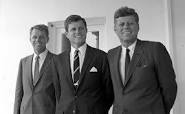


On Friday’s 50th anniversary of President John F. Kennedy’s assassination, it’s only natural to dwell on how the tragedy affected the nation. But while we remember and pay tribute to the charismatic 35th President half a century later, it is also relevant to assess the Kennedy legacy and look forward.
The Kennedy family has shaped the politics, news and minds of America. Their power and allure continues with the new generation of Kennedys. JFK’s grandchildren, great nieces and great nephews are making names for themselves in a variety of fields. Read on to learn more about the most recent members of the Kennedy family tree, and why you should expect to see their names in the news.

Relation to JFK: Jack is the youngest child of JFK’s daughter, Caroline Kennedy, and her husband, Edwin Schlossberg.Claim to Fame: Twenty-year-old Schlossberg has recently received attention for his resemblance to his late uncle John F. Kennedy Jr. JFK’s only grandson graduated from the Collegiate School New York as valedictorian and is currently attending Yale. He also made news as an eighth-grader for co-founding ReLight New York, a project which raised money to provide affordable lighting for low-income housing

Relation to JFK: Joe is one of the twin sons born to Sheila Rauch and Joe Kennedy II, who is the son of JFK’s brother Robert F. Kennedy.Claim to Fame: This Kennedy is the first politician of the sixth generation. Following in the family business, Joe Kennedy III was elected to Massachusetts’ 4th congressional district in 2012, taking Congressman Barney Frank’s seat. The congressman, 33, serves on the Committee on Foreign Affairs and the Committee on Science, Space and Technology.

Relation to JFK: Patrick is the firstborn son of Arnold Schwarzenegger and Maria Shriver. Shriver is the daughter of JFK’s sister, Eunice Kennedy.Claim to Fame: While you might recognize Patrick from Arnold Schwarzenegger’s recent scandals, the 20-year-old has been working hard to make his own name. Patrick started a philanthropic clothing line known as Project360, which raises awareness about issues like Alzheimer’s disease and cancer. Shriver’s son has also done some modeling work.

Relation to JFK: Kathleen or “Kick” is the second child of Robert F. Kennedy Jr. and his first wife, Emily Black. Robert F. Kennedy Jr. is the second son of JFK’s brother Robert F. Kennedy Sr.Claim to Fame: Many assume that all Kennedys are destined to pursue politics, but “Kick” is one of the first from the family to venture into acting. The 25-year-old landed a role on The Newsroom and has taken method acting classes. “Kick” is also known for keeping it cool in New York City, frequenting pool halls and dive bars.

Conor KennedyOLIVIER DOULIERY/ABACA/STARTRAKSPHOTO
Relation to JFK: Conor Kennedy is the oldest child of Robert F. Kennedy Jr. and his second wife, Mary Richardson. Robert F. Kennedy Jr. is the second son of JFK’s brother Robert F. Kennedy Sr.Claim to Fame: Eighteen-year-old Conor soared into headlines when he was romantically linked to relationship connoisseur Taylor Swift. The pair briefly dated in 2012, splitting after a few months due to distance.

Relation to JFK: Bobby is the first son of Robert F. Kennedy Jr. and his first wife, Emily Black. Robert F. Kennedy Jr. is the second son of JFK’s brother Robert F. Kennedy Sr.
Claim to Fame: The 26-year-old descendant made news in 2011 for his directorial debut in theater. His one-act comedic play, ELEW: Live from Infinity, featured puppets enacting mythical stories about defending your musical high ground. Aside from this venture, Robert F. Kennedy’s grandson is also known for being photographed in fedoras.

Relation to JFK: Katherine is the oldest child of Arnold Schwarzenegger and Maria Shriver. Shriver is the daughter of JFK’s sister Eunice Kennedy.Claim to Fame: In 2010, at 20 years old, Katherine wrote the book Rock What You’ve Got: Secrets to Loving Your Inner and Outer Beauty from Someone Who’s Been There and Back. The book focuses on Katherine’s own struggles with her body image and provides advice for other young girls dealing with the same insecurities.
Nora Kara Kennedy: The Newborn

Relation to JFK: The second child of Patrick Kennedy II and his wife Amy. Patrick is the youngest child of JFK’s brother Sen. Ted Kennedy.Claim to Fame: Nora is currently the youngest Kennedy alive today, born only this Tuesday. We’re sure fame and fortune await.
“We should not hate but love one another.”–Bobby Kennedy

After a decades-long steady decline, murder has jumped back to center stage in many American cities. Though the overall rate across the country showed only a minor increase, in several cities it is a genuine emergency. Chicago had 762 murders in 2016, an increase of over 50 percent in one year. Baltimore had 318, off slightly from 2015 but still 50 percent more than 2014. This raises two obvious questions. What is driving the murders, and how might it be stopped?
It’s a good opportunity to read Jill Leovy’s Ghettoside, an extraordinarily good work on murder in the modern American city. It advances a deceptively simple thesis: To stop homicide, police should solve the ones that happen.
Let me address causes first. There is a very strong case that the immense crime wave of the late-middle 20th century was caused by heavy metal poisoning from leaded paint and gasoline. But there is no such obvious environmental factor this time — the increases are too fast and too localized.
Instead, though one must be cautious at this early stage, it appears to be a problem with the police, who have sharply cut back on work in many cities. A recent 60 Minutes report in Chicago detailed a near-collapse of investigative effort, and Baltimore has been struggling with police recruitment since 2015.
This is a crock. But it would also be a mistake to say that the police brutality protests led by Black Lives Matter and today’s murder problem are totally unrelated. BLM is not responsible for the murder increase, but it reflects one aspect of why the police are not doing their jobs properly.
This is where Ghettoside comes in. Leovy persuasively argues that the spectacular murder problem in the American black community is a failure of state-building. The most basic function of the state is to enforce a monopoly on violence, and the single most important task in that effort is ensuring that violent crime is punished. Murder is the king of crimes, and if the state cannot be relied upon to find and punish the culprits, then people will take matters into their own hands.
This was the case in the Appalachian backwoods years ago where rival clans would get into horrifically bloody, decades-long feuds, and it is the case in many African-American communities today. Clans and gangs are not the product of “bad culture” or other such anxious liberal notions. They are the product of the basic human desire for safety and justice manifested in an area of state weakness — indeed, they might well be considered a sort of broken, horrible proto-state.
The responsibility for murder falls to police homicide investigators. But as Leovy demonstrates, American police are not great at this task. It’s not due to a failure of talent — the detective Leovy follows, John Skaggs, is cocksure but extraordinarily effective — but due to the structure of American police departments. Homicide work is challenging, extremely resource-intensive, and not much amenable to the sort of Taylorism that is in vogue among the upper-class liberals who design policy for large cities.
Good homicide work is a craft. It requires someone with organization and discipline, a powerful work ethic, and excellent people skills. It means careful management of evidence, backed up by a trained forensic team; interviewing tens or hundreds of sources, often going back again and again and again to wheedle someone into talking; placing witnesses in protected locations to convince them to testify; and great skill in psychological manipulation to convince suspects to confess. This is poles apart from simply beating false confessions out of someone, of course; one of the most remarkable parts of the book recounts Skaggs’ coaxing a confession out of a guilty suspect with nothing but some off-putting friendly banter and a few well-chosen lies.
Modern police departments are not a friendly place for the craftsman. Department budgets are strangled in the age of austerity, and the brass are constantly possessed by faddish ideas about preventative policing like “broken windows” and “stop-and-frisk” that can be quantified down to the pencil stroke. Grueling, uncertain detective work does not have that Big Data shine, and even a moderately complicated case can rack up tremendous bills before it is remotely close to going to court, with no guarantee that it will lead to a conviction.
Skaggs and his comrades make a good living at detective work, but they struggle constantly for department resources and professional recognition — what success they have is more in spite of the department structure than because of it. Worse still, the beloved Big Data projects often involve flooding troubled areas with patrolmen who do little more than stand around and hassle people, leading to the occasional beating or killing, and creating tremendous resentment of the police.
That structural incompetence is colliding head on with a popular uprising against police brutality to create a crisis of legitimacy for American police in cities like Chicago and Baltimore, both of which had brutal, high-profile police killings. People are outraged and often refuse to cooperate with investigators, police morale is low, and more than a few cops appear to think that a huge increase in murders is just deserts for failing to respect the police. Result: a spree of murders. As Leovy emphasizes, it is precisely because police are generally apathetic about a certain class of homicides — namely, those of black men — that so many happen.
The solution is as obvious as it is difficult — reform police departments to solve murders. First, restore the reputation of police. Punish abusive cops, and drastically cut back mass harassment tactics, like stop-and-frisk, that solve nothing except soothing upper-class liberals’ neurotic need for large spreadsheets. Patrolmen and beat cops have important roles to play in investigation (and in policing generally), but “constantly jacking up tens of thousands of innocent people” is not among them.
On the other hand, make homicide detectives the crown jewel of the police — recruit the best investigators and shower them with resources and status, then demand dogged, ethical effort and solved cases. As Leovy writes, homicide work is extraordinarily compelling for someone with a talent for it. It quite literally is a foundation of American society. Given a reasonable context and proper support, the work will be done well.
Operator has suggested that shippers had a right to terminate their contracts with the project if the pipeline was not operating by a 1 January deadline

Indigenous activists are focussing on the Dakota Access pipeline’s finances before Donald Trump takes office in an effort to further strain the oil corporation and cause continuing delays that they hope could be disastrous for the project.
After the Obama administration denied the company a key permit to finish construction, Native American activists warned that the win was only temporaryand that Trump, an investor in the pipeline corporation, would seek to quickly advance the project next year.
The firm wrote in a filing this year that the pipeline “committed to complete, test and have DAPL in service” by the start of 2017. And if the company did not meet its contract deadline, then its shipping partners had a “right to terminate their commitments”.
In asking a judge to speedily green-light the $3.8bn project, vice-president Joey Mahmoud claimed that the loss of shippers could “effectively result in project cancellation”, leading advocates and analysts to declare that a missed January deadline could be financially disastrous for ETP and a huge feat for Standing Rock.
But in emails to the Guardian, DAPL spokeswoman Vicki Granado claimed that January was just an “initial target” and not a “contractual date”, which is “much later”, though she refused to say when.
Her statement, which contradicts the company’s official court testimony on multiple occasions, has prompted accusations that the corporation has either committed perjury or is lying to reporters. (Granado claimed that the court filing didn’t explicitly say that 1 January was a contract deadline even though the language strongly suggested it was.)
Shippers contacted by the Guardian either did not respond to inquiries or declined to comment on the terms of their contracts with Energy Transfer.
“If DAPL is not available as scheduled, we will continue to use our current transportation methods,” said John Roper, spokesman for Hess Corporation, one of the shippers. A representative of Phillips 66 said it remained a “committed shipper on these pipelines systems” but did not elaborate.
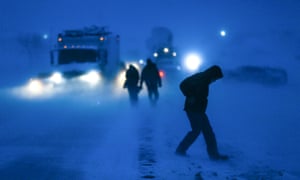
Regardless of the significance of the January date, opponents of the project argued that the continuing suspension of the project is already having a big impact on the ETP’s bottom line.
“A couple of months delay for a project like this is significant,” said Cathy Kunkel, energy analyst for the Institute for Energy Economics and Financial Analysis (Ieefa) and co-author of a recent report that scrutinized DAPL’s funding.
The corporation claimed in court that each month of delay cost the company $4.5m and that a failure to launch on time would lead to losses of $913m in 2017.
While some activists have continued to camp near the construction site in very harsh winter conditions, others have been organizing successful “defund DAPL” campaigns.
“There’s been increasing concern by the entities that are financing this enterprise, some of which actually care about indigenous people and some of whom care about how they appear to care about indigenous people,” said Jan Hasselman, attorney for the tribe.
In November, the largest bank in Norway, DNB, announced that it had sold its assets in DAPL, while Odin Fund Management, a major Norwegian fund manager, sold $23.8m worth of shares invested in the companies behind the pipeline. Earlier this month, the Swedish bank Nordea said it would not back the pipeline if the corporation violated the demands of the Standing Rock tribe.
Tim Donaghy, senior research specialist with Greenpeace, which has petitioned banks to abandon DAPL, noted that reports of extreme police violence against Native Americans have further fuelled the divestment efforts. “No bank wants to be associated with a project that’s violating human rights.”
The financial challenges for Energy Transfer come at a time when the company is already in a precarious economic situation due to broader industry trends, analysts said.
Global oil prices began to collapse in 2014 after shippers committed to DAPL, and production in the Bakken Shale oil field has fallen, which has created major hardships for drillers, according to the recent Ieefa report.
That means the existing pipeline infrastructure may be adequate to handle regional oil production, and that if the contract deadline does expire, shippers could be eager to pull out or renegotiate favorable terms.
“They’ve locked themselves into a long-term commitment in the midst of a steep and what appears now to be a sustained decline in oil production from the region,” said Clark Williams-Derry, director of energy finance at the Sightline Institute, who has analyzed the pipeline’s finances and who co-authored the report. “If I were a shipper, I would be very concerned.”
Dallas Goldtooth, organizer with the Indigenous Environmental Network, who has been a leader on the ground at Standing Rock, said a permanent cancellation of the project could have long-term implications for the industry.
“They are trying to ram these projects into the ground as quickly as possible with no concern about the risk,” he said, adding: “I hope this sucker sinks Energy Transfer.”
LaDonna Brave Bull Allard, a Standing Rock tribe member who owns land where one of the main camps remains in place, said the DAPL corporation was “panicking” about its finances and misleading the public.
The company should not be trusted, she said, noting that the construction site was being monitored to ensure that DAPL workers do not start drilling under the Missouri river, which provides the tribe’s water supply.
“We are preparing because we know we have a fight on our hands. We will be standing our ground no matter what.”
While we were celebrating the dropping of the ball in Times Square on New Year’s Eve and ringing in 2017, the protesters were still at Standing Rock. The ones that were home by that time were trying to get their lives and homes organized once again. They had walked away from their lives, jobs, classes, homes, and social obligations to go to Standing Rock; to take a stand for their beliefs and against big business and the federal government. This is very admirable for people we have spent years trying to ignore because of the crimes we had committed against them.
Would you have the strength to keep fighting after centuries of oppression and genocide?
Do you have the strength to put aside your privilege and stand by them? Reblog this and keep posting other supportive blogs and articles — help them get the word out.
Both the US and Germany have committed horrific racist atrocities in the past. But Americans learn about their own cruelties differently than Germans do, writes Megan Carpentier
In America, we learn that Hitler and the Nazis committed the Holocaust; in Germany, German children learn that they all participated in it, because the Germans came to believe that acknowledging their collective culpability as individuals was the only way to prevent it from ever happening again.
Americans, meanwhile, continue to debate whether the Civil War was fought to preserve the institution of slavery, as stated by actual Confederates at the time, or to settle a far more abstract and nebulous quarrel over the less morally indefensible concept of “states rights.” History isn’t always written by the victors, especially if there’s a version that makes everyone feel a little less guilty.
Obviously, this is to some extent simplifying the cultural and political differences between the US and Germany. (For one, Germany hasn’t wholly avoided the rise of right-wing extremism since the Nazis.)
But as Carpentier explains in her piece, America tends to take individualistic views of its history, focusing on heroes like George Washington or Abraham Lincoln and villains like Adolf Hitler. Germany has instead made a conscious effort to look at its role during World War II not through individuals but through a collective view — hence the focus not on how Hitler himself went wrong, but on how the nation that supported him and the Nazis did.
The impact of these distinct approaches sticks with us today. Germany still atones for World War II in its schools. Americans learn of slavery and other racist acts as largely the mistakes of their individual ancestors, and sometimes even refuse to admit what the mistakes were at all.
Just last year, there was a big debate about the Confederate flag after the Charleston church shooting, in which a gunman — who donned the flag and describes himself as a white supremacist — shot and killed nine black parishioners.
The flag is a racist symbol of a racist institution that defended slavery, based on the direct admissions of the Confederate states at the time. But some Americans refuse to see the flag in this way, terrified of what that would say about ancestors who once supported the Confederate cause. So there was a national conversation about the issue, mostly focused on if the flag should come down at the South Carolina Capitol.
It seemed ridiculous to be having this debate 150 years after the Civil War, but that’s emblematic of how much of the country has never truly atoned for America’s racist past.
The result is that we repeat the mistake of enabling systemic racism over and over again. After slavery, there were Jim Crow laws that enforced segregation and stripped black Americans of their voting rights. After Jim Crow, we still have mass incarceration, aggressive policing tactics, new waves of voting restrictions, and redlining and other forms of residential segregation, all of which have hurt black Americans much more than their white counterparts.
And all the while, many Americans deny that any of this is part of a deeper collective story of systemic racism. So we never fully learn our lesson.

We are now securely into January. I slept with the window open last night and I love it! It was 60 degrees here today. However, winter still has short days and longer nights and curling up with a good read is a wonderful alternative to sitting glassy eyed in front of the TV. I found the list and wanted to share it as an alternative. I also would like to add a book suggestion of my own. The Dalai Lama and Desmond Tutu have a collaboration out and it is called simply: The Book of Joy. It inspirational and humorous. I believe it is a perfect read for 2017. Let me know if you read it.
Namaste
Barbara
11 Inspirational Books to Read This Winter
Well, we’re officially past the winter solstice, which means that technically the days are only going to get longer from here on out. But despite that, the distant memories of spring and summer are still fading as quickly as the daylight. If you’re feeling unmotivated, lethargic, depressed or just … *loud exhale full of ennui* … here are some books you can read that may help.
Neil Pasricha’s The Happiness Equation
Pasricha’s best-known work is The Book of Awesome, but The Happiness Equation takes a more philosophical approach to the pursuit of happiness instead of … just listing things.
Matt Haig’s Reasons to Stay Alive
An in-depth exploration of Haig’s battle with depression, if you need a pick-me-up on a very fundamental level, you could do a lot worse than this book.
Felicia Day’s You’re Never Weird on the Internet (Almost)
Day’s cloistered upbringing and variety of interests eventually congealed into her career as one of the earliest YouTube stars. If the pressures of social media have you feeling distinctly less social, take a lesson from Day and glean solace from your uniqueness, not shame.
Jennifer Niven’s All the Bright Places
Want a good ugly cry? Think you’re too good for YA? Pick up All the Bright Places.
Cristina Henríquez’s The Book of Unknown Americans
If for no other reason than to gain a little perspective.
Terry Tempest Williams’ When Women Were Birds
After all the gender-related ugliness of the 2016 election, When Women Were Birds should be required reading.
Malala Yousafzai’s I Am Malala
A young girl shot in the head turned international hero. A testimony to the power of the human spirit.
Fredrik Bachman’s A Man Called Ove
Sometimes you’re the elderly curmudgeon at the heart of this story, and sometimes you’re the neighbors who run over his mailbox.
This one’s also filed under “Riveting true story that will make you reconsider your station in life.”
If you need a good shot in the arm to jump-start 2017, Rob Bell’s got it for you.
It’s a classic for a reason. It’s about writing, sure, but it’s also about addiction, relationships and the idea of a craft, period, told by one of the defining authors of our generation.


This story is one I read in 6th grade. It profoundly moved me and I never forgot it. It is interesting to me that I found it here. Wishing you a happy New Year. Barbara

At this time of year, I think of The Little Match Girl fairy tale by Hans Christian Andersen. “It was terribly cold. It had snowed that day and it was almost dark”, begins the story of The Little Match Girl who carried with her a little box of matches to sell, but no passerby had stopped to give her even a penny as she walked along, hoping for someone to buy her matches for a penny, but no one even glanced her way.
The Little Match Girl was so terribly cold and her thin little body ached with the cold. She had no coat or shoes. Her old hand-me-down sweater was soaked through from the snow that had fallen earlier in the day. She shivered uncontrollably as the snow started falling again. She saw a place between two houses where she could sit down and look across the street.
There…
View original post 232 more words
Merry Christmas and a Happy New Year to you Ina and to Croatia. I wish you the best. Hugs, Barbara

 President of Croatia
Kolinda Grabar-Kitarovic
Photo: http://www.predsjednica.hr
Were I to put together Christmas messages and wishes from Croatia’s President Kolinda Grabar-Kitarovic, from Prime Minister Andrej Plenkovic and from State Secretary head of government’s office for Croats living abroad Zvonko Milas, I would end up with a mangled and aloof heap of teasers, tinsels and tassels I couldn’t possibly reuse on next year’s Christmas tree. However, not all Christmas public mood was lost on teasers, tinsel and tassels – General Zeljko Glasnovic, Member of Croatian Parliament representing the diaspora or Croats living abroad did pass on a sobering, sensible and solemn Christmas message that suggests that he, at least, has ditched (or has not owned a pair ever) the rose-coloured glasses one often finds on Croatian politicians these days and replaced them with 20/20 vision.
“The Year of Mercy that has recently ended gave us an incentive to provide lasting…
View original post 1,270 more words
Three people are in custody Monday awaiting formal charges after two Dakota Access pipeline protesters rappelled from the roof of the U.S. Bank Stadium in Minneapolis to hang a banner during the Minnesota Vikings‘ season finale against the Chicago Bears.
The game was not interrupted by the protest Sunday, but eight rows of fans seated below the banner were cleared as a precaution. The Vikings beat the Bears 38-10.
The banner urged Minneapolis-based U.S. Bank to divest from the four-state, $3.8 billion pipeline. Opponents contend the pipeline could affect drinking water and Native American artifacts. Texas-based developer Energy Transfer Partners says the pipeline will be safe.
Minneapolis police spokesman Officer Corey Schmidt said a 32-year-old man and 26-year-old woman were arrested Sunday on misdemeanor burglary and trespass charges for the high-flying stunt.
Police also arrested a 27-year-old woman at the stadium Sunday whom they accused of obstructing the legal process. Schmidt said Monday that accusations against the woman have been upgraded to include burglary. He declined to discuss her alleged role in the incident, citing the ongoing investigation.
He said a complaint with formal charges is expected to be filed Tuesday.
The Hennepin County Jail roster shows all three suspects still in custody on Monday.
Minnesota’s burglary law includes entering a building without consent and with the intent to commit a crime. Schmidt said the manner in which the suspects got inside the stadium was part of the ongoing probe.
The protesters rappelled into place during the second quarter, and hung in a seated position about 100 feet above the seats that were evacuated for safety. The pair watched the rest of the game, occasionally shifting positions or waving at spectators. One wore a purple Brett Favre Vikings jersey.
U.S. Bank Stadium operator SMG said in a statement that they apparently climbed over a guard rail to access the ridge truss. Police spoke with them from a catwalk in attempt to get them to stop, and by the fourth quarter about a half-dozen police and firefighters in rappelling gear were on the truss waiting to remove the pair.
The protesters willingly climbed up their ropes when the game ended, as fans booed them from below.
Vikings spokesman Lester Bagley said the team’s only concern was for the “safety of our fans and guests.”
Protesters say U.S. Bank has extended a large credit line to Energy Transfer Partners. U.S. Bank spokesman Dana Ripley declined comment.
The pipeline would carry oil from western North Dakota through South Dakota and Iowa to a shipping point in Illinois. Protesters camped in North Dakota for months to try to stop completion of the project.
———
Associated Press reporters Blake Nicholson in Bismarck, North Dakota, and Jeff Baenen in Minneapolis contributed to this report.
I am following up with news about the native people. A protest was conducted and three protesters were arrested. They are still in custody. The US Bank, according to protesters explained that US Bank made a large credit line available to Energy Transfer Partners. This is the company that is attempting to build the North Dakota Pipeline.
My personal opinion is that putting the banner up at the game was non-violent and creative. They are trying to call attention to the part US Bank is playing in this whole tragedy. I am still in support of the water protectors and the native people protesting to save their sacred land.
I will continue to bring you news of the native people as it develops. To me they are American heroes.
I am starting the New Year with photographs of the American capital, Washington, D.C. I have always thought Washington to be a beautiful city. I have been there many times for marches, art exhibits, and for treks through the government agencies. The FBI, the US Mint, the Ford Theatre — where Lincoln was assassinated — were some of them. I wanted to begin 2017 with a bit of beauty and a feeling for our Capital City before the upcoming change of government. I hope you enjoy Washington.
Namaste,
Barbara
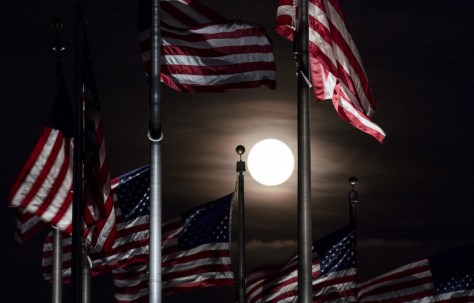
The full moon rises above the flags at the Washington Monument on Monday, June 20. June’s full moon, also known as the Strawberry Moon, coincided with the summer solstice for the first time since the Summer of Love in 1967.
Getty

The U.S. Capitol dome can be seen behind piles of snow removed from parking areas and walkways around the Capitol grounds on January 26. The Washington area was resuming partial business on Tuesday as trains and buses restarted near-normal service, while federal offices remained closed following the massive blizzard that hammered the U.S. East Coast.
REUTERS
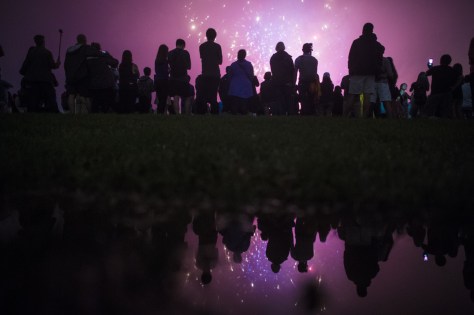
Patrons, reflected in a rain puddle, watch near the Washington Monument as the Independence Day fireworks go off on the National Mall on Monday, July 04.
Getty
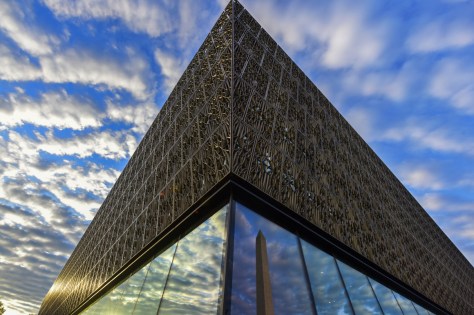
The Smithsonian Institute’s National Museum of African American History and Culture, NMAAHC, sits near the Washington Monument on Tuesday, August 9. The Museum would open to the public on September 24 in a ceremony attended by President Obama and many other dignitaries.
Getty
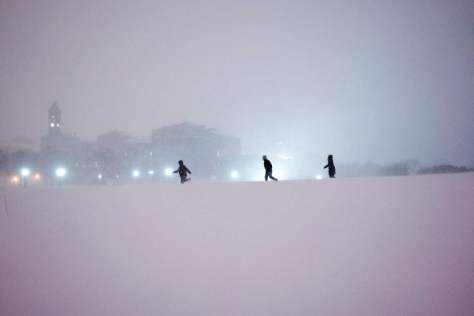
Children play in the snow on the National Mall after a snowstorm on January 23.
Getty
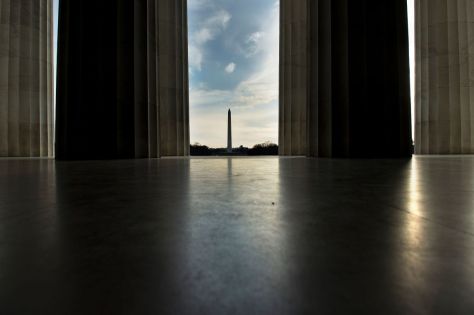
The Washington Monument is seen from the Lincoln Memorial on February 12. When it was completed in 1884, the Washington Monument was the tallest structure in the world, and it remains the tallest structure in Washington, D.C.
Getty
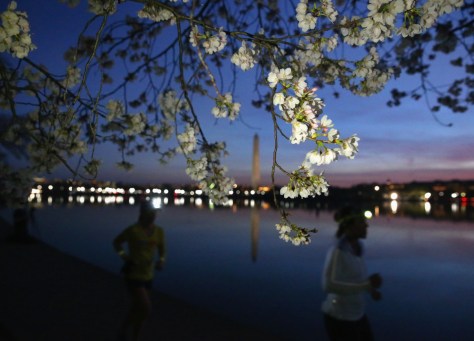
Joggers run past blooming cherry blossoms that surround the Tidal Basin on March 24. The National Park Service had predicted that the cherry blossom trees would reach peak bloom later that day.
Getty

Construction Manager Shane Gallagher leads members of the media on a tour of the rebuilt cast-iron dome of the U.S. Capitol, which was formally completed on Tuesday, November 15, on time for the inauguration of President-elect Donald Trump.
REUTERS
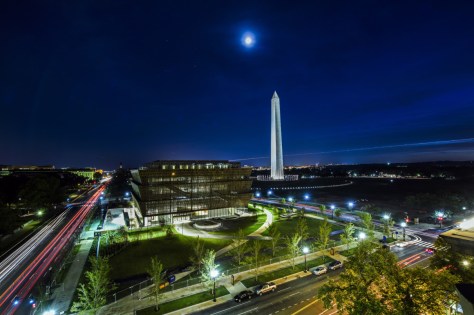
From the top of the Department of Commerce building looking south across Constitution Avenue NW, the NMAAHC sits between 14th Street, left, and 15th Street, right, near the Washington Monument.
Getty
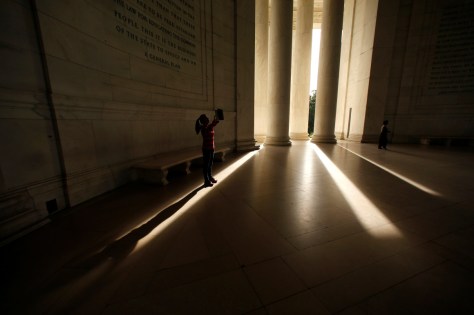
A visitor to the Jefferson Memorial casts a long shadow as she holds up her tablet to take a photo on October 12.
REUTERS
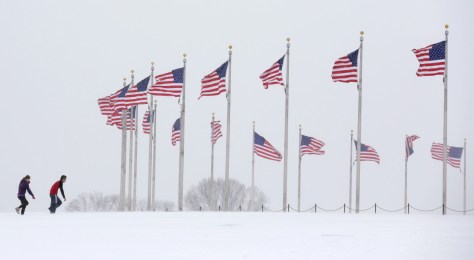
People frolic in the snow near the Washington Monument during a winter storm on January 23. A deadly blizzard blanketed the eastern United States in near-record amounts of snow, shutting down New York and Washington in a colossal storm expected to affect more than 85 million people. More than 4,400 flights were cancelled as the mega-storm brought airports in New York, Philadelphia, Washington and Baltimore to a halt, shuttered transport in the US capital and prompted New York officials to issue a sweeping travel ban.
REUTERS
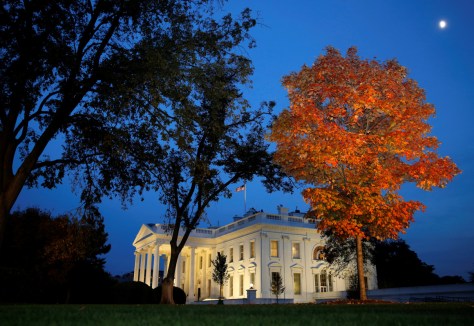
A tree is awash in autumn color as the moon rises over the White House on election night, November 08.
REUTERS
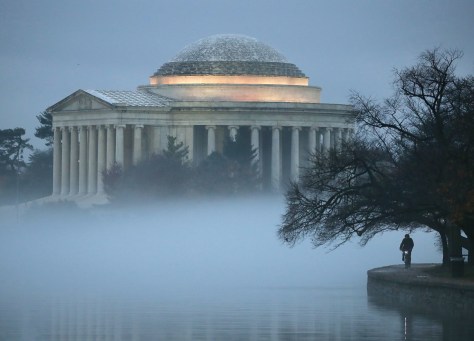
The Jefferson Memorial is surrounded in fog as a man rides a bicycle along the Tidal Basin, on November 30.
Getty
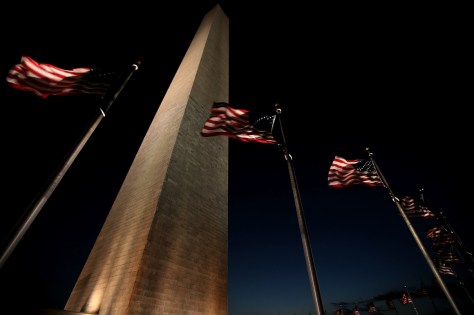
The Washington Monument stands at the National Mall on December 02. The National Park Service announced that day that the monument will remain closed until 2019 for updating the elevator system in the structure.
Getty

People look at a Christmas tree at CityCenterDC in downtown Washington on December 04.
Getty
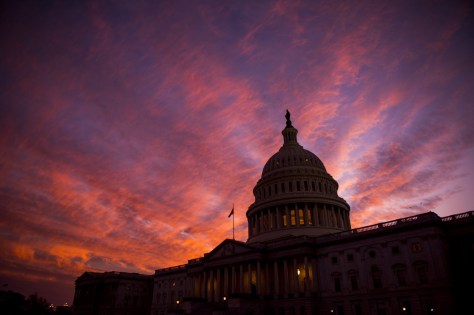
The sun sets at the U.S. Capitol as the 114th session of Congress comes to a close on Thursday, December 08. The House passed a spending bill to fund the government through April before heading home for the holiday recess.
Getty
Mensen maken de samenleving en nemen daarin een positie in. Deze website geeft toegang tot een diversiteit aan artikelen die gaan over 'samenleven', belicht vanuit verschillende perspectieven. De artikelen hebben gemeen dat er gezocht wordt naar wat 'mensen bindt, in plaats van wat hen scheidt'.
Enhance your photos with professional precision using our top-notch photo editing services
Observations about my life and the world around me.
The Middle Miocene Play of Color
We didn’t end when we said goodbye maybe because the promise was ETERNITY
Wanderers in the world
The news. The dog. Dialectics.
Husband from Utah, Wife from Hong Kong, Two Mix Babies
Walter Singleton's blog, dedicated to Aiden Singleton and Seth Singleton living near Chattanooga, TN.
Mentor and Writing assistance for women
Peace and Pain
SurveyStud: https://appsto.re/us/Ddj18.i
Speak out, judge righteously, defend the rights of the poor and the needy
A MODERN PERSPECTIVE ON COGNITIVE SCIENCE AND MENTAL HEALTH
welcome!

 idealisticrebel