
The link above will take you to a video that will discuss the girls still missing. If you are not aware, approximately two years ago, a terrorist group called Boko Haram, took girls from the…
Monthly Archives: April 2016
We Have Not Forgotten Our Missing Girls
http://www.nbcnews.com/widget/video-embed/667033155784
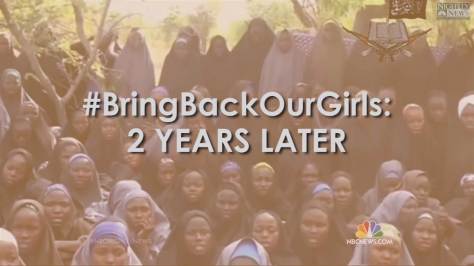
The link above will take you to a video that will discuss the girls still missing. If you are not aware, approximately two years ago, a terrorist group called Boko Haram, took girls from their schools. Why girls? Because this terrorist group does not want females to be educated. They want them as wives for their soldiers and they want to sell them into slavery or human trafficking. Some girls were able to escape but the majority are under the watchful eye of Boko Haram.
On Congresswoman Fredericka Wilson’s website a clock counted down the days, hours, seconds and minutes since terrorists tore through the village of Chibok, Nigeria and ripped 200 schoolgirls from their community in a violent rampage that shocked the world.
Thursday marked two years to the day.
And, just as the social media hashtag #BringBackOurGirls, galvanized a global community — including First Lady Michelle Obama — to raise their voices in a collective outcry against such brutality, Wilson, a Florida Democrat is hoping to harness the power of social media to address “the security and humanitarian crisis in the region.” She is hosting a ‘Twitterstorm” on Thursday to refocus attention on the horrors the terrorist group has continued to inflict on West Africa and the plight of the missing schoolgirls.
“Social media is a powerful tool. It has the ability to reach millions of people,” Wilson told NBC News. “After we began the #BringBackOurGirls campaign, the world started to take notice.”
Wilson, a former teacher and school principal, plans to Tweet until every girl is found.
And she urges everyone to “Tweet prayers, pictures of remembrance, blessings for the families and words of consolation” to commemorate the anniversary for the girls’ abduction.
Women in Congress have been especially vocal on behalf of the missing girls.
Just before Mother’s Day in 2014, every female lawmaker in Congress signed letters to President Barack Obama urging his administration to push the U.N. Security Council to add Boko Haram to an al Qaeda Sanctions List. The list was aimed at requiring members to freeze the assets of anyone affiliated with Boko Haram and prevent them from crossing their borders.
The U.N. Security Council added Boko Haram to the list later that month.
This week the State Department reiterated its support for the safe return of all those taken by Boko Haram, a terrorist organization with ties to ISIS, which has kidnapped and killed thousands of people in Nigerian territories and neighboring countries for more than seven years. The Obama administration has offered support through intelligence gathering, financial assistance and psychological aid to Nigeria in its efforts to push back against the terrorist group and help victims recover.
“Unfortunately there have been thousands of people kidnapped in Nigeria,” White House press secretary Josh Earnest said on Thursday adding that the Nigerian government is ultimately responsible for the effort to find the girls.
Organizations, such as Amnesty International, say more could be done.
“We have tried to push the Obama administration to press for genuine, transparent reform within the Nigerian military when it considers providing security assistance and we have also worked with other NGOs and members of congress to make sure that the situation is not brushed (aside) and forgotten,” Adotei Akwei, managing director of government relations at Amnesty International USA told NBC News.
The U.N. High Commissioner for Refugees recently announced that over the last few months more than 135,000 people from Cameroon, Chad and Niger have fled to escape Boko Haram.
More than 2.5 million have been forced from their homes.
One million children have been forced from school causing 2,000 schools to close.
As many as 20,000 people have been killed, 2,000 of which were killed in January’s massacre in the city of Baga.
This week relatives of some of the abducted Chibok schoolgirls gathered in Abuja to watch a recently released proof-of-life video that appeared to show 15 of the students. The bittersweet moment was made all the more so, parents told members of the media, because they have not been reunited with their children.
In the U.S., a chorus of congressional women have continued to raise their voices against Boko Haram’s atrocities.
Over the past two years, female lawmakers and their male counterparts have taken to the floor to speak about the kidnapping and remind those listening of the perils of the rise of terrorist group. Wilson is hoping that lawmakers will make one-minute speeches each week and help support appropriations to help the female victims of Boko Haram.
Many of the women in Congress have also worn red on Wednesdays to remind the world that the girls are still missing.
And several of the lawmakers, including Wilson, Rep. Sheila Jackson Lee, D-Texas, Rep. Lois Frankel, D-Florida and were joined by Rep. Steve Stockman, R-Texas in meeting with some of the Chibok schoolgirls who escaped.
About 50 girls managed to escape soon after they were abducted. More than 200 remain missing.
Related: Boko Haram’s Use of Child ‘Suicide’ Bombers Skyrocketed Last Year: U.N.
The tales of the survivors of Boko Haram attacks are chilling.
“Boko Haram captured a village in Northern Nigera and killed the mother and father of a young boy and girl. Later, the insurgents debated on whether or not to kill the boy. After speculating that the young boy would follow in his father’s footsteps and become a Christian pastor, the insurgents decided to kill the boy,” Wilson said. “
The little girl was tied on top of the bodies of her family and left for dead. She was rescued three days later.
Wilson says she will continue to press the United States and Nigerian governments to work together to help end these atrocities.
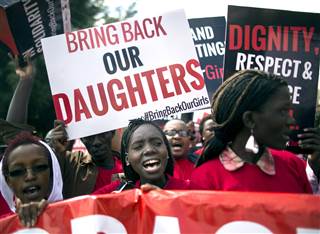
Kenyan activists shout slogans during a demonstration to protest against kidnapping of Nigerian school girls by Nigeria’s Islamist militant group Boko Haram, in Nairobi, Kenya, on May 15. DAI KUROKAWA / EPA file
Though the Nigerian government claims it has nearly defeated Boko Haram attacks continue — especially on vulnerable communities.
“It represents the world’s failure to stand up to terrorism and stand for our civilization,” said Emmanuel Ogebe, an international human rights lawyer that works with the escaped schoolgirls.
Combat operations and intelligence efforts must continue to pressure these groups, said Malcolm Nance, executive director of Terror Asymmetrics Project on Strategy, Tactics and Radical Ideologies, a think tank in Hudson, New York.
Once captured, the women are exploited sexually and face mental abuse. There have also been reports that some of the kidnapped women and girls have been used in suicide attacks.
“These women are victims of gang rape and humiliation, then told that they can only redeem themselves in god’s eyes through “martyrdom” via suicide bombing,” Nance said.
Nance said the mass abductions in Chibok and other places in the region are a critical recruiting strategy to attract young men.
“(Boko Haram) promises women and children to their fighters in exchange for their willingness to attack and mass murder their own people,” Nance said.
In his work at the Education Must Continue Initiative, a organization that works to help victimized children in northeastern Nigeria, Ogebe has witnessed depression and Stockholm Syndrome among the young victims.
“Some women abused by terrorists in the faux marriages have shown sympathy towards them after their rescue by the (Nigerian) army,” he said.
At one relief camp, the rescued women were unfriendly to relief teams that brought them supplies. The military found out they were still in contact with their captors and were moved to an undisclosed location, Ogebe said.
Still, there are glimmers of progress.
Ogebe said his organization helped a teen named Dela, one of the recovered Chibok schoolgirls, begin college. After a series of delays from funding to the snow blizzard this past winter, she will continue the education she was stolen from after 660 days in captivity, he said.
Stories like that reinforce for Wilson why it’s important to remember what happened.
“We must never forget what happened to the girls along with Boko Haram’s other victims,” she said.
© 2016 NBCNEWS.COM
2 Years After #BringBackOurGirls, Boko Haram Is Still Attacking Schools
Since 2009, Boko Haram has destroyed over 900 schools and forced at least 1,500 to close.
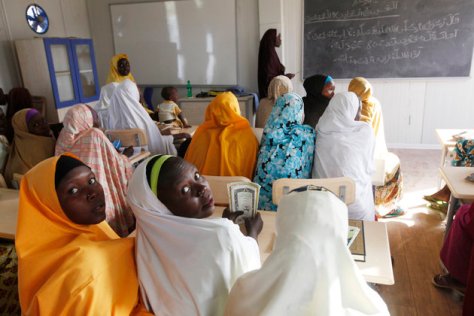
In this photo taken Monday, Dec. 7, 2015, children displaced by Boko Haram during an attack on their villages receive lectures in a camp in Maiduguri, Nigeria. Attacks by Islamic extremist group Boko Haram in northeastern Nigeria and neighboring countries have forced more than 1 million children out of school, heightening the risk they will be abused, abducted or recruited by armed groups, the United Nations children’s agency said Tuesday, Dec. 22, 2015. (AP Photo/ Sunday Alamba)
Today marks two years since Boko Haram abducted more than 270 girls from a school in northeast Nigeria. Since then, millions more children have been affected by the conflict — most notably by being kept out of school.
Boko Haram’s violence has caused nearly one million children in Northeast Nigeria alone to have little or no access to education, according to a new Human Rights Watch (HRW) report. Since 2009, the militant group has been attacking schools, teachers and students, terrorizing the local education system.
“We didn’t know what was going on, we just felt the blast,” said Hassan, a 14-year-old boy who was injured in a suicide attack on his school, in a video from HRW. “I tried to stand up and fell because my leg was no more.”
Hassan’s legs were injured when a Boko Haram suicide bomber blew himself up during his school assembly, according to the video. The young boy was unable to attend school for more than a year, because he didn’t have a wheelchair.
Boko Haram’s attacks have destroyed more than 900 schools and forced at least 1,500 more to close since 2009, according to the HRW report. The attacks are aimed at what the militants call “Western” education, or non-Quranic schools.
More than 600 teachers have been killed and another 19,000 forced to flee. The group has abducted more than 2,000 people, including many students.
“In its brutal crusade against western-style education, Boko Haram is robbing an entire generation of children in northeast Nigeria of their education,” said Mausi Segun, a Nigeria researcher in an HRW article. “The government should urgently provide appropriate schooling for all children affected by the conflict.”

PIUS UTOMI EKPEI VIA GETTY IMAGES
The militants aren’t the only ones placing schools at risk: Nigerian government security forces who are fighting them have also used schools for military purposes, according to HRW, placing the institutions at heightened risk of attack.
“It is up to both sides to immediately stop the attacks on education,” Segun said in the HRW article, “and end the cycle of poverty and underachievement to which far too many children in the region are being sentenced.”
The conflict has reached beyond Nigeria’s borders to also dramatically affect the education systems in Cameroon, Chad and Niger, which were already fragile, according to a Unicef report.

– VIA GETTY IMAGES
Most people remember the abduction of over 270 schoolgirls from Chibok, Nigeria on April 14, 2014, after which people worldwide took to Twitter demanding their return with #BringBackOurGirls.
What many don’t know is that since then, at least 1.3 million children, have been displaced by Boko Haram’s violence across four countries, according to Unicef. It is one of the fastest growing displacement crises in Africa.
Since the notorious abductions in 2014, the group’s violence has only increased. Thousands more children have disappeared, with little international attention paid to it. In 2015 alone, the number of suicide attacks rose from 32 to 151, the report said, including an alarming rise in suicide attacks by children.
In order to address the humanitarian crisis, Unicef has scaled up its operations in the region, but due to insufficient funding and difficult access from insecurity,thousands of children have still not been able to receive the assistance they need.
“The challenge we face is to keep children safe without interrupting their schooling,” said Manuel Fontaine, a Unicef director, in a statement in December. “Schools have been targets of attack, so children are scared to go back to the classroom; yet the longer they stay out of school, the greater the risks of being abused, abducted and recruited by armed groups.”

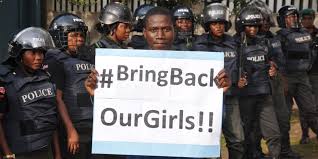
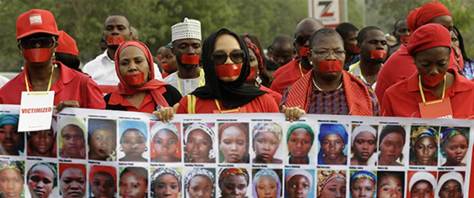
A young man demonstrates for the return of the girls. We must all use our voices. These young women and girls are voiceless!
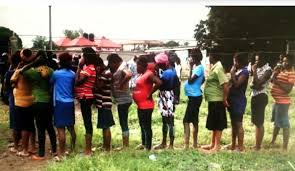
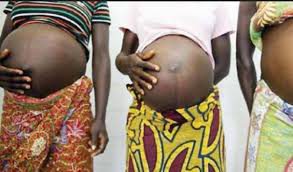
Girls kidnapped from their school are now suffering from forced marriages, rape and unwanted pregnancy. And let us not forget some of them are being human trafficked.
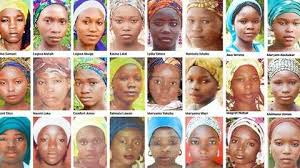
Pictures of the original girls who were stolen from their school. Please notice how young many of them are.
Nigerian families continue to grieve and demand that their daughters be returned. The problem is that the ones that are impregnated when they return are ostracised.
Truth
Releasing water from China’s dams ‘won’t wash away mistrust’ over Mekong
The Chinese government is showing no compassion or empathy here. Hugs, Barbara
Rock and Roll
I wanted to share a few glimpses of The Duran Duran show Saturday night. Please bear in mind that I had to use my phone camera. So the photographs are not stellar. On a couple, please notice the si…
Source: Rock and Roll
Rock and Roll
I wanted to share a few glimpses of The Duran Duran show Saturday night. Please bear in mind that I had to use my phone camera. So the photographs are not stellar. On a couple, please notice the silhouette of Simon LeBon just to the right off stage.
It was a beautiful evening and we were at an outdoor pavilion and they played all my favorites and then some. The opening act was Chic. Of the three original members, two have passed from Cancer. Nile Rodgers, the guitarist, is a cancer survivor and writes songs not only for Chic but also for other performers. He also sang on stage with Duran for a few tunes.
For those of you who do not know, Simon LeBon is the singer of Duran, Roger Taylor is the drummer, Nick Rhodes is keyboards and John Taylor plays bass. This is the original band and Dom Brown now plays guitar since Andy Taylor quit the band again.

The opening band Chic. Photographed and copyright by Barbara Mattio, 2016

Duran playing their song Rio. Photograph and copyright by Barbara Mattio, 2016

Roger Taylor on the big screen. Photograph and copyright by Barbara Mattio, 2016

Duran performing A View to a Kill. It was the theme song for an James Bond movie. Photograph and copyright by Barbara Mattio, 2016

Confetti being dropped during set. It was very fun. Photograph and copyright by Barbara Mattio, 2016

Friends enthralled. Photograph and copyright by Barbara Mattio, 2016

Completely packed with fans. Photograph and copyright by Barbara Mattio, 2016

Duran performing Pressure Off. Photograph and copyright by Barbara Mattio, 2016

It was a packed house. Photograph and copyright by Barbara Mattio, 2016

Simon in silhouette stage right. Photograph and copyright by Barbara Mattio, 2016
Update
My sister, friends and I are going to Charlotte for the weekend. We are going to the Duran Duran concert. I will try to blog when I get home Sunday evening, but if I am too tired please forgive me and I will be back Monday. Have a safe and happy weekend everyone.
Harmony, peace, love and rock and roll
The Rebel

I wish you all blue skies and gentle breezes. Photograph and copyright by Barbara Mattio, 2013
Playing for Change
This year’s sixth annual Playing For Change Day is September 24, 2016.
Here’s some of what happened in 2012, as musicians around the world Played to make the world a better place.
Sing along, dance along, hum along, work for change!
Namaste,
Barbara
Medical Experiments
While medical research is a legitimate activity of scientists, even today, there are ethical and moral limitations and considerations that MUST be addressed. Medical research has been done in the …
Source: Medical Experiments
Medical Experiments
While medical research is a legitimate activity of scientists, even today, there are ethical and moral limitations and considerations that MUST be addressed. Medical research has been done in the past, by more than one country, illegally and immorally upon its citizens. In America, it was the syphilis testing on blacks; and studies involving convicts and college students.
There is good reason for the limitations and ethics surrounding medical research. Not every scientist who conducts medical research truly has the best interests of humankind — and certainly not of his subjects — at heart. Often, such so-called researchers are looking to make an indelible name for themselves in the scientific community, regardless of the cost.
Perhaps the worst experimentation done on human beings was headed by Dr. Josef Mengele at the concentration camps in World War II. Jews, Gypsies, Poles, Russians, the disabled, the very young and very old — any “undesirables” — were all experimented on, and the majority of these helpless human subjects died.
As I have said more than once: This may NEVER happen again.
In order for us to be sure these atrocities are never repeated, we need to know what happened before. It is my duty to tell you what I know of what happened to these people; these human beings; these helpless internees.

http://www.mengele.dk/children/experimentsmed.swf
|
|||||||||||||||||||||||||||||||||||||||||||||||||||||||||
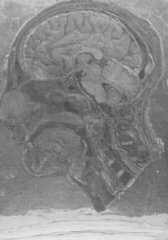
- Result of a medical experiment on a prisoner. Buchenwald concentration camp, Germany, date uncertain.Photograph
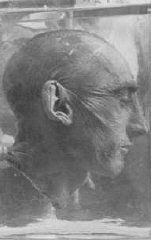 A victim of Nazi medical experiments. Buchenwald concentration camp, Germany, date uncertain.Photograph
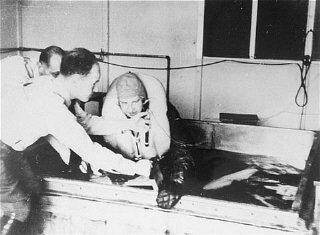 A victim of a Nazi medical experiment is immersed in icy water at the Dachau concentration camp. SS doctor Sigmund Rascher oversees the experiment. Germany, 1942.Photograph
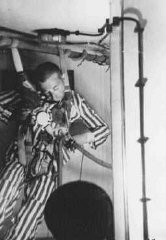 A prisoner in a compression chamber loses consciousness (and later dies) during an experiment to determine altitudes at which aircraft crews could survive without oxygen. Dachau, Germany, 1942.Photograph
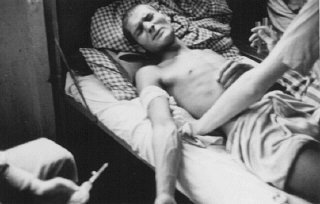 A Romani (Gypsy) victim of Nazi medical experiments to make seawater potable. Dachau concentration camp, Germany, 1944.Photograph
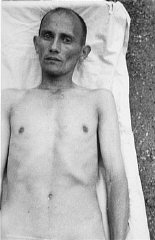 A Romani (Gypsy) victim of Nazi medical experiments to make seawater potable. Dachau concentration camp, Germany, 1944.Photograph
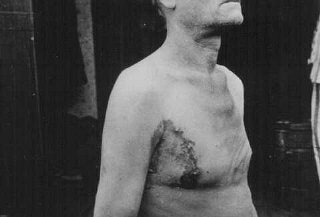 A Soviet prisoner of war, victim of a tuberculosis medical experiment at Neuengamme concentration camp. Germany, late 1944.Photograph
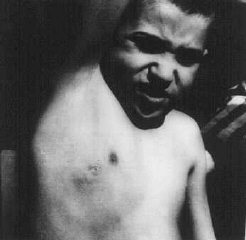 A Jewish child is forced to show the scar left after SS physicians removed his lymph nodes. This child was one of 20 Jewish children injected with tuberculosis germs as part of a medical experiment. All were murdered on April 20, 1945. Neuengamme concentration camp, Germany, between December 1944 and February 1945.Photograph
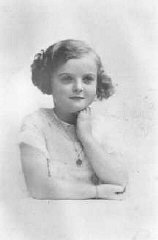 Seven-year-old Jacqueline Morgenstern, later a victim of tuberculosis medical experiments at the Neuengamme concentration camp. She was murdered just before the liberation of the camp. Paris, France, 1940.Photograph
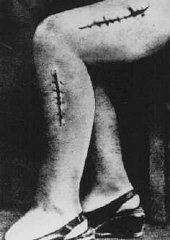 A war crimes investigation photo of the disfigured leg of a survivor from Ravensbrueck, Polish political prisoner Helena Hegier (Rafalska), who was subjected to medical experiments in 1942. This photograph was entered as evidence for the prosecution at the Medical Trial in Nuremberg. The disfiguring scars resulted from incisions made by medical personnel that were purposely infected with bacteria, dirt, and slivers of glass.Photograph
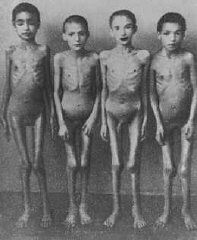 Victims of Dr. Josef Mengele’s medical experiments at Auschwitz-Birkenau. Poland, 1944.Photograph
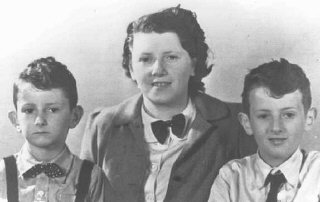 Eduard, Elisabeth, and Alexander Hornemann. The boys, victims of tuberculosis medical experiments at Neuengamme concentration camp, were murdered shortly before liberation. Elisabeth died of typhus in Auschwitz. The Netherlands, prewar.Photograph
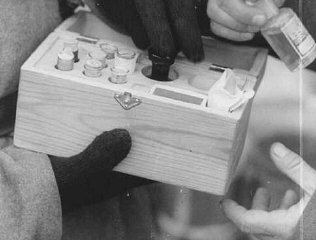 Soviet soldiers inspect a box containing poison used in medical experiments. Auschwitz, Poland, after January 27, 1945.Photograph
 United Nations personnel vaccinate an 11-year-old concentration camp survivor who was a victim of medical experiments at the Auschwitz camp. Bergen-Belsen displaced persons camp, Germany, May 1946.Photograph
 Four Polish women arrive at the Nuremberg train station to serve as prosecution witnesses at the Doctors Trial. From left to right are Jadwiga Dzido, Maria Broel-Plater, Maria Kusmierczuk, and Wladislawa Karolewska. December 15, 1946.Photograph
 Josef Mengele, German physician and SS captain. In 1943, he was named SS garrison physician (Standortartz) of Auschwitz. In that capacity, he was responsible for the differentiation and selection of those fit to work and those destined for gassing. Mengele also carried out human experiments on camp inmates, especially twins. Place and date uncertain.Photograph
 Nazi physician Carl Clauberg, who performed medical experiments on prisoners in Block 10 of the Auschwitz camp. Place and date uncertain.Photograph
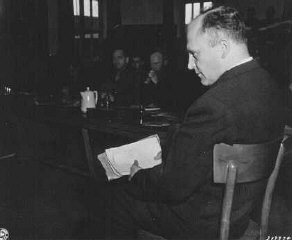 Friedrich Hoffman, holding a stack of death records, testifies about the murder of 324 Catholic priests who were exposed to malaria during Nazi medical experiments at Dachau concentration camp. Dachau, Germany, November 22, 1945.Photograph
 Wladislava Karolewska, a victim of medical experiments at the Ravensbrueck camp, was one of four Polish women who appeared as prosecution witnesses at the Doctors Trial. Nuremberg, Germany, December 22, 1946.Photograph
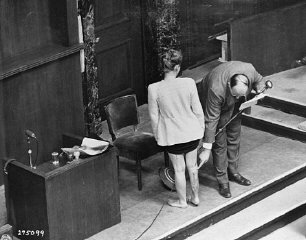 Concentration camp survivor Jadwiga Dzido shows her scarred leg to the Nuremberg court, while an expert medical witness explains the nature of the procedures inflicted on her in the Ravensbrück concentration camp on November 22, 1942. The experiments, including injections of highly potent bacteria, were performed by defendants Herta Oberheuser and Fritz Ernst Fischer. December 20, 1946.Photograph
 Waldemar Hoven, head SS doctor at the Buchenwald concentration camp, during his trial before an American military tribunal. Hoven conducted medical experiments on prisoners. Nuremberg, Germany, June 23, 1947.Photograph
 Herta Oberhauser, who was a physician at the Ravenbrueck concentration camp, is sentenced at the Doctors Trial in Nuremberg. Oberhauser was found guilty of performing medical experiments on camp inmates and was sentenced to 20 years in prison. Nuremberg, Germany, August 20, 1947.Photograph
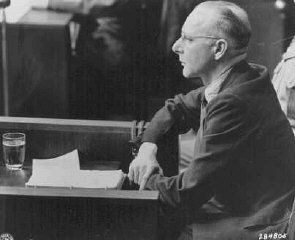 Victor Brack, one of the Nazi doctors on trial for having conducted medical experiments on concentration camp prisoners. Nuremberg, Germany, August 1947.Photograph
 idealisticrebel