Pair Accused Of Offering Bogus Leases For Apartments, Bilking Victims Out Of $60,000


Here in America, we consider ourselves the Land of the Free; but for Women and Blacks and many other minorities, that’s not always been the case.
As I have before, I am sharing with you today the words of sages past, wonderful American poets who put things in perspective far better than I can. All selections and bios are taken from 101 Great American Poems, published by The American Poetry & Literacy Project.
I hope you enjoy them, and that they make you think, as they make me think, about how much better we need to do — and can do with a bit of effort.

If ever two were one, then surely we.
If ever man were loved by wife, then thee.
If ever wife was happy in a man,
Compare with me, ye women, if you can.
I prize thy love more than whole mines of gold,
Or all the riches that the East doth hold.
My love is such that rivers cannot quench,
Nor ought but love from thee give recompense.
They love is such I can no way repay;
The heavens reward thee manifold I pray
Then while we live, in love let’s so persevere
That when we live no more, we may live ever
–Anne Bradstreet (1612?-1672) – America’s first published poet, the wife and daughter of governors of the Massachusetts Bay Colony and mother of eight.
Make me a grave where’er you will,
In a lowly plain, or a lofty hill,
Make it among earth’s humblest graves,
But not in land where men are slaves.
I could not rest if around my grave
I heard the steps of a trembling slave:
His shadow above my silent tomb
Would make it a place of fearful gloom.
I could not rest if I heard the tread
Of a coffle gang to the shambles led,
And the mother’s shriek of wild despair
Rise like a cures on the trembling air.
I could not sleep if I saw the lash
Drinking her blood at each fearful gash,
And I saw her babes torn from her breast,
Like trembling doves from their parent nest.
I’d shudder and start if I heard the bay
Of blood-hounds seizing their human prey;,
And I heard the captive plead in vain
As they bound afresh his galling chain.
If I saw young girls from their mother’s arms
Bartered and sold for their youthful charms,
My eye would flash with mournful flame,
My death-paled cheek grow red with shame.
I would sleep, dear friends, where bloated might
Can rob no man of his dearest right;
My rest shall be calm in any grave
Where none can call his brother as slave.
I ask no monument, proud and high,
To arrest the gaze of passers-by;
All that my yearning spirit craves,
Is bury me not in a land of slaves
–Frances E.W. Harper (1825-1911); Frances Harper used her writing as a vehicle for advocating racial equality (she was herself the daughter of freed slaves) and women’s rights.
Laugh, and the world laughst with you;
weep, and you weep alone.
For the sad old earth must borrow its mirth,
but has trouble enough of its own.
Sing, and the hills will answer,
Sigh, it is lost on the air.
The echoes bound to a joyful sound
But shrink from voicing care.
Rejoice, and men will seek you;
Grieve , and they turn and go.
They want full measure of all your pleasure,
But they do not need your woe.
Be glad, and your friends are many;
Be sad, and you lose them all.
There are none to decline your nectared wine,
But alone you must drink life’s gall.
Feast, and your halls are crowded
Fast, and the world goes by.
Succeed and give, and it helps you live,
But no man can help you die.
There is room in the halls of pleasure
For a long and lordly train,
But one by one we must all file on
Through the narrow aisles of pain.
–Ella Wheeler Wilcox (1850-1919); Her sentimental and passionate verse was published in newspapers and magazines throughout America, garnering a readership almost unequaled in her time.
Peace flows into me
As the tide to the pool by the shore;
It is mine forevermore,
It will not ebb like the sea
I am the pool of blue
That worships the vivid sky
My hopes were heaven-high,
The all fulfilled in you.
I am the pool of gold
When sunset burns and dies —
You are my deepening skies;
Give me your stars to hold.
–Sara Teasdale (1884-1933). Teasdale won the Pulitzer Prize for poetry in 1918.
I, too, sing America
I am the darker brother.
They send me to eat in the kitchen
When company comes,
But I laugh,
And eat well,
And grow strong.
Tomorrow,
I’ll be at the table
When company comes
Nobody’ll dare
Say to me,
“Eat in the kitchen,”
Then.
Besides,
They’ll see how beautiful I am
and be ashamed —
I, too, am America
–Langston Hughes (1902-1967) Hughes was drawn to New York by its role as the crucible of black cultural activity. The work he produced there — including poetry that wedded traditional poetic forms to jazz and the blues — won him the sobriquet “the band of Harlem.”
I’ve been scarred and battered
My hopes the wind done scattered
Snow has friz me, sun has baked me.
Looks like between ’em
They done tried to make me
Stop laughin’, stop lovin’, stop livin’ —
But I don’t care
I’m still here!
–Langston Hughes (1902-1967)

Black Mountain, NC Photographed and Copyrighted by Barbara Mattio 2012

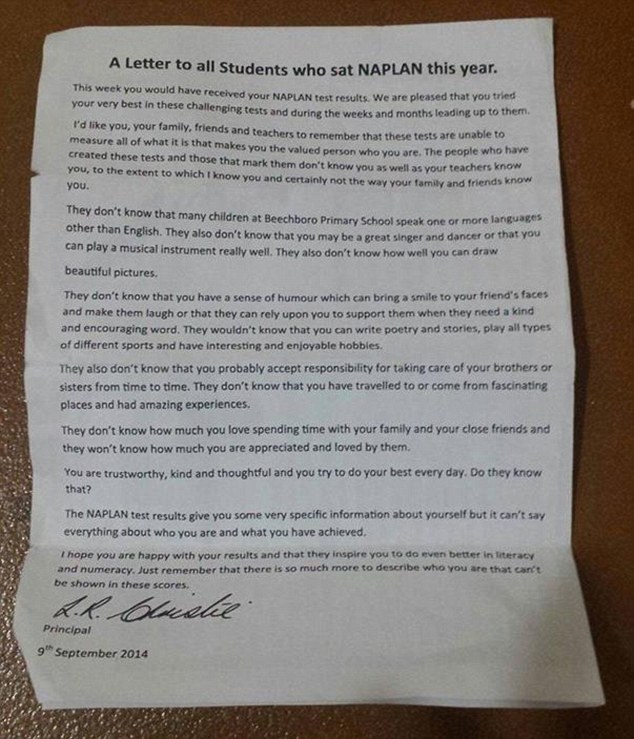
A Letter to all Students who sat NAPLAN this year
This week you would have received your NAPLAN test results. We are pleased that you tried your very best in these challenging tests and during the weeks and months leading up to them.
I’d like you, your family, friends and teachers to remember that these tests are unable to measure all of what it is that makes you the valued person who you are. The people who have created these tests and those that mark…
View original post 407 more words


It’s trending on Twitter, the elevator punch seen across the world. You know the one !Ray Rice the former Baltimore Raven’s running back, knocks his then fiance’, Janay out cold. This happened on camera at an Atlantic City Casino in an elevator. Preceding this altercation, the vile Ray spits on his then fiance’, also caught on camera. After Ray knocks Janay out in the elevator he’s seen dragging her unconscious body from the elevator to the lobby.
Janay and ass wipe Ray were both arrested. When all is said and done, Janay marries Ray, a few month’s later. Ray enters a diversionary program, and if he is a good boy and completes it, this little incident of him almost killing his fiance’ is erased from the good ole’ boys record books. For those of you wondering how could she marry this piece of shit that just knocked her ass out…
View original post 846 more words
Mensen maken de samenleving en nemen daarin een positie in. Deze website geeft toegang tot een diversiteit aan artikelen die gaan over 'samenleven', belicht vanuit verschillende perspectieven. De artikelen hebben gemeen dat er gezocht wordt naar wat 'mensen bindt, in plaats van wat hen scheidt'.
Enhance your photos with professional precision using our top-notch photo editing services
🍀 “Be careful of what you know. That’s where your troubles begin” 🌷 Wade in The 3 Body Problem ~ Cixin Liu
Observations about my life and the world around me.
The Middle Miocene Play of Color
We didn’t end when we said goodbye maybe because the promise was ETERNITY
Wanderers in the world
The news. The dog. Dialectics.
Husband from Utah, Wife from Hong Kong, Two Mix Babies
Walter Singleton's blog, dedicated to Aiden Singleton and Seth Singleton living near Chattanooga, TN.
Mentor and Writing assistance for women
Peace and Pain
SurveyStud: https://appsto.re/us/Ddj18.i
Speak out, judge righteously, defend the rights of the poor and the needy
A MODERN PERSPECTIVE ON COGNITIVE SCIENCE AND MENTAL HEALTH
welcome!

 idealisticrebel