1. SOFT TARGETS
On April 12, 1982, Yuri Andropov, the chairman of the K.G.B., ordered foreign-intelligence operatives to carry out “active measures”—aktivniye meropriyatiya—against the reëlection campaign of President Ronald Reagan. Unlike classic espionage, which involves the collection of foreign secrets, active measures aim at influencing events—at undermining a rival power with forgeries, front groups, and countless other techniques honed during the Cold War. The Soviet leadership considered Reagan an implacable militarist. According to extensive notes made by Vasili Mitrokhin, a high-ranking K.G.B. officer and archivist who later defected to Great Britain, Soviet intelligence tried to infiltrate the headquarters of the Republican and Democratic National Committees, popularize the slogan “Reagan Means War!,” and discredit the President as a corrupt servant of the military-industrial complex. The effort had no evident effect. Reagan won forty-nine of fifty states.
Active measures were used by both sides throughout the Cold War. In the nineteen-sixties, Soviet intelligence officers spread a rumor that the U.S. government was involved in the assassination of Martin Luther King, Jr. In the eighties, they spread the rumor that American intelligence had “created” the aids virus, at Fort Detrick, Maryland. They regularly lent support to leftist parties and insurgencies. The C.I.A., for its part, worked to overthrow regimes in Iran, Cuba, Haiti, Brazil, Chile, and Panama. It used cash payments, propaganda, and sometimes violent measures to sway elections away from leftist parties in Italy, Guatemala, Indonesia, South Vietnam, and Nicaragua. After the collapse of the Soviet Union, in the early nineties, the C.I.A. asked Russia to abandon active measures to spread disinformation that could harm the U.S. Russia promised to do so. But when Sergey Tretyakov, the station chief for Russian intelligence in New York, defected, in 2000, he revealed that Moscow’s active measures had never subsided. “Nothing has changed,” he wrote, in 2008. “Russia is doing everything it can today to embarrass the U.S.”
Vladimir Putin, who is quick to accuse the West of hypocrisy, frequently points to this history. He sees a straight line from the West’s support of the anti-Moscow “color revolutions,” in Georgia, Kyrgyzstan, and Ukraine, which deposed corrupt, Soviet-era leaders, to its endorsement of the uprisings of the Arab Spring. Five years ago, he blamed Secretary of State Hillary Clinton for the anti-Kremlin protests in Moscow’s Bolotnaya Square. “She set the tone for some of our actors in the country and gave the signal,” Putin said. “They heard this and, with the support of the U.S. State Department, began active work.” (No evidence was provided for the accusation.) He considers nongovernmental agencies and civil-society groups like the National Endowment for Democracy, Human Rights Watch, Amnesty International, and the election-monitoring group Golos to be barely disguised instruments of regime change.
The U.S. officials who administer the system that Putin sees as such an existential danger to his own reject his rhetoric as “whataboutism,” a strategy of false moral equivalences. Benjamin Rhodes, a deputy national-security adviser under President Obama, is among those who reject Putin’s logic, but he said, “Putin is not entirely wrong,” adding that, in the past, “we engaged in regime change around the world. There is just enough rope for him to hang us.”*
The 2016 Presidential campaign in the United States was of keen interest to Putin. He loathed Obama, who had applied economic sanctions against Putin’s cronies after the annexation of Crimea and the invasion of eastern Ukraine. (Russian state television derided Obama as “weak,” “uncivilized,” and a “eunuch.”) Clinton, in Putin’s view, was worse—the embodiment of the liberal interventionist strain of U.S. foreign policy, more hawkish than Obama, and an obstacle to ending sanctions and reëstablishing Russian geopolitical influence. At the same time, Putin deftly flattered Trump, who was uncommonly positive in his statements about Putin’s strength and effectiveness as a leader. As early as 2007, Trump declared that Putin was “doing a great job in rebuilding the image of Russia and also rebuilding Russia period.” In 2013, before visiting Moscow for the Miss Universe pageant, Trump wondered, in a tweet, if he would meet Putin, and, “if so, will he become my new best friend?” During the Presidential campaign, Trump delighted in saying that Putin was a superior leader who had turned the Obama Administration into a “laughingstock.”
For those interested in active measures, the digital age presented opportunities far more alluring than anything available in the era of Andropov. The Democratic and Republican National Committees offered what cybersecurity experts call a large “attack surface.” Tied into politics at the highest level, they were nonetheless unprotected by the defenses afforded to sensitive government institutions. John Podesta, the chairman of Hillary Clinton’s campaign and a former chief of staff of Bill Clinton’s, had every reason to be aware of the fragile nature of modern communications. As a senior counsellor in the Obama White House, he was involved in digital policy. Yet even he had not bothered to use the most elementary sort of defense, two-step verification, for his e-mail account.
“The honest answer is that my team and I were over-reliant on the fact that we were pretty careful about what we click on,” Podesta said. In this instance, he received a phishing e-mail, ostensibly from “the Gmail team,” that urged him to “change your password immediately.” An I.T. person who was asked to verify it mistakenly replied that it was “a legitimate e-mail.”
The American political landscape also offered a particularly soft target for dezinformatsiya, false information intended to discredit the official version of events, or the very notion of reliable truth. Americans were more divided along ideological lines than at any point in two decades, according to the Pew Research Center. American trust in the mainstream media had fallen to a historic low. The fractured media environment seemed to spawn conspiracy theories about everything from Barack Obama’s place of birth (supposedly Kenya) to the origins of climate change (a Chinese hoax). Trump, in building his political identity, promoted such theories.
“Free societies are often split because people have their own views, and that’s what former Soviet and current Russian intelligence tries to take advantage of,” Oleg Kalugin, a former K.G.B. general, who has lived in the United States since 1995, said. “The goal is to deepen the splits.” Such a strategy is especially valuable when a country like Russia, which is considerably weaker than it was at the height of the Soviet era, is waging a geopolitical struggle with a stronger entity.
In early January, two weeks before the Inauguration, James Clapper, the director of national intelligence, released a declassified report concluding that Putin had ordered an influence campaign to harm Clinton’s election prospects, fortify Donald Trump’s, and “undermine public faith in the U.S. democratic process.” The declassified report provides more assertion than evidence. Intelligence officers say that this was necessary to protect their information-gathering methods.
Critics of the report have repeatedly noted that intelligence agencies, in the months before the Iraq War, endorsed faulty assessments concerning weapons of mass destruction. But the intelligence community was deeply divided over the actual extent of Iraq’s weapons development; the question of Russia’s responsibility for cyberattacks in the 2016 election has produced no such tumult. Seventeen federal intelligence agencies have agreed that Russia was responsible for the hacking.
In testimony before the Senate, Clapper described an unprecedented Russian effort to interfere in the U.S. electoral process. The operation involved hacking Democrats’ e-mails, publicizing the stolen contents through WikiLeaks, and manipulating social media to spread “fake news” and pro-Trump messages.
At first, Trump derided the scrutiny of the hacking as a “witch hunt,” and said that the attacks could have been from anyone—the Russians, the Chinese, or “somebody sitting on their bed that weighs four hundred pounds.” In the end, he grudgingly accepted the finding, but insisted that Russian interference had had “absolutely no effect on the outcome of the election.” Yevgenia Albats, the author of “The State Within a State,” a book about the K.G.B., said that Putin probably didn’t believe he could alter the results of the election, but, because of his antipathy toward Obama and Clinton, he did what he could to boost Trump’s cause and undermine America’s confidence in its political system. Putin was not interested in keeping the operation covert, Albats said. “He wanted to make it as public as possible. He wanted his presence to be known,” and to “show that, no matter what, we can enter your house and do what we want.”
2. COLD WAR 2.0
Remarkably, the Obama Administration learned of the hacking operation only in early summer—nine months after the F.B.I. first contacted the D.N.C. about the intrusion—and then was reluctant to act too strongly, for fear of being seen as partisan. Leaders of the Pentagon, the State Department, and the intelligence agencies met during the summer, but their focus was on how to safeguard state election commissions and electoral systems against a hack on Election Day.
That caution has embittered Clinton’s inner circle. “We understand the bind they were in,” one of Clinton’s senior advisers said. “But what if Barack Obama had gone to the Oval Office, or the East Room of the White House, and said, ‘I’m speaking to you tonight to inform you that the United States is under attack. The Russian government at the highest levels is trying to influence our most precious asset, our democracy, and I’m not going to let it happen.’ A large majority of Americans would have sat up and taken notice. My attitude is that we don’t have the right to lay blame for the results of this election at anybody’s feet, but, to me, it is bewildering—it is baffling—it is hard to make sense of why this was not a five-alarm fire in the White House.”
The Obama circle, which criticizes Clinton’s team for failing to lock down seemingly solid states like Wisconsin, Michigan, and Pennsylvania, insists that the White House acted appropriately. “What could we have done?” Benjamin Rhodes said. “We said they were doing it, so everybody had the basis to know that all the WikiLeaks material and the fake news were tied to Russia. There was no action we could have taken to stop the e-mails or the fake news from being propagated. . . . All we could do was expose it.”
Last September, at a G-20 summit, in China, Obama confronted Putin about the hacking, telling him to “cut it out,” and, above all, to keep away from the balloting in November, or there would be “serious consequences.” Putin neither denied nor confirmed the hacking efforts, but replied that the United States has long funded media outlets and civil-society groups that meddle in Russian affairs.
In October, as evidence of Russian meddling mounted, senior national-security officials met to consider a plan of response; proposals included releasing damaging information about Russian officials, including their bank accounts, or a cyber operation directed at Moscow. Secretary of State John Kerry was concerned that such plans might undercut diplomatic efforts to get Russia to coöperate with the West in Syria—efforts that eventually failed. In the end, security officials unanimously agreed to take a measured approach: the Administration issued a statement, on October 7th, declaring it was confident that the Russians had hacked the D.N.C. The Administration did not want to overreact in a way that could seem political and amplify Trump’s message that the vote was rigged.
The White House watched for signs that Russian intelligence was crossing what a senior national-security official called “the line between covert influence and adversely affecting the vote count”—and found no evidence that it had done so. At the time, Clinton was leading in the race, which, the official said, reinforced Obama’s decision not to respond more aggressively. “If we have a very forceful response, it actually helps delegitimize the election.”
That sense of caution continued during the transition, when Obama was intent on an orderly transfer of power. Secretary of State Kerry proposed the creation of an independent bipartisan group to investigate Russian interference in the election. It would have been modelled on the 9/11 Commission, a body consisting of five Republicans and five Democrats who interviewed more than twelve hundred people. According to two senior officials, Obama reviewed Kerry’s proposal but ultimately rejected it, in part because he was convinced that Republicans in Congress would regard it as a partisan exercise. One aide who favored the idea says, “It would have gotten the ball rolling, making it difficult for Trump to shut it down. Now it’s a lot harder to make it happen.”
During the transition, officials in the Obama Administration were hearing that Trump was somehow compromised or beholden to Russian interests. “The Russians make investments in people not knowing the exact outcome,” one senior Administration official said. “They obtain leverage on those people, too.” No conclusive evidence has yet emerged for such suspicions about Trump. Another Administration official said that, during the transfer of power, classified intelligence had shown multiple contacts between Trump associates and Russian representatives, but nothing that rose to the level of aiding or coördinating the interference with the election. “We had no clear information—that I was aware of—of collusion,” the official said. That question, however, persists, and will likely be a central focus for congressional investigators.
By Inauguration Day, January 20th, the evidence of a wide-scale Russian operation had prompted the formation of a joint task force, including the C.I.A., the F.B.I., the N.S.A., and the financial-crimes unit of the Treasury Department. Three Senate committees, including the Intelligence Committee, have launched inquiries; some Democrats worry that the Trump Administration will try to stifle these investigations. Although senators on the Intelligence Committee cannot reveal classified information, they have ways of signalling concern. Three weeks after the election, Ron Wyden, an Oregon Democrat, and six other members of the committee sent a public letter to Obama, declaring, “We believe there is additional information concerning the Russian Government and the U.S. election that should be declassified and released to the public.” At a hearing in January, Wyden pushed further. While questioning James Comey, the director of the F.B.I., Wyden cited media reports that some Trump associates had links to Russians who are close to Putin. Wyden asked if Comey would declassify information on that subject and “release it to the American people.” Comey said, “I can’t talk about it.” Wyden’s questioning had served its purpose.
Later, in an interview, Wyden said, “My increasing concern is that classification now is being used much more for political security than for national security. We wanted to get that out before a new Administration took place. I can’t remember seven senators joining a declassification request.” Asked if he suspects that there has been improper contact between the Trump campaign and Russian interests, Wyden said, “I can’t get into that”—without revealing classified information. “But what I can tell you is, I continue to believe, as I have for many months, that there is more that could be declassified.” He added, “When a foreign power interferes with American institutions, you don’t just say, ‘Oh, that’s business as usual,’ and leave it at that. There’s a historical imperative here, too.” After viewing the classified materials, Mark Warner, of Virginia, the ranking Democrat on the Senate Intelligence Committee, said of the Russia investigation, “This may very well be the most important thing I do in my public life.”
Two weeks before the Inauguration, intelligence officers briefed both Obama and Trump about a dossier of unverified allegations compiled by Christopher Steele, a former British intelligence officer. The thirty-five-page dossier, which included claims about Trump’s behavior during a 2013 trip to Moscow, had been shopped around to various media outlets by researchers opposed to Trump’s candidacy. The dossier concluded that Russia had personal and financial material on Trump that could be used as blackmail. It said that the Russians had been “cultivating, supporting, and assisting” Trump for years. According to current and former government officials, prurient details in the dossier generated skepticism among some members of the intelligence community, who, as one put it, regarded it as a “nutty” product to present to a President. But, in the weeks that followed, they confirmed some of its less explosive claims, relating to conversations with foreign nationals. “They are continuing to chase down stuff from the dossier, and, at its core, a lot of it is bearing out,” an intelligence official said. Some officials believe that one reason the Russians compiled information on Trump during his 2013 trip was that he was meeting with Russian oligarchs who might be stashing money abroad—a sign of disloyalty, in Putin’s eyes.
Trump denounced the dossier as a fake. Putin’s spokesman called it “pulp fiction.” But, before the dossier became public, Senator John McCain passed it along to the F.B.I.; later, some of his colleagues said that it should be part of an investigation of Trump. Richard Burr, a Republican from North Carolina and the chairman of the Senate Intelligence Committee, vowed to investigate “everywhere the intelligence tells us to go.”
For many national-security officials, the e-mail hacks were part of a larger, and deeply troubling, picture: Putin’s desire to damage American confidence and to undermine the Western alliances—diplomatic, financial, and military—that have shaped the postwar world.
Not long before leaving the White House, Benjamin Rhodes said that the Obama Administration was convinced that Putin had gone into an “offensive mode beyond what he sees as his sphere of influence,” setting out to encourage the “breakup” of the European Union, destabilize nato, and unnerve the object of his keenest resentment—the United States. Rhodes said, “The new phase we’re in is that the Russians have moved into an offensive posture that threatens the very international order.” Samantha Power offered a similar warning, shortly before leaving her post as United Nations Ambassador. Russia, she said, was “taking steps that are weakening the rules-based order that we have benefitted from for seven decades.”
For nearly two decades, U.S.-Russian relations have ranged between strained and miserable. Although the two countries have come to agreements on various issues, including trade and arms control, the general picture is grim. Many Russian and American policy experts no longer hesitate to use phrases like “the second Cold War.”
The level of tension has alarmed experienced hands on both sides. “What we have is a situation in which the strong leader of a relatively weak state is acting in opposition to weak leaders of relatively strong states,” General Sir Richard Shirreff, the former Deputy Supreme Allied Commander of nato, said. “And that strong leader is Putin. He is calling the shots at the moment.” Shirreff observes that nato’s withdrawal of military forces from Europe has been answered with incidents of Russian aggression, and with a sizable buildup of forces in the vicinity of the Baltic states, including an aircraft-carrier group dispatched to the North Sea, an expanded deployment of nuclear-capable Iskander-M ballistic missiles, and anti-ship missiles. The Kremlin, for its part, views the expansion of nato to Russia’s borders as itself a provocation, and points to such U.S. measures as the placement of a new ground-based missile-defense system in Deveselu, Romania.
Robert Gates, who was Secretary of Defense under both George W. Bush and Barack Obama, describes relations between Obama and Putin as having been “poisonous” and casts at least some of the blame on Obama; referring to Russia as a “regional power,” as Obama did, was “the equivalent of referring to isis as a J.V. team,” in his view. “I think the new Administration has a big challenge in front of it in terms of stopping the downward spiral in the U.S.-Russia relationship while pushing back against Putin’s aggression and general thuggery,” Gates said. “Every time nato makes a move or Russia makes a move near its border, there is a response. Where does that all stop? So there is a need to stop that downward spiral. The dilemma is how do you do that without handing Putin a victory of huge proportions?”
Some in Moscow are alarmed, too. Dmitry Trenin, a well-connected political and military analyst for the Carnegie Moscow Center, said that in early fall, before Trump’s victory, “we were on a course for a ‘kinetic’ collision in Syria.” He said that the Kremlin expected that, if Clinton won, she would take military action in Syria, perhaps establishing no-fly zones, provoking the rebels to shoot down Russian aircraft, “and getting the Russians to feel it was Afghanistan revisited.” He added, “Then my imagination just left me.”
Not in a generation has the enmity run this deep, according to Sergey Rogov, the academic director of the Institute for U.S. and Canadian Studies, in Moscow. “I spent many years in the trenches of the first Cold War, and I don’t want to die in the trenches of the second,” Rogov said. “We are back to 1983, and I don’t enjoy being thirty-four years younger in this way. It’s frightening.”
3. PUTIN’S WORLD
Putin’s resentment of the West, and his corresponding ambition to establish an anti-Western conservatism, is rooted in his experience of decline and fall—not of Communist ideology, which was never a central concern of his generation, but, rather, of Russian power and pride. Putin, who was born in 1952, grew up in Leningrad, where, during the Second World War, Nazi troops imposed a nine-hundred-day siege that starved the city. His father was badly wounded in the war. Putin joined the K.G.B. in 1975, when he was twenty-three, and was eventually sent to East Germany.
Posted in one of the grayest of the Soviet satellites, Putin entirely missed the sense of awakening and opportunity that accompanied perestroika, and experienced only the state’s growing fecklessness. At the very moment the Berlin Wall was breached, in November, 1989, he was in the basement of a Soviet diplomatic compound in Dresden feeding top-secret documents into a furnace. As crowds of Germans threatened to break into the building, officers called Moscow for assistance, but, in Putin’s words, “Moscow was silent.”
Putin returned to Russia, where the sense of post-imperial decline persisted. The West no longer feared Soviet power; Eastern and Central Europe were beyond Moscow’s control; and the fifteen republics of the Soviet Union were all going their own way. An empire shaped by Catherine the Great and Joseph Stalin was dissolving.
In Moscow, Western reporters could arrange visits to crumbling nuclear-weapons sites, once secret underground bunkers, and half-empty prison camps. The most forbidding commissars of the Soviet Union—leaders of the K.G.B., the Army, and the Communist Party—failed in an attempt to pull off a counter-revolutionary coup d’état, in August, 1991, and were locked away in a notorious prison called the Sailor’s Rest. Other high-ranking loyalists, refusing the judgment of the new order, administered justice for themselves. The head of the Ministry of Internal Affairs, knowing that he was about to be arrested, wrote a note (“I lived honestly all my life”), shot his wife, shoved the barrel of a revolver into his mouth, and pulled the trigger.
For Westerners caught up in post-Cold War triumphalism, it was easier to take note of the new liberties than of the new anxieties, which were profound for millions of Russians. The fall of the imperial state meant the loss of two million square miles of territory, a parcel larger than India. Tens of millions of ethnic Russians now found themselves “abroad.” Amid newfound freedoms of expression, travel, religion, and association, there was also a palpable sense of disorientation, humiliation, and drift.
In speeches and interviews, Putin rarely mentions any sense of liberation after the fall of Communism and the Soviet Union; he recalls the nineteen-nineties as a period of unremitting chaos, in which Western partners tried to force their advantages, demanding that Russia swallow everything from the eastward expansion of nato to the invasion of its Slavic allies in the former Yugoslavia. This is a common narrative, but it ignores some stubborn facts. The West welcomed Russia into the G-8 economic alliance. The violence in the Balkans was the worst in Europe since the end of the Second World War and without intervention would likely have dragged on. And Russian security concerns were hardly the only issue at stake with respect to the expansion of nato; Poland, Czechoslovakia, and other countries in the region were now sovereign and wanted protection.
“It just felt to me grotesquely unfair, if that word can be used in geopolitics, that yet again the Central Europeans were going to be screwed,” Strobe Talbott, Bill Clinton’s leading adviser on Russia and the region, said. “To tell them they had to live in a security limbo because the Russians would have hurt feelings and be frightened just didn’t hold water.” Nevertheless, American politicians did worry about how reordering the economic and security arrangements of Europe would affect a fallen power and would-be partner. Clinton and his advisers were aware that reactionary political forces in Russia—the so-called “red-brown coalition” of diehard Communists and resurgent nationalists—viewed the United States as exploitative and triumphalist and hoped to gain control of the state.
In 1996, during a summit meeting in Moscow, Clinton went for an early-morning run with Talbott in the Sparrow Hills, near Moscow State University. Clinton had known Talbott since they were students at Oxford, and confided his anxiety. He did not regret the expansion of nato or the decision, at last, to battle Serbian forces in Bosnia. But he knew that he was making Yeltsin’s political life excruciatingly difficult.
“We keep telling ol’ Boris, ‘O.K., now, here’s what you’ve got to do next—here’s some more shit for your face,’ ” Clinton told Talbott as they ran. “And that makes it real hard for him, given what he’s up against and who he’s dealing with.”
Earlier that year, Yeltsin had summoned Talbott. “I don’t like it when the U.S. flaunts its superiority,” he told him. “Russia’s difficulties are only temporary, and not only because we have nuclear weapons but also because of our economy, our culture, our spiritual strength. All that amounts to a legitimate, undeniable basis for equal treatment. Russia will rise again! I repeat: Russia will rise again.”
When the 1996 election season began, Yeltsin was polling in the single digits. Much of the country held him responsible for economic measures that seemed to help only those close to Kremlin power. For millions, reform—including the “shock therapy” pushed by Western advisers and politicians—meant a collapse in basic services, hyperinflation, corruption, kleptocratic privatization, and an economic downturn as severe as the Great Depression. Most Russians blamed not the corrosion of the old system but, rather, the corruptions of the new. Demokratiya (democracy) was popularly referred to as dermokratiya (shit-ocracy). Yeltsin, benefitting from the support of both the oligarchs and the International Monetary Fund, managed to eke out a victory against his Communist opponent, but he continued to drink heavily, despite a history of heart attacks, and, in his final years in power, was often a sorry, inebriated spectacle.
On New Year’s Eve, 1999, Yeltsin appeared on national television sitting in front of a Christmas tree. Looking blocky and moribund, he said that he was resigning. “I am sorry that many of our dreams failed to come true,” he said. “I am sorry that I did not live up to the hopes of people who believed that we could, with a single effort, a single strong push, jump out of the gray, stagnant, totalitarian past and into a bright, wealthy, civilized future. I used to believe that myself.”
A man who had resisted a coup eight years earlier no longer had the endurance for office or the political imagination to advance the cause. “I have done all I could,” he said. “A new generation is coming.” With that, he appointed as his successor Vladimir Putin, a relatively obscure intelligence agent who had been accelerated through the ranks because he had proved himself disciplined, shrewd, and, above all, loyal to his bosses.
One of Putin’s first decrees was to protect Yeltsin from future prosecution. Then he set out to stabilize the country and put it on a course of traditional Russian autocracy. “As Yeltsin started to withdraw, the old system reconsolidated, and Putin finalized this regression,” Andrei Kozyrev, the foreign minister between 1990 and 1996, said. “The fundamental problem was an inability to complete the economic and political reforms, and so we slipped back into confrontation with the West and nato.”
Putin revealed his distrust for an open system almost immediately. He saw a state that had become barely functional, and he set about restoring its authority the only way he knew how: manually, and from the top. He replaced the freewheeling anarchy of Yeltsin’s rule with something more systematized, casting aside or coöpting the oligarchs of the nineteen-nineties and elevating a cast of corrupt satraps loyal to him—an arrangement that became known as Kremlin, Inc. Every aspect of the country’s political life, including the media, was brought under the “vertical of power” that he constructed. When Yeltsin held office, privately owned television stations, such as NTV, reported on the horrific war in Chechnya and even satirized Yeltsin and other Kremlin leaders on a puppet show called “Kukly.” NTV, which was owned by an oligarch named Vladimir Gusinsky, seemed to test Putin in the beginning, airing discussions about corruption and human-rights abuses; “Kukly” added a puppet depicting the new President. Putin was not amused. Within five months of taking power, he dispatched armed Interior Ministry troops to raid Gusinsky’s headquarters; by 2001, Gusinsky had been forced to give up NTV to more obedient owners and had fled the country. Ever since, television has been under strict federal control.
Putin, in his first few years in office, was relatively solicitous of the West. He was the first foreign leader to call George W. Bush after the destruction of the World Trade Center towers. When he spoke at the Bundestag, later that month, he addressed its members in German, the language that he had spoken as a K.G.B. agent in Dresden. He even entertained the notion of Russian membership in nato.
America’s invasion of Iraq, which Putin opposed, marked a change in his thinking. Bush had made some progress with him on bilateral issues such as nuclear-arms proliferation, but by 2007 Putin had grown deeply disenchanted and came to feel that the West was treating Russia as a “vassal.” Robert Gates recalls a security conference, in Munich, in 2007, at which Putin angrily charged that the United States had “overstepped its national borders in every area” and that the expansion of nato was directed against Russian interests. “People were inclined to pass it off as a one-off,” Gates said. “But it was a harbinger.”
For Putin, it was a story of misplaced hopes and rejection: he became convinced that, no matter how accommodating he might try to be, Western powers—the United States, above all—had an innate disinclination to treat Russia as a full partner and a respected member of the international order. At home, Putin was increasingly drawn to an authoritarian, nationalist conception of the Russian state. He knew that the fall of Communism and Soviet power had left a vacuum—the lack of a “national idea” to replace Marxism-Leninism. When Putin returned to the Presidency for a third term, in 2012, he felt the need to develop a Russian ideology of his own, and called on currents that run deep in Russian political culture: nationalism, xenophobia, and social conservatism. When, four years ago, Putin endorsed anti-gay legislation, for instance, he was playing to entrenched conservative prejudices that predate Soviet Communism—perhaps not for Western-oriented intellectuals and the urban middle class but for many millions of others.
Putin was hardly surprised by the liberal umbrage voiced by the Obama Administration and other Western governments. That confrontation was the point, a means of cementing his authority at home by playing up the notion of an encircled, perpetually menaced Russian state. Although Putin grew up under Soviet atheism, he nonetheless decried secular Americans and Europeans for “rejecting their roots, including the Christian values that constitute the basis of Western civilization.” His conservatism, he insisted, “prevents movement backward and downward, into chaotic darkness and a return to a primitive state.”
He was alarmed by the Obama Administration’s embrace of the uprisings in Tunisia and Egypt. And he was infuriated by the U.S.-led assault on Muammar Qaddafi’s regime. In early 2011, as Libyans challenged Qaddafi, Putin was ostensibly offstage, serving as Prime Minister; his protégé Dmitry Medvedev was President, and made a crucial decision not to veto an American-backed U.N. Security Council resolution in favor of military action in Libya. In a rare public split, Putin condemned the decision, comparing the resolution to a “medieval call to the crusades.” In October, 2011, a crowd of Libyans found Qaddafi hiding in a culvert with a gold-plated 9-mm. pistol, dragged him out, and killed him—a gruesome event that was broadcast worldwide. From Putin’s perspective, this was a case study in Western intervention: stir up protests, give them rhetorical support and diplomatic cover, and, if that doesn’t work, send in the fighter jets. The epilogue comes in the form of uncontrollable violence and an inglorious end for the country’s leader. According to Mikhail Zygar, the former editor-in-chief of the independent Internet station TV Rain and the author of “All the Kremlin’s Men,” Putin absorbed the death of Qaddafi as an object lesson: weakness and compromise were impermissible. “When he was a pariah, no one touched him,” Zygar wrote. “But as soon as he opened up he was not only overthrown but killed in the street like a mangy old cur.”
Putin also regarded the anti-Kremlin, pro-democracy demonstrations in Moscow, which started in 2011, as a rehearsal for an uprising that had to be thwarted. Together with the upheavals abroad, they compounded his grievances against the West. Obama’s national-security adviser at the time, Tom Donilon, observed that Putin’s concerns were then focussed on domestic political stability and perceived foreign threats to it. He was convinced that “there were efforts under way to undermine his regime,” Donilon said. “From the outset of his second run as President, in my judgment, he was bringing Russia to a posture of pretty active hostility toward the United States and the West.” In September, 2013, after Putin declined requests to turn over Edward Snowden, Obama cancelled a planned summit in Moscow. “The communication really broke after that,” Donilon said. He saw Putin steadily remove non-intelligence personnel from his orbit. “In sharp contrast to the Chinese situation, there’s not a Russian national-security ‘system,’ ” he said. “He works with a very small group of individuals, namely, former K.G.B. and F.S.B. people.”
Dissent has now been effectively marginalized. Opposition candidates are frequently kept off the ballot on legal technicalities, and, when they do make it on, they are denied media coverage, let alone the “administrative resources” enjoyed by pro-Kremlin politicians. Some thirty journalists have been murdered in Russia in the past decade and a half; human-rights groups that receive funding from abroad are registered in Moscow as “foreign agents.” And contemporary Russian television is not only compliant but celebratory. “Imagine you have two dozen TV channels and it is all Fox News,” Vladimir Milov, a former deputy energy minister under Putin and now a critic, said.
Yet those channels bear little resemblance to the dreary Soviet broadcasts with their stilted language and shabby production values. Just as Putin no longer fills prison camps with countless “enemies of the people,” as Stalin did, but, rather, makes a chilling example of a famous few, like the businessman Mikhail Khodorkovsky or the group Pussy Riot, his propagandists have taken their cue from foreign forms: magazine shows, shout-fests, game shows, and reality shows. There are many figures in public life who are not permitted to appear on any talk show or news program. Russians can still find independent information on Facebook and various Web sites; critical books and magazines are available in stores and online; Echo of Moscow, a liberal radio station, hangs on. But, even in the Internet era, more than eighty per cent of Russians get their news from television. Manipulation of TV coverage is a crucial factor in Putin’s extraordinarily high popularity ratings, typically in excess of eighty per cent—ratings that Donald Trump both admires and envies.
In October, 2012, on the occasion of Putin’s sixtieth birthday, Dmitry Kiselyov, the host of “News of the Week,” a favorite TV show of Putin’s, delivered a long encomium to the President: “In terms of the scope of his activities, Putin can be compared to only one of his predecessors in the twentieth century—Stalin.” NTV aired a documentary, “Visiting Putin,” that sent a broadcaster to his office and his house on the outskirts of Moscow. Although well-informed critics have said that Putin is worth tens of billions of dollars and has twenty residences at his disposal, the program portrayed him as a near-ascetic, who wakes at eight-thirty, lifts weights, swims long distances, eats a modest breakfast (beet juice, porridge, raw quail eggs), and works deep into the night.
“All these TV genres emphasize the stature of Putin, as being above everybody and everything—not just the ultimate boss but the embodiment of Russian statehood,” Masha Lipman, the editor of the journal Counterpoint, said. The most important political space is not the grounds of the Kremlin. It is the space within the President’s skull.
“A well-known person once said, ‘You can get much farther with a kind word and a Smith & Wesson than you can with just a kind word,’ ” Putin says in “President,” a long documentary that aired on state television in 2015. “Unfortunately, he was right.” Later in the documentary, the host asks Putin if he thinks that the West fears Russia, because a “once failing state” is now “suddenly a powerful political player.” He calls Putin “the leader, if I may say, of the conservative part of both European and American society.”
Putin accepts both premises. “The so-called establishment, the political and economic élites of these countries, they like us only when we are poor and standing there with a beggar’s bowl,” he says. “As soon as we start talking about our interests and they start feeling some element of geopolitical competition, well, they don’t like that.”
In February, 2014, hours after President Victor Yanukovych of Ukraine, weakened by months of protests, fled Kiev, Putin made the decision to invade Crimea. He feared that Ukraine would turn its back on Russia and gravitate toward Europe. It was a way for Putin to signal, loudly and rudely, that he was finished going along with the Western-led order. It was personal as well. Michael Morell, a former deputy director of the C.I.A., said that the fall of Yanukovych led Putin to worry about his own power and well-being. “It happened in the heart of the Slavic world, and he could not allow it to become a precedent for a similar movement in Russia against him,” Morell said. “He had to crush it.”
Putin and members of his circle also saw the Syrian civil war as an opportunity to halt a trend that had started with the invasion of Iraq and continued through the downfall of dictators in Egypt and Libya. A former senior U.S. official who has interacted with Russians said, “There was this period of time when the United States, in Putin’s view, was able to use international institutions to take on regimes that we found offensive, right through Libya, and Putin was determined to put a stake in the ground in Syria, to have Russia be at the table, and be able to resist the international community’s efforts to continue this pattern of conduct.” As Russia’s Defense Minister, Sergey Shoigu, remarked last month, Russia’s intervention in Syria “helped solve the geopolitical task of breaking the chain of ‘color revolutions.’ ” Russian television, of course, covered the siege of Aleppo as an enlightened act of liberation, free of any brutality or abuses.
In the United States, the issue of what to do about Russia was a growing point of contention between the Pentagon and the White House. Ukraine’s government wanted advanced weaponry to help battle Russian-backed rebels. Evelyn Farkas, the Pentagon’s most senior policy officer for Russia, strongly supported the request; Obama and others on his national-security team turned it down. Instead, the U.S. provided “nonlethal” aid, including vehicles, radar, and body armor. In testimony before the Senate Foreign Relations Committee, in 2014, Farkas argued for greater American force, calling Russia’s actions “an affront to the international order that we and our allies have worked to build since the end of the Cold War.”
The Administration believed, with considerable justification, that escalating the conflict would provoke retaliation from Russia, push Putin into a corner, and—since Putin would never let the rebels suffer a battlefield defeat—prove costly for Ukraine. But Farkas disagreed: “We just ignore everything the Russians do in Ukraine because, well, that’s Ukraine and the stakes are so high for Russia there. They wouldn’t risk it in the U.S.” Finally, she gave up trying to convince Obama. “I was so done,” she said. “I was so tired of fighting.” She resigned in October, 2015, and eventually became a foreign-policy adviser to Hillary Clinton, who had sometimes favored the use of military force when Obama did not. “The crazy thing was, when I joined the Clinton campaign, I was, like, Great, I’m not going to have to fight anymore, because she got it on Russia,” Farkas said. “Then it just got worse.”
4. HYBRID WAR
Putin rarely uses a computer, but he has moved his country into the digital age. Russia was once a technological laggard: the Soviets did not connect to the global Internet until 1990, and the state security services were so befuddled by the technology that, according to “The Red Web,” by Andrei Soldatov and Irina Borogan, agents demanded that Relcom, Russia’s first commercial Internet Service Provider, print out every communication that crossed its network. (Engineers rebelled, and the order was abandoned.) By 1996, however, a new generation of hackers in Russia had achieved the first state-directed penetration of America’s military network, pilfering tens of thousands of files, including military-hardware designs, maps of military installations, and troop configurations. In 2008, according to “Dark Territory,” a history of cyberwar by Fred Kaplan, Russian hackers accomplished a feat that Pentagon officials considered almost impossible: breaching a classified network that wasn’t even connected to the public Internet. Apparently, Russian spies had supplied cheap thumb drives, stocked with viruses, to retail kiosks near nato headquarters in Kabul, betting, correctly, that a U.S. serviceman or woman would buy one and insert it into a secure computer. In the past decade, cyber tactics have become an essential component of Russia’s efforts to exert influence over its neighbors.
Late one evening in the spring of 2007, President Toomas Hendrik Ilves of Estonia was at home using his laptop computer. He had trouble getting online. The news sites were down. The banks were down. Government sites were down. The President figured that it must be some kind of technical glitch. “The first reaction is not ‘We’re under attack,’ ” he said recently. But, after a few calls, he realized that someone was attacking one of Estonia’s core assets.
The birthplace of Skype and the home of other tech firms, Estonia is known in technology circles as “eStonia”; it is one of the most wired countries in the world. But Estonia was involved in a conflict with Russia over plans to move a Second World War-era statue of a Soviet soldier out of the center of Tallinn, the capital. Estonians regarded it as a symbol of occupation. The Russian government had warned publicly that moving it would be a grave offense to history and “disastrous for Estonians.”
On April 27th, the statue was moved. Almost immediately, commentators in Russian-language chat rooms posted instructions on how to become a “script kiddie,” an amateur hacker. The attackers did not need to “hack” Estonia’s sites, exactly; they simply swamped them with a “distributed denial of service”—DDoS—assault, which continued for two weeks. Investigators never pinpointed the source of the attack, but Ilves, who left the Presidency in October, 2016, believes that it was an alliance between members of the Russian government and organized crime. “I call it a public-private partnership,” he said wryly. “It was a state actor that paid mafiosos.”
Although the incident barely registered in international headlines, it was a landmark event: a state-backed cyberattack for political purposes. “What Estonia showed was that Russia was going to react in a new but aggressive way to perceived political slights,” Michael Sulmeyer, a senior Pentagon official in charge of cyber policy under Obama, said. “What was the offending act? The Estonians moved a statue.”
Russia was acquiring a reputation, in defense circles, for ambition, technical acumen, and speed. Barely a year after the Estonia attack, during a conflict with Georgia over the territory of South Ossetia, Russian tanks and planes crossed into the disputed territory at the same moment that hackers broke into fifty-four Web sites serving the government, media, and banks. They stole military information and immobilized the nation’s Internet. Georgian officers struggled to send orders to troops, and bewildered citizens had no way to find out what was happening.
The Georgia campaign was “one of the first times you’ve seen conventional ground operations married with cyber activity,” Sulmeyer said. “It showed not just an understanding that these techniques could be useful in combined ops but that the Russians were willing to do them. These guys implemented.”
And yet Russian military planners and officials in the Kremlin regarded Georgia as a failure in the realm of international propaganda. Although Russia prevailed militarily, its narrative was overshadowed by the Georgian one from the first minutes of the campaign. For Russia, the five-day conflict represented a “total defeat in the information space,” said Pavel Zolotarev, a retired major general in the Russian Army, who is now a professor at the Academy of Military Sciences. “Our television showed how the shelling started, the incursion of Georgian forces, and so on,” Zolotarev, who helped draft Russia’s national-security doctrine in the nineteen-nineties, said. “These pictures were shown in the West two days later—but as if Russia were doing the shelling, attacking Georgia.” Russian generals took this lesson to heart, and began to study how to use the media and other instruments to wage “information war,” later putting what they learned into practice in Ukraine and then Syria.
The United States, meanwhile, had its own notable cyberwar success. In 2008, in tandem with Israeli intelligence, the U.S. launched the first digital attack on another country’s critical infrastructure, deploying a “worm,” known as Stuxnet, that was designed to cause centrifuges in Iran to spin out of control and thereby delay its nuclear development.
Yet diplomatic concerns inhibited some of the United States’ active measures. The Obama Administration had a “reset” policy with Russia, forging agreements and coöperating on select issues, despite an over-all increase in tension. “Cyber was an area where we were trying to work with Russia,” Evelyn Farkas, the Pentagon official, said. “That’s the irony. We were meeting with their big spies, trying to develop some kind of arms control for cyber.”
When Robert Knake arrived as the director of cybersecurity policy at the National Security Council, in 2011, the White House had a formal initiative to combat Chinese hacking, known as the Counter-China strategy. Knake recalled, “The question was: ‘O.K., now, what’s the counter-Russia plan? And the counter-Iran plan?’ ” The difficulty was that, in the aftermath of Stuxnet, the U.S. needed Iran’s coöperation on diplomatic priorities. From 2011 to 2013, Iranian-backed hackers waged a sustained DDoS attack on dozens of American banks and financial-services companies, but the U.S. didn’t respond in kind, partly because the Administration was negotiating with Iran to curb its nuclear program. “If we had unleashed the fury in response to that DDoS attack, I don’t know if we would have gotten an Iran deal,” Knake said. In other cases, the Administration declined to respond forcefully so that it could retain the option of deploying similar means on other countries. “As long as we think we’re getting more value from this set of rules than we’re losing, then this is the set of rules we want to promote,” Knake said.
A new doctrine was taking shape, under which Russia sought to study the nefarious tools of the West, as it understood them, so as to counteract them at home and put them into practice abroad. One indication of what that might look like came in February, 2013, when, in the pages of the Military-Industrial Courier—a journal with a tiny yet influential readership of Russian military strategists—Valery Gerasimov, the Russian chief of general staff, published an article with the anodyne title “The Value of Science in Prediction.” The article identified and urged the adoption of a Western strategy that involved military, technological, media, political, and intelligence tactics that would destabilize an enemy at minimal cost. The strategy, which came to be known as “hybrid war,” was an amalgam that states have used for generations, but the text took on the status of a legend, and is now known in international military circles as the Gerasimov doctrine.
Gerasimov is sixty-one years old, and is always photographed in a stiff, forest-green military uniform and with a perpetually sagging frown. He trained as a tank commander, and then climbed the military hierarchy; he led the Fifty-eighth Army during the Second Chechen War. In the article for Military-Industrial Courier, Gerasimov suggested that, in the future, wars will be fought with a four-to-one ratio of nonmilitary to military measures. The former, he wrote, should include efforts to shape the political and social landscape of the adversary through subversion, espionage, propaganda, and cyberattacks. His essay, written in the shadow of the Arab Spring, cited the anarchy and violence that erupted in Libya and Syria as proof that, when faced with the combination of pressure and interference, a “perfectly thriving state can, in a matter of months, and even days, be transformed into an arena of fierce armed conflict, become a victim of foreign intervention, and sink into a web of chaos, humanitarian catastrophe, and civil war.”
Such events were “typical of warfare in the twenty-first century,” he wrote. “The role of nonmilitary means of achieving political and strategic goals has grown, and, in many cases, they have exceeded the power of force of weapons in their effectiveness.”
Pavel Zolotarev, the retired Russian general, explained that, when Gerasimov’s essay was published, “we had come to the conclusion, having analyzed the actions of Western countries in the post-Soviet space—first of all the United States—that manipulation in the information sphere is a very effective tool.” Previously, one had to use “grandfather-style methods: scatter leaflets, throw around some printed materials, manipulate the radio or television,” Zolotarev said. “But, all of a sudden, new means have appeared.”
Gerasimov’s prescriptions began to look prophetic a year later, when Russia annexed Crimea in a quick operation that caught U.S. officials by surprise and contravened international law. Russian-made propaganda whipped up pro-Moscow sentiment in a population that was already wary of Ukrainian political leaders in Kiev and had deep, historical ties with Russia. Unidentified soldiers (the so-called “little green men”) surrounded Ukrainian bases in Crimea, and within days Russia had pulled off a hastily organized, stage-managed referendum.
Even with the rise of new technologies, the underlying truth about such operations hasn’t changed. They are less a way to conjure up something out of nothing than to stir a pot that is already bubbling. In the U.S., a strategy like the alleged hacking of the Democrats was merely an effort to deepen an existing state of disarray and distrust. “For something to happen, many factors have to come together at once,” said Alexander Sharavin, the head of a military research institute and a member of the Academy of Military Sciences, in Moscow, where Gerasimov often speaks. “If you go to Great Britain, for example, and tell them the Queen is bad, nothing will happen, there will be no revolution, because the necessary conditions are absent—there is no existing background for this operation.” But, Sharavin said, “in America those preconditions existed.”
As tensions with Russia rose over the conflicts in Ukraine and Syria, in early 2014, the U.S. was stung by a tactic common in Moscow politics: the weaponized leak. While the U.S. and the European Union discussed the details of a potential transitional government in Ukraine, an aide to the Russian deputy prime minister tweeted a reference to part of a wiretapped conversation, posted soon afterward to YouTube, between Victoria Nuland, a U.S. Assistant Secretary of State, and her colleague Geoffrey Pyatt, the U.S. Ambassador in Ukraine. Nuland is heard saying “Fuck the E.U.”—a line that the Russians knew would cause difficulties between the Americans and their E.U. counterparts. The State Department called the leak “a new low in Russian tradecraft.” Asked what form of penalty was extracted from Russia, Michael McFaul, the Ambassador to Moscow during the Obama Administration, said, “To the best of my knowledge, there was none. I think that was a mistake.”
Obama’s adviser Benjamin Rhodes said that Russia’s aggressiveness had accelerated since the first demonstrations on Maidan Square, in Kiev. “When the history books are written, it will be said that a couple of weeks on the Maidan is where this went from being a Cold War-style competition to a much bigger deal,” he said. “Putin’s unwillingness to abide by any norms began at that point. It went from provocative to disrespectful of any international boundary.”
In the fall of 2014, a hacking group known as the Dukes entered an unclassified computer system at the U.S. State Department and gained enough control so that, as one official put it, they “owned” the system. In security circles, the Dukes—also referred to as Cozy Bear—were believed to be directed by the Russian government. Very little is known about the size and composition of Russia’s team of state cyberwarriors. In 2013, the Russian Defense Ministry announced that it was forming “scientific” and “information operations” battalions. A defense official later explained their purpose as “disrupting the information networks of the probable enemy.” Oleg Demidov, an expert on information security and cybercrime, and a consultant at the PIR-Center, a research institute in Moscow, said, “At the time, this idea was met with laughter. But this was something real, these units were indeed formed, and staffed by graduates of the country’s leading technical universities.” The next year, the Russian military expanded its public recruitment of young programmers; social-media ads for the “Research Squadron of the Russian Federation” depicted a soldier putting down a rifle and turning to a keyboard, accompanied by a heavy-metal soundtrack.
A retired K.G.B. colonel recently told the magazine Ogonyok that Russia had about a thousand people working in military and security operations online. According to a detailed report that appeared last November in the well-regarded online publication Meduza, several hundred technical specialists have left commercial firms to work for state-run cyber teams. A Defense Ministry spokesperson refused to confirm any details, telling a Meduza correspondent that the topic is secret, “so no one can see how we might apply these methods,” and warning against publication: “Don’t risk doing anything further—don’t put yourself in the crosshairs.”
After penetrating the State Department, the Dukes moved on to the unclassified computer network that serves the executive office of the President. (The network manages, for instance, details of his movements.) By February, 2015, the increasing intensity of Russian intrusions into sensitive political targets had raised alarms in Washington, and Clapper, the director of national intelligence, told a Senate hearing that the “Russian cyberthreat is more severe than we have previously assessed.”
European officials voice similar concerns. The Directorate-General for External Security, the French spy agency, is reportedly worried that Russian spies, hackers, and others are working to help Marine Le Pen, the Presidential candidate of the far-right National Front Party. Russian state media have suggested that one of her opponents, Emmanuel Macron, is a tool of American banks and has a secret gay lover. Le Pen, whose party has received loans from a Russian bank, has toed the Kremlin line on Crimea, saying that the territory was always part of Russia.
Bruno Kahl, the head of Germany’s foreign-intelligence agency, has expressed concern that Russian hackers are also trying to disrupt the German political scene, where Chancellor Angela Merkel is standing for reëlection as a stalwart supporter of nato and the E.U. Citing Russian interference in the American elections, Kahl told the newspaper Süddeutsche Zeitung, “The perpetrators are interested in delegitimizing the democratic process, as such, regardless of whom that ends up helping.” The director of Germany’s domestic-intelligence agency has since warned of “growing evidence for attempts to influence the federal election.” He told the Times that there has already been an increase in “aggressive cyberespionage” aimed at German politicians.
When the Dukes turned their attention to the Democratic National Committee, in 2015, the evident goal was to exploit divisions among Party members. In September, an F.B.I. agent called the D.N.C. and said that its computer network appeared to have been hacked. The agent was transferred to the help desk, where a tech-support contractor jotted down the information, checked Google for information on “the Dukes,” and ran a basic check for evidence of hacking. The F.B.I. agent left follow-up messages in October but never visited the office, and the D.N.C. leadership failed to mount a full-scale defense.
By March, 2016, the threat was unmistakable. Cybersecurity experts detected a second group of Russian hackers, known as Fancy Bear, who used “spear-phishing” messages to break into accounts belonging to John Podesta and other Democratic officials. Like Cozy Bear, Fancy Bear had left a trail around the globe, with its technical signature visible in cyberattacks against the German parliament, Ukrainian artillery systems, and the World Anti-Doping Agency. “I’ve never seen a group that doesn’t change its style of work after it has been detected,” Ilya Sachkov, who runs a leading cybersecurity firm in Moscow, said. “What logic led them to not adjust their methods?” Charles Carmakal, a specialist at FireEye, a cybersecurity organization that had previously studied the hacking groups implicated in the election operation, said that sophisticated hackers often leave forensic trails. “Even the best teams make mistakes, and, a lot of times, the guys who are great at hacking are not forensics guys who also know how to do investigations and understand all the artifacts that they’re leaving on a machine.”
Ultimately, the attack didn’t require an enormous amount of expertise. Gaining access to an e-mail account through spear-phishing is more akin to breaking into a car with a clothes hanger than to building a complex cyberweapon like Stuxnet. Oleg Demidov, the information-security expert, said that, from a technical perspective, the hacking was “mediocre—typical, totally standard, nothing outstanding.” The achievement, from Demidov’s perspective, was the “knowledge of what to do with this information once it had been obtained.”
On July 22nd, three days before the Democratic National Convention, WikiLeaks released nearly twenty thousand e-mails, the most damaging of which suggested that the D.N.C., though formally impartial, was trying to undermine Bernie Sanders’s campaign. In one e-mail, the D.N.C. chair, Debbie Wasserman Schultz, said of Sanders, “He isn’t going to be President.” Her resignation did little to tamp down public anger that was fuelled by the themes of secrecy, populism, and privilege—already a part of Trump’s arsenal against Clinton. Months later, Wasserman Schultz reproached the F.B.I. for not reacting more aggressively to the hacking. “How do they spend months only communicating by phone with an I.T. contractor?” she said in an interview. “How was that their protocol? Something has to change, because this isn’t the last we’ve seen of this.”
The interim chair of the D.N.C., Donna Brazile, had worked on seven Presidential campaigns, but she was unprepared for the level of anger, including death threats, directed toward D.N.C. staff and donors. “I’m from the South, and I’ve been through the traditional kind of campaigns where everybody got to call you the N-word, the B-word, or the C-word,” she said. “But this was not the usual kind of antipathy that you find in American politics. It was something else.” Someone created a fake e-mail account in her name and sent messages to a reporter at the Times. “It was psychological warfare at its best,” she said. (CNN, where Brazile had been a commentator, cut ties with her when hacked e-mails revealed that, after attending network strategy sessions, she shared potential debate questions with the Clinton campaign.)
While officials in the Obama Administration struggled with how to respond to the cyberattacks, it began to dawn on them that a torrent of “fake news” reports about Hillary Clinton was being generated in Russia and through social media—a phenomenon that was potentially far more damaging. “The Russians got much smarter since the days of rent-a-crowds and bogus leaflets,” one Obama Administration official said. “During the summer, when it really mattered, when the Russian social-media strategy was happening, we did not have the whole picture. In October, when we had it, it was too late.”
In the weeks after WikiLeaks released the D.N.C. e-mails, John Mattes, a Bernie Sanders organizer who ran a Facebook page for supporters in San Diego, noticed a surge of new adherents with false profiles. One “Oliver Mitov” had almost no friends or photographs but belonged to sixteen pro-Sanders groups. On September 25th, Mitov posted to several pro-Sanders pages: “new leak: Here Is Who Ordered Hillary To Leave The 4 Men In Benghazi!—USAPoliticsNow.” It was a baseless story alleging that Clinton had received millions of dollars from Saudi royals. Mattes said, “The fake news depressed and discouraged some percentage of Bernie voters. When I realized it, I said, ‘We are being played.’ ”
A post-election study by two economists, Matthew Gentzkow, of Stanford, and Hunt Allcott, of New York University, found that, in the final three months of the campaign, fabricated pro-Trump stories were shared four times as often as fabricated pro-Clinton stories. The researchers also found that roughly half the readers of a fake-news story believed it. A study led by Philip N. Howard, a specialist in Internet studies at Oxford University, found that, during the second debate of the general election, automated Twitter accounts, known as “bots,” generated four tweets in favor of Trump for every one in favor of Clinton, driving Trump’s messages to the top of trending topics, which mold media priorities. Internet researchers and political operatives believe that a substantial number of these bots were aligned with individuals and organizations supported, and sometimes funded, by the Kremlin.
On October 7th, WikiLeaks released the first installment of a total of fifty thousand e-mails from Podesta’s account. In the years since WikiLeaks gained prominence, in 2010, by posting secret U.S. government documents, its founder, Julian Assange, had taken refuge in the Ecuadorean Embassy in London to avoid a Swedish rape investigation that he considers a pretext for an American effort to extradite him. He has remained politically outspoken, hosting a show on Russian television for a time and later criticizing Clinton’s candidacy, writing, in February, 2016, that she “will push the United States into endless, stupid wars which spread terrorism.”
WikiLeaks put out a new batch of the e-mails nearly every day until the election. Reporters covered the contents of the messages—gossipy asides, excerpts from Hillary Clinton’s highly paid Wall Street speeches, internal discussion about Clinton’s statements on Benghazi, infighting at the Clinton Foundation over the political risks of foreign donations—and Podesta believes that the impact of individual stories was magnified by manipulation on social media. The Clinton campaign tried to shift focus from the details in the e-mails to the fact that they had been hacked. That argument was largely futile. “You don’t see the full extent at the time,” he said. “But it’s corrosive and it’s eating away underneath.”
Some Clinton aides suspect that Roger Stone, an on-again, off-again adviser to Trump, counselled WikiLeaks on the optimal timing for its disclosures. Six days before the leaks began, Stone tweeted, “@HillaryClinton is done. #Wikileaks.” Stone said that he was “flattered” by the suspicion but denied that he had given the group advice. He said that he was merely alerted to the leaks by a “mutual friend” of his and Assange’s: “And I was told that the information he had would be devastating to Hillary. I was not told the subject matter.” Stone was among those named in news reports about evidence that Trump associates had had exchanges with Russian intelligence officials. According to Stone, he has not been contacted by the F.B.I., and such suspicions are unfounded. (“If they have evidence of a crime, indict somebody,” he said. “I have not been in touch with anybody in Russia. I’ve never been to Russia. I don’t know any Russians.”)
The Clinton campaign was making plenty of tactical errors, without foreign assistance, and Trump was reaching white working-class voters far more effectively than the media recognized. But, in Podesta’s view, hacked e-mails did heavy damage to the campaign, because they revived a preëxisting liability, the unconnected story about Clinton’s use of a private e-mail server. “It shaped the Facebook newsfeed,” he said. “It kept ‘e-mails’ front and center, even at a very slow boil. There was just a dark cloud under the banner of ‘e-mails.’ ”
On Friday, October 28th, the F.B.I. director, James Comey, announced that new e-mails from Clinton had surfaced, in an unrelated case. Podesta said, “It’s not until that Friday, eleven days out, that you see a major movement of public opinion. The group in the electorate that was moving around the most was non-college-educated women. I think particularly the pushing of the fake news in the last couple of weeks was important in the places that mattered. When you lose by a total of seventy thousand votes in three states, it’s hard to say if any one thing made the difference. Everything makes a difference. I think it definitely had an impact. The interaction between all of this and the F.B.I. created a vortex that produced the result.”
5. TURBULENCE THEORY
Russia’s political hierarchy and official press greeted Trump’s Inauguration with unreserved glee. An old order had crumbled and, with it, an impediment to Putin’s ambitions. “In 1917, armed supporters of Lenin stormed the Winter Palace and arrested capitalist ministers and overthrew the social political order,” the lead article in the daily Moskovski Komsomolets read. “On January 20, 2017, nobody in Washington planned to storm Congress or the White House and hang prominent members of the old regime from lampposts, but the feeling of the American political élite, especially the liberal part of it, is not different from that of the Russian bourgeoisie one hundred years ago.”
On “News of the Week,” Dmitry Kiselyov, the host, dismissed charges that Trump was a racist as “unfounded myth,” and the new President’s sexist and predatory remarks as nothing more than a “minute’s worth of impulsivity.” Trump, Kiselyov said, “is what we call in our country a muzhik,” a real man. “On the first day of his Presidency, he removed from the official White House Web site the section protecting the rights of gays and lesbians. He never supported that. He was always behind the values of the traditional family.”
No reasonable analyst believes that Russia’s active measures in the United States and Europe have been the dominant force behind the ascent of Trump and nationalist politicians in Europe. Resentment of the effects of globalization and deindustrialization are far more important factors. But many Western Europeans do fear that the West and its postwar alliances and institutions are endangered, and that Trump, who has expressed doubts about nato and showed allegiance to Brexit and similar anti-European movements, cannot be counted on. Although both Secretary of State Rex Tillerson and Defense Secretary James Mattis have expressed support for traditional alliances, Trump remains entirely uncritical of Putin. “Trump changes the situation from a nato perspective,” General Shirreff said. “The great fear is the neutering of nato and the decoupling of America from European security. If that happens, it gives Putin all kinds of opportunities. If Trump steps back the way he seemed to as a candidate, you might not even need to do things like invade the Baltic states. You can just dominate them anyway. You’re beginning to see the collapse of institutions built to insure our security. And if that happens you will see the re-nationalizing of Europe as a whole.”
“How long will Angela Merkel hold out against Donald Trump?” Stephen Sestanovich, who was an adviser on Russia to both the Reagan and the Clinton Administrations, asked. “She is already by herself in Europe. Putin is going to look like the preëminent power in Europe.” Der Spiegel published a startling editorial recently that reflected the general dismay in Europe, and the decline of American prestige since Trump’s election. The new President, it said, is becoming “a danger to the world” that Germany must stand up in opposition to.
Strobe Talbott, the former Clinton adviser, said, “There is a very real danger not only that we are going to lose a second Cold War—or have a redo and lose—but that the loss will be largely because of a perverse pal-ship, the almost unfathomable respect that Trump has for Putin.” Talbott believes that Trump, by showing so little regard for the institutions established by the political West in the past seventy years, is putting the world in danger. Asked what the consequences of “losing” such a conflict would be, Talbott said, “The not quite apocalyptic answer is that it is going to take years and years and years to get back to where we—we the United States and we the champions of the liberal world order—were as recently as five years ago.” An even graver scenario, Talbott said, would be an “unravelling,” in which we revert to “a dog-eat-dog world with constant instability and conflict even if it doesn’t go nuclear. But, with the proliferation of nuclear powers, it is easy to see it going that way, too.”
Andrei Kozyrev, who served as foreign minister in the Yeltsin government, now lives in Washington, D.C. He left Russia as it became increasingly authoritarian; he now sees a disturbingly similar pattern in his adopted country. “I am very concerned,” he said. “My fear is that this is probably the first time in my memory that it seems we have the same kind of people on both sides—in the Kremlin and in the White House. The same people. It’s probably why they like each other. It’s not a matter of policy, but it’s that they feel that they are alike. They care less for democracy and values, and more for personal success, however that is defined.”
Although the evidence for Russia’s interference appears convincing, it is too easy to allow such an account to become the master narrative of Trump’s ascent—a way to explain the presence of a man who is so alien and discomforting to so much of the population by rendering him in some way foreign. In truth, he is a phenomenon of America’s own making.
At the same time, Trump’s management style as President has been so chaotic, so improvisational, that the daily bonfire sometimes obscures what has been put in place. “Putin likes people like Tillerson, who do business and don’t talk about human rights,” one former Russian policy adviser said. The Trump Administration, notably, said nothing when a Russian court—the courts are well within Putin’s control—found Alexei Navalny, an anti-corruption campaigner and Putin’s only serious rival in next year’s Presidential election, guilty of a fraud charge that had already been overturned once, a conviction that may keep him out of the race. The Russians see friendly faces in the Administration. Tillerson, as the chairman of ExxonMobil, did “massive deals in Russia,” as Trump has put it. He formed an especially close relationship with Igor Sechin, who is among Putin’s closest advisers, and who has made a fortune as chief executive of the state oil consortium, Rosneft. Trump’s first national-security adviser, Michael Flynn, took a forty-thousand-dollar fee from the Russian propaganda station RT to appear at one of its dinners, where he sat next to Putin.
The Obama Administration, in its final days, had retaliated against Russian hacking by expelling thirty-five Russian officials and closing two diplomatic compounds. The Kremlin promised “reciprocal” punishment, and American intelligence took the first steps in sending new officials to Moscow to replace whoever would be expelled. “People were already on planes,” a U.S. intelligence official said. But on December 30th Putin said that he would not retaliate. To understand the abrupt reversal, American intelligence scrutinized communications involving Sergey Kislyak, Russia’s Ambassador to the U.S., and discovered that Flynn had had conversations with him, which touched on the future of economic sanctions. (Jared Kushner, Trump’s son-in-law, met with Kislyak in Trump Tower during the transition; the aim, according to the White House, was to establish “a more open line of communication in the future.”) Flynn was forced to resign when news broke that he had lied to Vice-President Mike Pence about these exchanges.
Trump has given risibly inconsistent accounts of his own ties to Russia. When he was in Moscow for the Miss Universe contest in 2013, and an interviewer for MSNBC asked him about Putin, he said, “I do have a relationship and I can tell you that he’s very interested in what we’re doing here today”; at a subsequent National Press Club luncheon, he recalled, “I spoke indirectly and directly with President Putin, who could not have been nicer.” During the Presidential campaign, he said, “I never met Putin, I don’t know who Putin is.” Trump has tweeted that he has “nothing to do with Russia”; in 2008, his son Donald, Jr., said that “Russians make up a pretty disproportionate cross-section of a lot of our assets.” At a news conference on February 16th, Trump was asked, again, if anyone in his campaign had been in contact with Russia, and he said, “Nobody that I know of.” He called reports of Russian contacts “a ruse,” and said, “I have nothing to do with Russia. Haven’t made a phone call to Russia in years. Don’t speak to people from Russia.” The next day, the Senate Intelligence Committee formally advised the White House to preserve all material that might shed light on contacts with Russian representatives; any effort to obscure those contacts could qualify as a crime.
By mid-February, law-enforcement and intelligence agencies had accumulated multiple examples of contacts between Russians and Trump’s associates, according to three current and former U.S. officials. Intercepted communications among Russian intelligence figures are said to include frequent reference to Paul Manafort, Trump’s campaign chairman for several months in 2016, who had previously worked as a political consultant in Ukraine. “Whether he knew it or not, Manafort was around Russian intelligence all the time,” one of the officials said. Investigators are likely to examine Trump and a range of his associates—Manafort; Flynn; Stone; a foreign policy adviser, Carter Page; the lawyer Michael Cohen—for potential illegal or unethical entanglements with Russian government or business representatives.
“To me, the question might finally come down to this,” Celeste Wallander, President Obama’s senior adviser on Russia, said. “Will Putin expose the failings of American democracy or will he inadvertently expose the strength of American democracy?”
The working theory among intelligence officials involved in the case is that the Russian approach—including hacking, propaganda, and contacts with Trump associates—was an improvisation rather than a long-standing plan. The official said, “After the election, there were a lot of Embassy communications”—to Moscow—“saying, stunned, ‘What we do now?’ ”
Initially, members of the Russian élite celebrated Clinton’s disappearance from the scene, and the new drift toward an America First populism that would leave Russia alone. The fall of Michael Flynn and the prospect of congressional hearings, though, have tempered the enthusiasm. Fyodor Lukyanov, the editor-in-chief of a leading foreign-policy journal in Moscow, said that Trump, facing pressure from congressional investigations, the press, and the intelligence agencies, might now have to be a far more “ordinary Republican President than was initially thought.” In other words, Trump might conclude that he no longer has the political latitude to end sanctions against Moscow and accommodate Russia’s geopolitical ambitions. As a sign of the shifting mood in Moscow, the Kremlin ordered Russian television outlets to be more reserved in their coverage of the new President.
Konstantin von Eggert, a political commentator and host on Russian television, heard from a friend at a state-owned media holding that an edict had arrived that, he said, “boiled down to one phrase: no more Trump.” The implicit message, von Eggert explained, “is not that there now should be negative coverage but that there should be much less, and more balanced.” The Kremlin has apparently decided, he said, that Russian state media risked looking “overly fawning in their attitude to Trump, that all this toasting and champagne drinking made us look silly, and so let’s forget about Trump for some time, lowering expectations as necessary, and then reinvent his image according to new realities.”
Alexey Venediktov, the editor-in-chief of Echo of Moscow, and a figure with deep contacts inside the Russian political élite, said, “Trump was attractive to people in Russia’s political establishment as a disturber of the peace for their counterparts in the American political establishment.” Venediktov suggested that, for Putin and those closest to him, any support that the Russian state provided to Trump’s candidacy was a move in a long-standing rivalry with the West; in Putin’s eyes, it is Russia’s most pressing strategic concern, one that predates Trump and will outlast him. Putin’s Russia has to come up with ways to make up for its economic and geopolitical weakness; its traditional levers of influence are limited, and, were it not for a formidable nuclear arsenal, it’s unclear how important a world power it would be. “So, well then, we have to create turbulence inside America itself,” Venediktov said. “A country that is beset by turbulence closes up on itself—and Russia’s hands are freed.” ♦
*An earlier version of this passage wrongly indicated that the U.S. is known to have funded Russian political parties.
PHOTOGRAPHS: YURI SMITYUK/TASS/GETTY; SPIEGL/ULLSTEIN BILD/GETTY; MIKHAIL METZEL/TASS/GETTY; FROM LEFT TO RIGHT: VADIM GHIRDA/AP, LASKI DIFFUSION/GETTY, LEV FEDOSEYEV/TASS/GETTY, BULENT DORUK/ANADOLU AGENCY/GETTY, DREW ANGERER/GETTY, SERGEI SAVOSTYANOV/TASS/GETTY, FILIPPO MONTEFORTE/AFP/GETTY, ALEKSEY FILIPPOV/AFP/GETTY










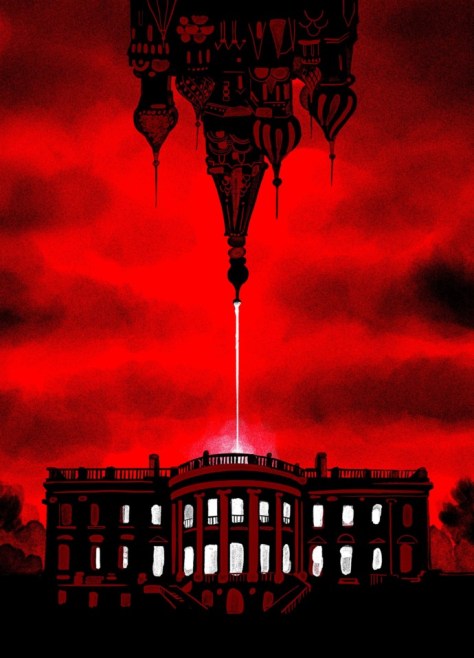
 idealisticrebel