The Sabbath of Mutual Respect


The Sabbath of Mutual Respect

Marge Piercy, Feminist author

In the natural year come two thanksgivings,

the harvest of summer and the harvest of fall,

two times when we eat and drink and remember our dead

under the golden basin of the moon of plenty


Abundance, Habondia, food for the winter,

too much now and survival later.  After

the plant bears, it dies into seed.

The blowing grasses nourish us, wheat

and corn and rye, millet and rice, oat

and barley and buckwheat, all the serviceable

grasses of the pasture that the cow grazes,

the lamb, the horse, the goat, the grasses

that quicken into meat and cheese and milk,

the humble necessary mute vegetable bees,

the armies of the grasses waving their

golden banners of ripe seed.

The sensual

round fruit that gleams with the sun

stored in its sweetness

The succulent

ephemera of the summer garden, bloodwarm

tomatoes, tender small squash, crisp

beans, the milky corn, the red peppers

exploding like cherry bombs in the mouth


We praise abundance by eating of it,

reveling in choice on a table set with roses

and lilies and phlox, zucchini and lettuce

and eggplant before the long winter

of root crops.

Fertility and choice

every row dug in spring means weeks

of labor.  Plant too much and the seedlings

choke in weeds as the warm rain soaks them.

The goddess of abundance Habondia is also

the spirit of labor and choice.

In another

life, dear sister, I too would bear six fat

children.  In another life, my sister, I too

would love another woman and raise one child

together as if that pushed from both our wombs.

In another life, sister, I too would dwell

solitary and splendid as a lighthouse on the rocks

or be born to mate for life like the faithful goose.

Praise all our choices.  Praise any woman

who chooses, and make safe her choice.


Habondia, Artemis, Cybele, Demeter, Ishtar,

Aphrodite, Au Set, Hecate, Themis, Lilith,

Thea, Gaia, Bridgit, The Great Grandmother of Us

All, Yemanja, Cerridwen, Freya, Corn Maiden,

Mawu, Amaterasu, Maires, Nut, Spider-Woman,

Neith, Au Zit, Hathor, Inanna, Shin Moo,

Diti, Arinna, Anath, Tiamat, Astoreth:

the names flesh out our histories, our choices,

our passions and what we will never embody

but pass by with respect.  When I consecrate

my body in the temple of our history,

when I pledge myself to remain empty

and clear for the voices coming through

I do not choose for you to lessen your choice.


Habondia, the real abundance, is the power

to say yes and to say no, to open

and to close, to take or to leave

and not to be taken by force or law

or fear or poverty or hunger.

To bear children or not to bear by choice

is holy.  To bear children unwanted

is to be used like a public sewer.

To be sterilized unchosen is to have

your heart cut out.  To love women

is holy and holy is the free love of men

and precious to live taking whichever comes

and precious to live unmated as a peachtree.


Praise the lives you did not choose.

They will heal you, tell your story, fight

for you.  You eat the bread of their labor.

You drink the wine of their joy.  I tell you

after I went under the surgeon’s knife

for the laparoscopy I felt like a trumpet

an Amazon was blowing sonorous charges on.

Then my womb learned to open on the full

moon with pain and my pleasure deepened

till my body shuddered like troubled water.

When my friend gave birth I held her in joy

as the child’s head thrust from her vagina

like the sun rising at dawn wet and red.


Praise our choices, sisters, for each doorway

open to us was taken by squads of fighting

women who paid years of trouble and struggle,

who paid their wombs, their sleep, their lives

that we might walk through these gates upright.

Doorways are sacred to women for we

are the doorways of life and we must choose

what comes in and what goes out.  Freedom

is our real abundance.


bjwordpressdivider


Embrace your world and make it be whatever you want.

Embrace your world and make it be whatever you want.
The Harmony & Peace Award


HarmonyPeace

I created this new award to celebrate all those who promote Harmony & Peace, and who add Love & Beauty to the world through their Blogs and through their lives.  Their Positivity makes the world a better place for all of us.

Rules:

As most of you know by now, I am not big on rules, but here they are:

  1. Give this award to seven bloggers who have added Harmony & Peace, Love & Beauty and Positivity to the world you live in.
  2. Let them know that you nominated them.
  3. Acknowledge the blogger from whom you received this award
  4. Display your award on your blog, because  you have earned it!
  5. Continue to live in Harmony & Peace

The first nominees for this award:

  1. Dr. Rex
  2. Hunt4Truth
  3. Victo Dolore
  4. Al
  5. Xena
  6. Maverick
  7. Rajagopal

The Long Term Effects of Violence


We are now living in a coarse society filled with violence, intolerance and hatred. Can we live with these influences without harm to our psyche? I think not. Must we always agree? No. Can we speak our truth? Yes.


It is important that we as individuals talk about our issues and points of disagreement. Is there damage from a violent society? Yes. I know this because there is damage left from violence in families and homes. I worked in Domestic Violence for over two score years, and counseled at Rape Crisis. I worked as a psych nurse for years. I am going to share a story of how long the effects can last.


One night, I was passing meds on my forty-two-bed lock down unit. I was in the hallway when I heard crying and indistinct words. I went into the room and both patients were in their beds and no one else was there. One woman was crying and screaming. Sobbing is more accurate. I was surprised because this woman had been in a catatonic state for many years. She never spoke.


I walked to her bed and said her name softly. She was in the middle of a dream. She was crying and saying, ” No, stop. I won’t do it.” “Don’t let them do it.” I lowered her bed rail and climbed up into her bed. I held her in my arms and crooned that she was safe and no one would hurt her now. I gently rocked as I held her and let her cry out her pain and fear. I listened carefully and was shocked at what I heard.


Slowly, she stopped crying and talking. I gently placed her back on her mattress. I was the one crying now. I wiped my tears quickly away, while putting the side rail back up. She appeared to be sleeping normally now. I could still feel the warmth of her body on my arms. Her tears were on my arms also.


I breathed deeply and finished passing meds. I was quiet and replaying her words over and over in my head. When I was done, I locked up the med cart in the med room and went back to her room where I found her sound asleep and quiet.


I returned to the nurse’s desk and pulled her chart to document the incident but first I read her social history. She had been married, not a surprise. Her husband was a long distance truck driver. According to the social workers’ notes, he had physically abused her and he had made her have sex with other men while he watched.


I felt sick. She had had a life full of violence, humiliation and sexual abuse. I was glad that I had been outside of her room when she was having the nightmare. I am glad that I had held her and comforted her because it seemed she hadn’t had much comfort in her life. Catatonic. She was at a better place than this world had been to her.


Checking dates and doing the math, these horrible experiences had happened about thirty years prior. I was sure this wasn’t the first nightmare she had had. It was just the first one I had witnessed.


Thirty years later, there was still enough painful damage to give her nightmares. To make her cry and talk. To beg not to let the men hurt her. This is an example of the damage done to a human psyche. Damage that destroyed this woman and left her very scarred.


I am sharing this story because we harm each other. We cause pain and suffering. There are long lasting effects for all of us. This is why we need to think of others. We need to create love, kindness, and acceptance in this world. We need compassion, forgiveness and understanding. We need to change us and our worlds. We need to put the positive energy into the world.


We need to expect the positive to come to our lives. We need to accept the positive and to be grateful for it. We need to breathe, open our hearts and let all the positive goodness flow out from us into the world. It will change our lives for the better and we will not be victim to the pain.


bjwordpressdivider


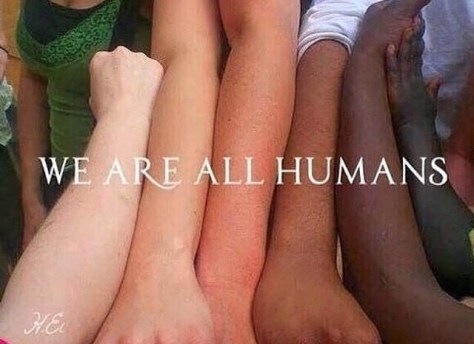
We are all part of one human family.

We are all part of one human family.


May Peace Prevail

May Peace Prevail


The parts of a happy life.

The parts of a happy life.


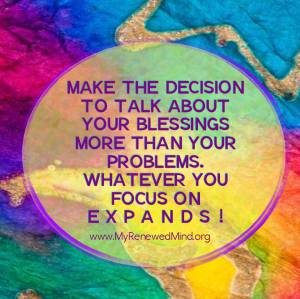
Focus on the positive

Focus on the positive

We Are Going Into the Future – With Positive Energy


I have been listening to people, what they write and what they say. I have looked around me at the people in my life and the acquaintances. When people talk, there is a flow of negativity. If one person does not make themselves clear, the other assumes the worst.

Now, it occurs to me that these threads of negative thought and speech are influencing more and more of the energy of our communities. People hurt others’ feelings, there is a lack of respect of others, of the elderly. Everyone seems to be on a hair-trigger. This trigger seems ready to go off and escalation is the result. My confusion comes from the fact that many of the angriest people have everything they could want. Yet it isn’t enough. Then I began thinking about how if friends and neighbors can’t have conversations without hurt feelings, there is something going on.

Times are changing. There is a lot of negativity in our cities, our country and all the countries of the world.  There is an outcry across the world by the people who have been living under dictators, who live amidst bombs and fear. We human beings are committing terrible crimes against each other. Racism, sexism, greed and power are bringing out the worst in humanity.  Not that we historically have had any difficulty torturing or causing pain to our fellow sentient beings.

Genocide is happening yet again. We have made it a purpose  in life to try to wipe out races of people who are different. Their skin color, religion, education, natural abilities all have worked together to sound the battle cry to kill…the “others”. Some countries are keeping women and girls from receiving an education. This leaves them in perpetual poverty and controlled by the males in their families. They are owned by fathers, brothers, and husbands. They never even have a chance to figure out who they are. They never get to experience themselves as a child of the Universe. They are stuck having to always do what they are told. They don’t know how to protect their daughters because no one protected them.

Girls are being married off at as young as 10 years old. Their bodies are not even completely formed yet. In my mind, only a pedophile could or would do something like this. IN some cultures, if a man wants a woman and she doesn’t want him, he has the right to throw acid in her face. This is done to save his family shame. Also no one will ever want her. I have seen such horrible pictures of young beautiful women who are scarred so much their families are shocked. Little girls disappear. Mothers cry and pray, but the girls are gone and have been sold into sexual slavery. Their life is essentially over. Very few governments will search for them, so they are used until they commit suicide or are thrown away like garbage. In many countries, when girls reach puberty and their menses begin, the mother takes her to the midwife for genital mutilation. This practice is what will make them marriageable. It is done to decrease sexual pleasure and to ensure virginity. Some men have their wives sewn closed while they are away on business so their labia is sewn together to prevent sexual intercourse. A small opening is left so they can pee.

All of this adds to the negativity which is swirling around our world.  Every time a girl or woman is saved and educated, we decrease the negative energy. It takes getting involved and understanding that every woman who is injured, is a sister.

Here in America, Domestic Violence is not stopping but increasing according to the FBI statistics. A woman who is married is not owned. She is not required to obey. She is not the reason he hits her. We  started building Domestic  Violence shelters and giving hope to abused women and their children in the 1970’s. We taught them to do the Activities of Daily Living so they could escape and survive in the world. Legal advice and assistance was provided. We saved lives. In those days, we were grass-roots organizations. Hard work, prayers and tenacity is what we lived on while we counseled, loved, fed and sheltered millions of women and their children. We just saw a need and began to do something to change lives.

This is exactly what we need to do to go forward into the future. We need to form grass-roots groups of dedicated men and women to stop the violence and negativity, of all kinds. Righting wrongs is an important aspect of our journey here on our World. Stopping negative energy and gut reactions is necessary to take us forward into the future. Caring is good, it is important. Volunteering a few hours a month would do much to create  positive energy. People need to just think and act positively. Get out and give the Universe a few of the hours of your life and we will feel the energy brighten and we will feel joy within us. This must be a present and the future and we all can participate.

Bloggers 4 Peace

Bob Marley said it so well. One World, One God, One life. Do what you can do to add positive energy to our world.

Darren Wilson resigns


Copyright NPR 2014

Ferguson Police Officer Darren Wilson Resigns

November 29, 2014 6:46 PM ET

Ferguson police officer Darren Wilson, shown during his medical examination after he fatally shot Michael Brown, has resigned from the Ferguson Police Department, the AP reports. Wilson has been on administrative leave since the Aug. 9 shooting.

AP

Darren Wilson, the Ferguson police officer who shot and killed 18-year-old Michael Brown nearly four months ago, is resigning, according to his attorney.

Wilson’s resignation was announced Saturday by Neil Bruntrager, who says his client’s resignation is effective immediately. Wilson had been on administrative leave since Aug. 9.

In his resignation letter, Wilson writes that he hopes his resignation “will allow the community to heal.” The Ferguson Police Department has not confirmed that it has received this letter.

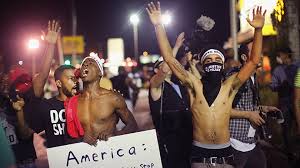
A grand jury spent more than three months reviewing evidence in the shooting incident before deciding that the 28-year-old police officer would not be charged in the case. The confrontation and grand jury decision sparked continuing protests in the St. Louis suburb and across the country.

The St. Louis Post-Dispatch posted the full text of Wilson’s resignation letter:

“I, Darren Wilson, hereby resign my commission as a police officer with the City of Ferguson effective immediately. I have been told that my continued employment may put the residents and police officers of the City of Ferguson at risk, which is a circumstance that I cannot allow. For obvious reasons, I wanted to wait until the grand jury made their decision before I officially made my decision to resign. It was my hope to continue in police work, but the safety of other police officers and the community are of paramount importance to me. It is my hope that my resignation will allow the community to heal. I would like to thank all of my supporters and fellow officers throughout this process.”


bjwordpressdivider


I am sharing this article with you because not only am I a feminist, but I am a humanist. I believe in certain actions that make up civilizations. I am not writing about the grand jury decision. I am writing about a man, it could be any man, who is capable of killing someone and going on with their life as they always did.


Darren Wilson spent his time between the murder of Michael Brown and the verdict moving from house to house. He feared for his life. He feared for his life…as Michael Brown must have at those last few moments of his life. Hands up. No longer running. He turned to face the officer who was chasing him. He was doing the right thing and he was shot in the head and killed for his effort.


Darren Wilson said he feared for his life. That seems very cowardly to me. Police officers are supposed to be men of rational thinking and bravery. This officer running after a kid who may have stolen some Cigarillos and walked in the street. Was Michael’s behavior without fault? No it wasn’t. He exhibited the behavior of a teenager with raging hormones. Mouthy, not listening to adults and breaking rules. I have four teenage grandchildren and I have stood toe to toe when they got angry.


But angry they were, for about 20 minutes then the kid I knew returned. Should they have been murdered for their actions? No. They get grounded and there is a talk about anger management.


Now, there is Officer Darren Wilson who got paid administrative leave for being a coward and shooting at Michael’s head knowing he was going to kill him. They say he got death threats and he had to move around for safety. He also got married. In a very quiet, under the radar ceremony, he married a fellow officer.


People protesting and grieving around the country and then even in the world. I have tried to imagine what Michael Brown’s parents must feel like but I can’t. Not really. I have lost a husband and it was the most horrible experience. I can’t even imagine the pain of losing a child. Both of his parents have done their best to mourn in public, to try to receive justice from our country and from the world.


They are so very courageous in my mind. They are not the only parents in America that are dealing with grief, sorrow, injustice and pain because their child has been shot in the bloom of his life.


Thousands if not millions of people are grieving in the world for their children who do not have justice. Officer Darren Wilson is celebrating his nuptials and starting a new life. He is not grieving and he has denied being remorseful. A civilized man would not be living in joy after taking a life, even in the call of duty. Shame on you Darren Wilson and shame on your bride for celebrating your joy when you are responsible for the pain of Michael’s family and friends.

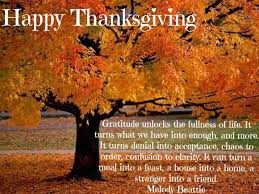
Happy Thanksgiving


HappyThanksGiving-MelodyBeattie


Happy Thanksgiving and Happy Thursday to all of my friends across the world.
If you are traveling, be safe.

One of the things I am grateful for in my life is my WordPress family.  Thank you all for your support, and all of your wonderful comments all year long.

I’m spending a few days with my family, but I’ll be back with you soon.

In Darren Wilson’s Testimony, Familiar Themes About Black Men


In Darren Wilson’s Testimony, Familiar Themes About Black Men
November 26, 2014 3:11 PM ET
FREDERICA BOSWELL
FergusonProtest1

Sid Hastings/AP
After Michael Brown was shot dead in August, his mother, Leslie McSpadden, said, “My son was sweet. He didn’t mean any harm to anybody.” He was, she said, “a gentle giant.”

But when police officer Darren Wilson fired the shot that ended Brown’s life, he saw things differently. “I felt like a five-year-old holding onto Hulk Hogan,” he said in his testimony to the grand jury. “That’s just how big he felt and how small I felt.” Wilson said “the only way” he could describe Brown’s “intense aggressive face” was that it looked like “a demon.” He feared for his life.

Many observers, such as Slate’s Jamelle Bouie and Vox’s Lauren Williams, pointed out that Wilson’s testimony has historical echoes of the “black brute” caricatures that portrayed black men as savage, destructive criminals.

After the Civil War, many white writers argued that the institution of slavery was what kept the supposed savagery of black men in check and also justified the punishments that they met. In the Reconstruction-era novel Red Rock, for example, Thomas Nelson Page wrote of a black politician — a “repulsive creature,” Moses — who tried to rape a white woman: “He gave a snarl of rage and sprang at her like a wild beast.”

But these depictions haven’t just been banished to old books. On Twitter, the hashtag #Chimpout started trending this week as tweeps used it to describe those protesting the grand jury’s decision. Again, drawing upon animal imagery, Urban Dictionary defines the term as “used to describe the bad behavior of black people, especially when they behave like animals.”

Contemporary studies suggest that language like this, as well as the language in Wilson’s testimony, has deeper psychological roots.

Take, for example, research published in the Journal of Personality and Social Psychology earlier this year. The report, titled “The Essence of Innocence: Consequences of Dehumanizing Black Children,” found that African-American boys as young as 10 were significantly less likely to be viewed as children than were their white peers. Philip Atiba Goff, an assistant professor of social psychology at UCLA and one of the lead authors of the report, spoke to NPR’s Michel Martin when it came out. “In black boys’ lives, what we know from developmental psychology is there are more situations that demand that they be adults than there are in the average white boys’ lives,” he said. “And the problem is we rarely see our black children with the basic human privilege of getting to act like children.”

As an example, Goff mentioned the death of Trayvon Martin after he was shot by George Zimmerman. “All of a sudden a 17-year-old boy was portrayed as a manly thug. He was seen sometimes by people to be older than he actually was,” Goff said. ” ‘He was a boy in a man’s body’ was something I heard multiple times. And you don’t hear that when it’s white children in the same context.”

Adam Waytz, a psychologist and assistant professor at Northwestern University’s Kellogg School of Management, has looked into why this happens. He points out psychological studies where “people demonstrate a racial bias whereby they believe black people experience less pain than white people.”

Waytz also points to literature and pop culture that depict African-Americans as stronger than whites. “Spike Lee’s famous terming of — and I quote — the mystical ‘magical Negro’ as a stock character comes up in a lot of films,” he says. “And even Melissa Harris Perry’s done some academic work on the myth of the strong black woman, which is … this popular trope in American culture of black women being superhumanly strong and being able to keep the family together and all of those things.”

Based on all this, Waytz recently co-authored a study, “A Superhumanization Bias in Whites’ Perceptions of Blacks.” It examined whether people were quicker to process words related to supernatural concepts like “wizard” and “magic” compared with words related to humanity like “person” or “citizen” when looking at black or white faces.

“Essentially what you see is that white participants in our studies were quicker to process superhuman words when these words were preceded by a black face,” he says. Participants were then asked which face — black or white — would be more capable of possessing superhuman strengths, superhuman speed, the ability to withstand heat or to suppress hunger and thirst in a more-than-human fashion. More than half the time, the black face was assumed to possess superhuman capacities.

Participants who made these assumptions were also more likely to think the black people shown were less sensitive to pain. And Waytz says this is not a good thing.

“We know dehumanization often emerges as people treating others as subhuman, like vermin in the case of the Holocaust, [or] as apelike in depictions of African-Americans in U.S. history, and that denies people humanity,” he says. “What we’re saying is that superhumanization is another way of denying humanity and ‘othering’ African-Americans by saying that they exist sort of outside the human realm.”

Waytz also says he recognized much of this language in Wilson’s testimony. “Superhuman strength, superhuman speed, this idea of him as a demon; this depiction of Brown as Hulk Hogan versus a child,” he points out. “All of this was exactly consistent with the types of capacities that we were asking about in our studies.” And Waytz says there are reasons why he might draw upon these depictions. “The other side of the superhumanization coin is you believe that black people are less sensitive to pain, and perhaps [Wilson] is suggesting that because of the superhuman nature of Brown in this moment, which he perceived, more excessive force was required.”

So could that be right? And do these perceptions usually affect police officers? “Of course,” says Tracie Keesee, a 25-year police veteran and co-founder of the Center for Policing Equity and the director of community outreach. “We’ve always talked about those social stereotypes that go along with aggressiveness,” she says. “How do you describe what aggressiveness looks like on a black male versus a white male?”

Stereotypes, implicit biases and media images, Keesee says, factor into the decisions officers make. “Your mind is trying to make sense of those things in a very rapid and quick fashion. And so what we always like to train, and fashion our training around: Are you reacting to the correct thing?”

That is on the mind of police chiefs across the country, she says. “How do we not only identify that we are engaging in this type of behavior, but how do we fix it?”

Amruta Trivedi contributed to this report.

bjwordpressdivider


When will our society respect the humanity of ALL people?

Namaste,

Barbara

Racism without Race


The new threat: ‘Racism without racists’
By John Blake, CNN
updated 8:03 PM EST, Wed November 26, 2014

Ferguson1

Source: CNN
STORY HIGHLIGHTS
Whites and blacks don’t speak the same language when they talk about racism
For many minorities, racism is less about overt hostility and more about bias
One sociologist calls it “racism without racists” and says “we are all in this game”
A new conversation on race can start with three phrases that often crop up
(CNN) — In a classic study on race, psychologists staged an experiment with two photographs that produced a surprising result.
They showed people a photograph of two white men fighting, one unarmed and another holding a knife. Then they showed another photograph, this one of a white man with a knife fighting an unarmed African-American man.
When they asked people to identify the man who was armed in the first picture, most people picked the right one. Yet when they were asked the same question about the second photo, most people — black and white — incorrectly said the black man had the knife.
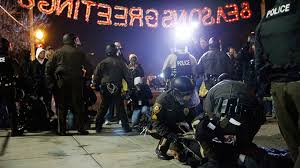
Even before the Ferguson grand jury’s decision was announced, leaders were calling once again for a “national conversation on race.” But here’s why such conversations rarely go anywhere: Whites and racial minorities speak a different language when they talk about racism, scholars and psychologists say.

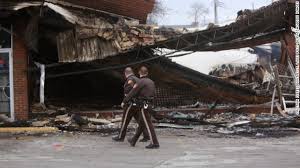
Ferguson3-burned out building
The knife fight experiment hints at the language gap. Some whites confine racism to intentional displays of racial hostility. It’s the Ku Klux Klan, racial slurs in public, something “bad” that people do.
Attorney: Cop’s ‘demon’ term revealing Ferguson couple: We’re afraid, staying What #Ferguson stands for New commission to help Ferguson heal
But for many racial minorities, that type of racism doesn’t matter as much anymore, some scholars say. They talk more about the racism uncovered in the knife fight photos — it doesn’t wear a hood, but it causes unsuspecting people to see the world through a racially biased lens.
It’s what one Duke University sociologist calls “racism without racists.” Eduardo Bonilla-Silva, who’s written a book by that title, says it’s a new way of maintaining white domination in places like Ferguson.
“The main problem nowadays is not the folks with the hoods, but the folks dressed in suits,” says Bonilla-Silva.
“The more we assume that the problem of racism is limited to the Klan, the birthers, the tea party or to the Republican Party, the less we understand that racial domination is a collective process and we are all in this game.”
As people talk about what the grand jury’s decision in Ferguson means, Bonilla-Silva and others say it’s time for Americans to update their language on racism to reflect what it has become and not what it used to be.
The conversation can start, they say, by reflecting on three phrases that often crop up when whites and racial minorities talk about race.

Ferguson2-withSeasonGreetings
‘I don’t see color’
It’s a phrase some white people invoke when a conversation turns to race. Some apply it to Ferguson. They’re not particularly troubled by the grand jury’s decision to not issue an indictment. The racial identities of Darren Wilson, the white police officer, and Michael Brown, the black man he killed, shouldn’t matter, they say. Let the legal system handle the decision without race-baiting. Justice should be colorblind.
Science has bad news, though, for anyone who claims to not see race: They’re deluding themselves, say several bias experts. A body of scientific research over the past 50 years shows that people notice not only race but gender, wealth, even weight.
When babies are as young as 3 months old, research shows they start preferring to be around people of their own race, says Howard J. Ross, author of “Everyday Bias,” which includes the story of the knife fight experiment.
Other studies confirm the power of racial bias, Ross says.
One study conducted by a Brigham Young University economics professor showed that white NBA referees call more fouls on black players, and black referees call more fouls on white players. Another study that was published in the American Journal of Sociology showed that newly released white felons experience better job hunting success than young black men with no criminal record, Ross says.
“Human beings are consistently, routinely and profoundly biased,” Ross says.
The knife fight experiment reveals that even racial minorities are not immune to racial bias, Ross says.
“The overwhelming number of people will actually experience the black man as having the knife because we’re more open to the notion of the black man having a knife than a white man, ” Ross says. “This is one of the most insidious things about bias. People may absorb these things without knowing them.”
Another famous experiment shows how racial bias can shape a person’s economic prospects.
The first thing we must stop doing is making racism a personal thing.
— Doreen E. Loury, director of Pan African Studies at Arcadia University
Professors at the University of Chicago and MIT sent 5,000 fictitious resumes in response to 1,300 help wanted ads. Each resume listed identical qualifications except for one variation — some applicants had Anglo-sounding names such as “Brendan,” while others had black-sounding names such as “Jamal.” Applicants with Anglo-sounding names were 50% more likely to get calls for interviews than their black-sounding counterparts.
Most of the people who didn’t call “Jamal” were probably unaware that their decision was motivated by racial bias, says Daniel L. Ames, a UCLA researcher who has studied and written about bias.
“If you ask someone on the hiring committee, none of them are going to say they’re racially biased,” Ames says. “They’re not lying. They’re just wrong.”
Ames says such biases are dangerous because they’re often unseen.
“Racial biases can in some ways be more destructive than overt racism because they’re harder to spot, and therefore harder to combat,” he says.
Still, some people are suspicious of focusing on the word bias. They prefer invoking the term racism because they say it leaves bruises. People claiming bias can admit they may have acted in racially insensitive ways but were unaware of their subconscious motivations.
“The idea of calling it racial bias lessens the blow,” says Crystal Moten, a history professor at Dickinson College in Carlisle, Pennsylvania.
“Do you want to lessen the blow or do you want to eradicate racism? I want to eradicate racism,” she says. “Yes I want opportunity for dialogue, but the impact of racism is killing people of color. We don’t have time to tend to the emotional wounds of others, not when violence against people of color is the national status quo.”
‘But I have black friends’
In the movie “The Godfather,” the character of Michael Corleone, played by Al Pacino, hatches an audacious plan to kill a mobster and a crooked cop who tried to kill his father. Michael’s elders scoff at his plans because they believe his judgment is clouded by anger. But in a line that would define his ruthless approach to wielding power, Michael tells them:
“It’s not personal. It’s strictly business.”
Ferguson has become a symbol of how some whites and racial minorities speak differently about racism, some say.
When some whites talk about racism, they think it’s only personal — what one person says or does to another. But many minorities and people who study race say racism can be impersonal, calculating, devoid of malice — such as Michael Corleone’s approach to power.
“The first thing we must stop doing is making racism a personal thing and understand that it is a system of advantage based on race,” says Doreen E. Loury, director of the Pan African Studies program at Arcadia University, near Philadelphia.
Loury says racism “permeates every facet of our societal pores.”
“It’s about more than that cop who targets a teen while ‘WWB’ (walking while black) but the system that makes it OK to not only stop him but to put him in a system that will target and limit his life chances for life,” she says.
Racial bias is so deeply engrained in people that it can manifest itself in surprising places, says Charles Gallagher, a sociologist at La Salle University in Philadelphia. He gave a hypothetical example:
“A white police officer in Ferguson may be married to a black woman and have black and Latino friends, but that doesn’t mean the officer is above racial profiling,” Gallagher says.
These old and new ways of talking about racism can be seen in how some whites and blacks perceive the events in Ferguson.
Many have already looked at them as something beyond a personal interaction between a white police officer and a young black man. They point out that two-thirds of Ferguson’s population is black, yet the mayor, police chief and five of six city council members are white — as are 50 of the 53 people in its Police Department.
Ferguson is like countless multiracial communities, they say: calm on the surface but seething with racial disparities beneath.
But those disparities are invisible to many whites, who often see themselves as victims of discrimination, writes Jamelle Bouie of Slate magazine in a recent essay, “The Gulf That Divides Us.”
“Median income among black Americans is roughly half that of white Americans. But a narrow majority of whites believe blacks earn as much money as whites, and just 37% believe that there’s a disparity between the two groups. Likewise, while 56% of blacks believe black Americans face significant discrimination, only 16% of whites agree,” he writes.
“Many whites — including many millennials — believe discrimination against whites is more prevalent than discrimination against blacks.”
But as Nicholas Kristof recently pointed out in The New York Times, the U.S. has a greater wealth gap between whites and blacks than South Africa had during apartheid.
The main problem nowadays is not the folks with the hoods, but the folks dressed in suits.
— Eduardo Bonilla-Silva, author of “Racism without Racists”
Such racial inequities might seem invisible partly because segregated housing patterns mean that many middle- and upper-class whites live far from poor blacks.
It’s also no longer culturally acceptable to be openly racist in the United States, says Bonilla-Silva, author of “Racism Without Racists.”
Overt racism is so widely rejected in America that a white supremacist in Montana recently announced that he is creating a new inclusive Ku Klux Klan chapter that will not discriminate against people because of their color or sexual orientation. Instead, according to one report, the chapter’s new mission will be to prevent a “new world order” where one government controls everything.
Another recent article revealed how white supremacists in America are facing such hostility at home that some have moved to Europe in an attempt to link up with far-right groups.
“The new racism, like God, works in mysterious ways and is quite effective in maintaining white privilege,” Bonilla-Silva says. “For example, instead of saying as they used to say during the Jim Crow era that they do not want us as neighbors, they say things nowadays such as ‘I am concerned about crime, property values and schools.’ ”
‘Who you calling a racist?’
When protests erupted in Ferguson after the shooting this summer, various white and black residents tried to talk about race, but such discussions didn’t bear fruit because of another reason:
People refuse to admit their biases, research has consistently shown.
Ross, author of “Everyday Bias,” cited a Dartmouth College survey where misinformed voters were presented with factual information that contradicted their political biases.
There were voters, for example, who were disappointed with President Obama’s economic record and believed he hadn’t added any jobs during his presidency. They were shown a graph of nonfarm employment over the prior year that included a rising line indicating about a million jobs had been added.
“They were asked whether the number of people with jobs had gone up, down, or stayed about the same,” Ross wrote. “Many, looking straight at the graph, said down.”
Ross says it’s even more difficult to get smart people to admit bias.
“The smarter we are, the more self-confident we are, and the more successful we are, the less likely we’re going to question our own thinking,” Ross says.
Some of the nation’s smartest legal minds aren’t big believers in racial bias either, and that could complicate efforts in Ferguson to reduce racial tensions.
Some say they could be eased by hiring more officers of color in Ferguson’s police force.
A conservative majority on the U.S. Supreme Court could get rid of an important tool against racial bias, some say.
But the conservative majority on the U.S. Supreme Court, led by Chief Justice John Roberts, has been suspicious of efforts to achieve diversity in workforces, believing that they amount to reverse racism or racial preferences, legal observers say.
Some fear the court is about to get rid of one of the most effective legal tools for addressing racial bias.
The court recently took up a fair housing case in Texas where the conservative majority could very well rule against the concept of “disparate impact,” a legal approach that doesn’t try to plumb the racist intentions of individuals or businesses but looks at the racial impact of their decisions.
Disparate impact is built on the belief that most people aren’t stupid enough to openly announce they’re racists but instead cloak their racism in seemingly race-neutral language. It also recognizes that some ostensibly race-neutral policies could reflect unintentional bias. A disparate impact lawsuit, for instance, wouldn’t have to prove that a police department’s white leaders are racist — it would only have to show the impact of having all white officers in an almost all-black town.
Roberts distilled his approach to race in one of the court’s most controversial cases in 2007. The court ruled 5-4 along ideological lines that a public school district in Seattle couldn’t consider race when assigning students to schools, even for the purposes of integration.
“The way to stop discrimination on the basis of race is to stop discriminating on the basis of race,” Roberts said in what is arguably his most famous quote.
Roberts has equated affirmative action programs with Jim Crow laws, says Erwin Chemerinsky, author of “The Case Against the Supreme Court.”
“Chief Justice Roberts has expressly said that the Constitution and the government should be colorblind,” Chemerinsky says. “He sees no difference between government action that discriminates against minorities and one that benefits minorities.”
What that means for Ferguson is that any aggressive attempt to integrate the police force could be struck down in court, says Mark D. Naison, an African-American Studies professor at Fordham University in New York City.
Unless a lawyer can find smoking-gun evidence of some police department official saying he won’t hire blacks, people won’t have much legal leverage to make the police department diverse, he says.
Racial biases can in some ways be more destructive than overt racism.
— Daniel L. Ames, UCLA researcher
“Once the doctrine of disparate impact is weakened, you have to prove discriminatory intent in order to declare a practice discriminatory,” Naison says. “Huge racial disparities in law enforcement can be tolerated if they are the result of policies which are race-neutral in how they are written in the law even through the implementation is anything but.”
The courts may ignore colorblind racism, but ordinary people ought to be aware of it when they talk about racism, others say. Ross, author of “Everyday Bias,” says being biased doesn’t make people bad, just human.
He says people are hardwired to be biased because it helped keep our ancestors alive. They survived, in part, by having to make quick assumptions about strangers who might prove threatening.
“We need to reduce the level of guilt but increase the level of responsibility we take for it,” he says. “I didn’t choose to internalize these messages, but it’s inside of me and I have to be careful.”
Part of being careful is expanding our definition of racism, says Bonilla-Silva, author of “Racism Without Racists.”
Racism has evolved, but our language for describing it hasn’t, he says.
“Colorblind racism is the new racial music most people dance to,” he says. “The ‘new racism’ is subtle, institutionalized and seemingly nonracial.”
How long before another Ferguson erupts is anyone’s guess. But if and when it does, the knife fight experiment suggests that before people look at videotapes, read police reports and listen to radio talk shows to form their opinions, they should do something else first:
Look within themselves.

Peace Is a Choice


Life isn’t predestined — you can always make choices and no matter where you start in life, your choices can make your life what you want it to be.  No one is stuck where they are.


Peace is a choice we all can make, regardless of where you start.

bjwordpressdivider


bjwordpressdivider