Keystone Kops in the White House


THE KEYSTONE KOPS IN THE WHITE HOUSE

“My fellow-Americans,” Donald Trump said in his weekly address on Friday, “It’s an exciting time for our country. Our new Administration has so much change under way— change that is going to strengthen our Union and improve so many people’s lives.”

It’s exciting, all right; in fact, it is hard to look away. Just when you think things can’t get worse for the Trump Administration, it drops another clanger on itself.

Three weeks ago, the White House unveiled its revised anti-Muslim travel ban, which the federal courts immediately froze, on constitutional grounds, just as they had blocked its predecessor. Last week, there was the ignominious failure of the G.O.P. health-care bill, which Trump had personally endorsed, although he seemed blissfully unaware of some of its contents. And this week there was the still-developing saga of Devin Nunes, the bumbling head of the House Intelligence Committee, who unwisely tried to do the President a favor and ended up being publicly humiliated.

It is now perfectly evident that Nunes, in claiming he had evidence that Trump and his aides had been caught up in “incidental surveillance” during the transition, was doing the White House’s bidding and trying to create a diversion from James Comey’s confirmation that the F.B.I. is investigating whether Trump’s campaign coördinated with Russia.

According to a Times report, Nunes obtained access to intelligence information from at least two Administration aides when he visited the White House on the night of March 21st, though he initially denied coördinating with anybody who works there. One of the White House staffers was reportedly a member of the National Security Council, and the other was a lawyer in the office of the White House counsel who used to work for Nunes’s committee on Capitol Hill.

So far, Nunes has managed to cling to his committee post, but he has about as much credibility left as a thief caught inside a bank vault. At Friday’s White House press briefing, Glenn Thrush, of the Times, asked Sean Spicer, Trump’s spokesman, whether it was normal for the head of an investigatory committee to roam the White House complex at night and meet two mid-level staffers to see sensitive information. Spicer didn’t have much of an answer, of course. But the larger story here goes beyond Nunes and his nocturnal wanderings.

It concerns the White House’s competence—or lack thereof. Ten weeks ago, when Trump stormed into office attacking the media and promising a blitzkrieg of new policies and initiatives during his first hundred days, the dominant emotion among people who hadn’t voted for him was fear. Many commentators, myself included, warned about the dangers of democratic erosion, and sales of George Orwell’s “1984” soared.

Today, there are still plenty of reasons to be concerned about Trump and his illiberalism. The White House’s recent decision to dismantle President Obama’s clean-air regulations offers fresh testament to the malevolence of the Trump Administration’s agenda, and next week’s meeting between Trump and Xi Jinping, China’s President, will be a reminder of the enormous responsibilities that rest on a President’s shoulders. But, even among ardent Trumpophobes, fear and foreboding have been supplemented by wonderment at the White House’s string of gaffes. These days, instead of Big Brother, it often looks like the Keystone Kops are in charge.

In an interview with Tucker Carlson, of Fox News, a couple of weeks ago, Trump hinted that the White House had some information about possible surveillance by the Obama Administration that it would like the public to see. “We will be submitting certain things, and I will be perhaps speaking about this next week,” he said. The surprise wasn’t that the White House would subsequently use a political ally (Nunes) as a conduit. It was that the operation was handled so clumsily that it backfired almost immediately. “It’s hard to know who is dumber: the Trump White House for giving Nunes the info or Nunes for accepting it. Pure Amateur hour,” Dan Pfeiffer, a former director of communications in the Obama White House, tweeted on Thursday.

Pfeiffer isn’t a neutral player, of course. But the Nunes fiasco is hardly an isolated incident. Consider the fallout from the health-care debacle. Since the moment that Paul Ryan pulled his Obamacare-replacement bill from consideration in the House, Trump’s options for pursuing other elements of his domestic agenda, and perhaps even resuscitating health-care reform, have been clear. He can move even further to the right, to placate the members of the recalcitrant Freedom Caucus, or he can abandon them and try to win over some moderate Democrats.

Last weekend, Reince Priebus, the White House chief of staff, indicated that the White House would follow the second strategy, and other Administration officials floated the idea of reaching a deal with congressional Democrats on tax reform and infrastructure spending. But Trump himself didn’t appear to have been let in on the plan—he continued to bait and berate the opposition party.

“The Democrats will make a deal with me on healthcare as soon as ObamaCare folds – not long,” he tweeted on Monday. “Do not worry, we are in very good shape!” On the same day, in a pair of tweets, the President also went after his favorite Democratic target, Hillary Clinton. “Why isn’t the House Intelligence Committee looking into the Bill & Hillary deal that allowed big Uranium to go to Russia, Russian speech . . . money to Bill, the Hillary Russian ‘reset,’ praise of Russia by Hillary, or Podesta Russian Company. Trump Russia story is a hoax. #maga!”

On Thursday, Trump directed his fire at the Freedom Caucus. In a tweet, he said that they would “hurt the entire Republican agenda if they don’t get on the team, & fast. We must fight them, & Dems, in 2018!” This lumping together of the Freedom Caucus and the Democrats came the morning after a group of conservative activists visited the White House for what was billed as friendly policy session. If Trump had decided to declare war on the right, he evidently hadn’t informed the members of his staff who arranged that session.

Mixed signals are nothing new from the Trump Administration. On Thursday, a reporter form Axios, the news site, sat in on a strategy session attended by Priebus, Steve Bannon, and Jared Kushner. The session was “on background,” which meant the reporter couldn’t identify who said what. But, on Friday morning, Mike Allen, Axios’s editor-in-chief, reported that one of the officials in the meeting “views the Trump White House in terms that could be applied to the iterative process of designing software. It’s a beta White House.”

Allen went on, “The senior official . . . said the White House was operating on similar principles to the Trump campaign: ‘We rode something until it didn’t work any more,’ the official said. ‘We recognized it didn’t work, we changed it, we adjusted it and then we kind of got better . . . [T]his was much more entrepreneurial.’ In the White House, he said, ‘we’re going to keep adjusting until we get it right.’ ”

No word on how long this adjustment process might take, or what role the man with the itchy Twitter finger might play in it.


NC Orchid Show at NC Arboretum


Last weekend, my sister and I went to the Orchid Show at the NC Arboretum.  As those of you have been following me for the last several years probably remember, I am a big fan of Orchids!  I went to the Orchid Show at the Cleveland Botanical Gardens every year.  I thought it was the most wonderful show I’d ever seen!


I was wrong.  The NC Orchid Show was the most amazing flower show of any kind I have ever been to !  It was 2 or 3 times the size of the Cleveland show, with exhibitors from as far away as Ecuador, and local and regional growers and exhibitors.


We had not intended to purchase orchids, but could not resist the offerings of Peach State Orchids and came home with two gorgeous specimens.


I hope you enjoy the photos!

(all photographs by Barbara Mattio, Copyright 2017)


Why It Matters that Pence won’t have dinner with a woman not his wife


Why It Matters That Pence Won’t Have Dinner With A Woman Who Isn’t His Wife

In Pence’s worldview, men have no self-control, and women are either temptresses or guardians of virtue.

GETTY/TWITTER

A recent Washington Post profile of Second Lady Karen Pence, wife of Vice President Mike Pence, uncovered an interesting detail about their extremely close relationship. Pence reportedly told The Hill in 2002 that “he never eats alone with a woman other than his wife and that he won’t attend events featuring alcohol without her by his side.”

This tidbit caused a small uproar on Twitter, with some praising Pence for respecting his wife and his marriage…

If you laugh at Pence for respecting his marriage, it’s probably because you’ve never been in a healthy one

…and others pointing out that, perhaps there are reasons outside of a sexually or emotionally untoward encounter to go out to dinner with someone. Maybe you have a friend who isn’t the same gender as you! Or maybe you work with people of different genders, and you sometimes attend professional dinners with them!

A whole swath of America thinks men and women don’t work together and can’t be friends. https://twitter.com/strandleper/status/847437292717318144 

The way Mike Pence and his wife mutually define a respectful marriage is up to them. But there are two reasons that this revelation about the Pences’ relationship set off such a firestorm online. First, the religious guidelines that govern what “respect” means to the Pences are part of a system that works to prop up male power and keep women subordinate. And second, VP Pence is not just a man with a wife, he’s the second most powerful person governing the nation ― which means that the way he views women in his personal life could have bearing on the way he sees American women writ large.

The no-eating-with-another-woman rule was first made popular by evangelical pastor Billy Graham in 1948, as part of the “Modesto Manifesto.” According to the Christian History Institute:

The most famous provision of the manifesto called for each man on the Graham team never to be alone with a woman other than his wife. Graham, from that day forward, pledged not to eat, travel, or meet with a woman other than Ruth unless other people were present. This pledge guaranteed Graham’s sexual probity and enabled him to dodge accusations that have waylaid evangelists before and since.

The provision, which came to be known as The Billy Graham Rule, allowed Graham to use his dashing looks to his advantage without cultivating an over-sexualized persona that other evangelicals might not have taken kindly to. (There are some Muslims who adhere to a similar only-dine-with-wives-and-relatives guideline, though one can assume such a disclosure would not elicit such a strong defense from the right.)

PICTORIAL PARADE VIA GETTY IMAGES
American evangelist Billy Graham and his wife Ruth. New York, New York, May 18, 1966.

This history makes it all-the-more clear that this do-not-dine-with-women rule is predicated on the idea that the company of women is always first and foremost about sex.

There is nothing disrespectful about a committed person having a meal with a friend or colleague who is not the same gender as they are ― unless one is to assume that any interaction not under the watchful eye of a spouse would inevitably lead to infidelity. In this worldview, men have no self-control, and women are either temptresses or guardians of virtue.

The underpinnings of this belief system are what allow men to view women as “other” rather than equal. They allow some to rationalize that female victims of sexual violence “asked for it” because they wore “provocative” clothing, and others (including our president) to believe that assault is a natural outcome of putting men and women together in a high-pressure environment like the military. These belief systems are what create male-dominated work environments where women are viewed as sexualized distractions or cut out of the office culture altogether.

Is the Vice President of the United States able to see any woman as his contemporary, rather than a potential threat to his marriage?

The ability to refuse to be alone with someone who is not the same gender as you and still climb the professional ladder is a privilege that is simply not afforded to women. Imagine if Elizabeth Warren or Kamala Harris or Nancy Pelosi refused to attend political functions where alcohol was served without their husbands in tow to supervise them. Imagine if they never took one-on-one meetings with potential campaign managers or fellow lawmakers who happened to be men. These women’s careers would have been over before they started.

To be a successful woman in an industry where men still make up the majority of power brokers means working with men. It means fighting for a spot at the table, and accepting that, sometimes, you may be the only woman there.

Is there a single successful female politician who could say she refuses to have have dinner with men alone? Lol no. She couldn’t.

Perhaps VP Pence has made exceptions to his 2002 marital rule in the intervening years. But as Mother Jones Editor-in-Chief Clara Jeffery pointed out on Twitter, following this rule to its logical conclusion would mean that Pence’s ability to meet with and work with women would be severely limited.

Can he have a professional lunch with Kellyanne Conway or Nikki Haley or Ivanka Trump without viewing it as a marital betrayal? Is he open to hiring women into positions of power on his staff ― specifically positions that require consistent contact? Is the Vice President of the United States able to see any woman as his contemporary, rather than a potential threat to his marriage?

I don’t doubt that Pence has a deep regard for his wife. What is worrisome is the idea that the principles that govern his marriage could be used to govern the country.

Proactive Compassion


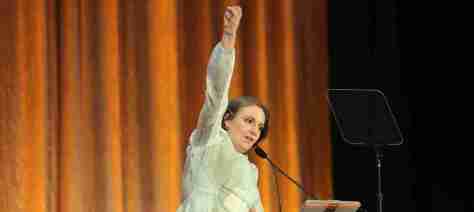
Lena Dunham Says ‘PC’ No Longer Means Political Correctness—It’s ‘Proactive Compassion’

By Lukas Mikelionis|

HBO Girls‘ Star and Hillary Clinton aficionado Lena Dunham is becoming more woke every day.

This weekend, Dunham tweeted: “Let’s say PC no longer means political correctness—it’s Powerful Consideration. Proactive Compassion. Cuz that’s what we’re all trying for.”

Let’s say PC no longer means political correctness–it’s Powerful Consideration. Proactive Compassion. Cuz that’s what we’re all trying for.

But to the likely surprise of the actress’ politically correct fans, Dunham has previously advocated standing up to political correctness. Back in 2016, during an interview with alleged comedian Amy Schumer, Dunham said she gets “really crazy about … this new world” of political correctness.

“The other thing that I get really crazy about is this new world in which women aren’t just supposed to be protected from actions, they’re supposed to be protected from language,” she said. “Women are so strong. My ovary has basically exploded in my stomach twice, and I was pretty chill about it. You think I can’t listen to some short comedy loser say something dumb about rape?”

In another interview with Vulture, the Girls‘ creator said she tries to separate politics from her social justice activism and other projects where she “turns off political correctness and judgment.”

“But I really think about that or making my podcast as a totally different activity than writing a book or writing a story for Lenny or making a show. There’s a part of my brain where I turn off political correctness and judgment and there’s the part of my brain where I try to think like an activist and advance a cause.”

And then there is this:

An uncool thought to have: “is that guy walking in the dark behind me a rapist? Never mind, he’s Asian.”

Not really “Powerfully Considerate” isn’t it, Lena?


Powerful Consideration is a wonderful concept.  We need to stop worry about how not to offend people and start worrying about how to help people.


Namaste,

Barbara

These are the Congressmen who voted in favor of selling your internet data


https://thenextweb.com/politics/2017/03/29/these-are-the-congressmen-who-voted-in-favor-of-selling-your-internet-data/

House Republicans vote to kill FCC privacy rules – Business Insider


http://www.businessinsider.com/house-republicans-kill-fcc-broadband-privacy-rules-2017-3

Trump’s ‘Alternative Facts’ Hurt Women


TRUMP’S ‘ALTERNATIVE FACTS’ HURT WOMEN EVERYWHERE


It is important to stay aware of issues that effect women in this political climate. Why? Women are one half of the worlds population. The other half may not approve of all the time. They want to control us, what we think and our bodies. To take care of ourselves and our daughters, sisters and granddaughters we need to be alert for what is happening that will negatively impact women and women’s lives.


Namaste


Barbara

Dan Rather: Failure to repeal ObamaCare most ‘staggering loss’ so early in a term | TheHill


http://thehill.com/blogs/blog-briefing-room/news/325804-dan-rather-failure-to-repeal-obamacare-most-staggering-loss-so

Dan Rather: Failure to repeal ObamaCare most ‘staggering loss’ so early in a term | TheHill


http://thehill.com/blogs/blog-briefing-room/news/325804-dan-rather-failure-to-repeal-obamacare-most-staggering-loss-so

The American Health Care Act Fails


THE HEALTH-CARE DEBACLE WAS A FAILURE OF CONSERVATISM


Let the recriminations begin! Actually, the health-care-failure finger-pointing got under way well before Friday, when Donald Trump and Paul Ryan cancelled a House vote on the American Health Care Act. A day earlier, aides to the President let it be known that he had come to regret going along with Ryan’s idea of making health care his first legislative priority.

In the coming days and weeks, there will be more of this blame shifting, and, in truth, there is plenty of blame to go around. Ryan failed to unify the House Republican caucus. Trump’s staff allowed him to endorse a bill that made a mockery of his campaign pledge to provide health insurance for everybody. And Trump himself blundered into a political fiasco, apparently believing he could win over recalcitrant Republican members of Congress simply by popping over to Capitol Hill.

But this is just politics. The larger lesson here is that conservatism failed and social democracy won. After seven years of fulminating against the Affordable Care Act and promising to replace it with a more free-market-oriented alternative, the House Republicans—who are in the vanguard of the modern conservative movement—failed to come up with a workable and politically viable proposal. Obamacare survived, and that shouldn’t be so surprising. When it comes to health-care policy, there is no workable or politically viable conservative alternative.

Of course, that isn’t how conservative lawmakers, pundits, and policy wonks will spin this. They will argue that Trump and Ryan betrayed free-market principles: if only they had proposed the outright repeal of Obamacare, and put forward a bill that genuinely liberated the health-care industry from federal intervention, everything would have worked out well. That will be the story—and it is a fairy tale.

The fact is that the health-care industry, which makes up about a sixth of the American economy, isn’t like the market for apples or iPhones. For a number of reasons (which economists understand pretty well), it is riven with problems. Serious illnesses can be enormously costly to treat; people don’t know when they will get ill; the buyers of health insurance know more about their health than the sellers; and insurers have a strong incentive to avoid providing their product to the sick people who need it the most.

Since the days of Otto von Bismarck, most developed countries have dealt with these problems by setting up a system in which the state provides medical insurance directly, or else mandates and subsidizes the purchase of private insurance, setting strict rules for what sorts of policies can be sold. Obamacare amounts to a hybrid model. It supplements employer-provided insurance, the traditional American way of obtaining health care, with a heavily regulated (and subsidized) individual insurance market and an expanded Medicaid system.

It is far from perfect. But, in combining mandates with subsidies, regulation, and access to a state-administered system for the poverty-stricken and low-paid, it is intellectually coherent. (Many of the problems it has encountered arose because the mandate to purchase insurance hasn’t been effectively enforced, and not enough young and healthy individuals have signed up.) Since it leaves in place the basic structure of private insurance and private provision, Obamacare is also conservative. As is well known, parts of it resemble a proposal that the Heritage Foundation put forward in 1992.

Today’s conservatives act as if they can simply wish away some of the problems that Obamacare was created to deal with. The original version of the American Health Care Act left in place many of the A.C.A.’s regulations but cut back the subsidies and gutted its Medicaid expansion. Had it been enacted, it would have led to higher premiums, at least in the short term, and a huge drop in coverage—twenty-four million people over ten years, according to the Congressional Budget Office. As these implications of the G.O.P. proposal became known to the public, the plan’s approval rating fell and fell. In the end, according to a Quinnipiac poll, only nineteen per cent of Americans supported it.

The Freedom Caucus, a group of right-wing conservatives in the House, wanted a bill that stripped away more regulations, which they claimed would enable insurers to offer cheaper and more flexible plans. On the eve of the vote, Ryan agreed to change a clause defining the “essential health benefits” that insurers are required to provide if they sell policies on the Obamacare exchanges—benefits including maternity and mental-health services. But this change would have created two insurmountable problems.

Once insurers were able to craft individual policies without adhering to any list of required benefits, buyers would self-select. Young, healthy people would choose cheap, crappy policies, and older, sicker people would choose more comprehensive policies. Insurers, knowing this, would raise the prices of the good policies. “Worthless policies would get really cheap, but comprehensive policies would get astronomically expensive,” Mother Jones’s Kevin Drum pointed out. “Virtually no one would be able to afford them.The other problem was political. Americans need maternity coverage, mental-health benefits, prescription drugs, pediatric services, lab tests, and the other things included on the list of essential health benefits. When moderate Republicans in places like New York, New Jersey, and Pennsylvania heard that these services might be eliminated under the amended legislation, they abandoned it in significant numbers. It was their desertion that ultimately killed the bill.

O.K., you might say: The American Health Care Act was a disaster, but what about all the other Republican health-care proposals that are out there? Maybe one of them provides a workable alternative to Obamacare. Let’s briefly look at a few of them.

When he was in Congress, Tom Price, the Secretary of Health and Human Services, who supported the A.H.C.A., put forward a bill of his own. But it was basically a less generous version of the bill that just died: in gutting Medicaid and strictly limiting federal funding for high-risk pools to insure sick people, it would surely lead to a big rise in the number of uninsured. Something similar applies to a bill put forward by Senator Orrin Hatch, who chairs the Senate Finance Committee.

There are a few other plans kicking around conservative think tanks, some of which, like Obamacare, tie the level of subsidies to income. But all of these plans have other serious problems. In eschewing purchasing mandates, they run into the issue of younger people being unlikely to sign up for coverage. In giving insurers more freedom to offer different plans and different pricing structures, they encourage self-selection and undermine the risk-pooling that is at the heart of successful insurance schemes. And in cutting federal support for Medicaid, they dismantle the element of Obamacare that has been the most successful at insuring more people at a reasonable cost.

Another Republican plan that may now attract some attention is the proposal put forward by Senators Bill Cassidy, of Louisiana, and Susan Collins, of Maine. But, far from dismantling Obamacare, the Cassidy-Collins plan would allow big, populous states like New York and California to keep the current system in place, including the Medicaid expansion and the surtaxes on high earners. Red states that don’t like Obamacare would be able to take federal money and design their own systems to provide basic, catastrophic coverage plans to everybody.

Because it retains so much of Obamacare, this proposal seems unlikely to receive majority support inside the G.O.P. In the coming weeks, Republicans in the Senate and the House will be trying anew to come up with an alternative that they can unite around, portray as a big break from the A.C.A., and sell to the American public. The lesson of the past few weeks is that they are likely to fail. As a novice to the subject noted recently, health care is complicated. Too complicated for ad-hoc policymaking and simplistic conservative nostrums.


The Republicans Fold on Health Care

The House abandoned its legislation to repeal and replace the Affordable Care Act, handing President Trump and Speaker Paul Ryan a major defeat.

Alex Brandon / AP

Updated on March 24 at 6:28 p.m. ET

To a man and woman, nearly every one of the 237 Republicans elected to the House last November made the same promise to voters: Give us control of Congress and the White House, and we will repeal and replace the Affordable Care Act.

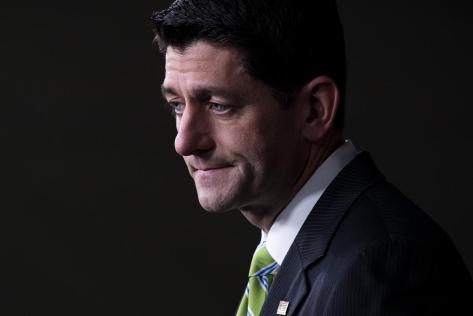
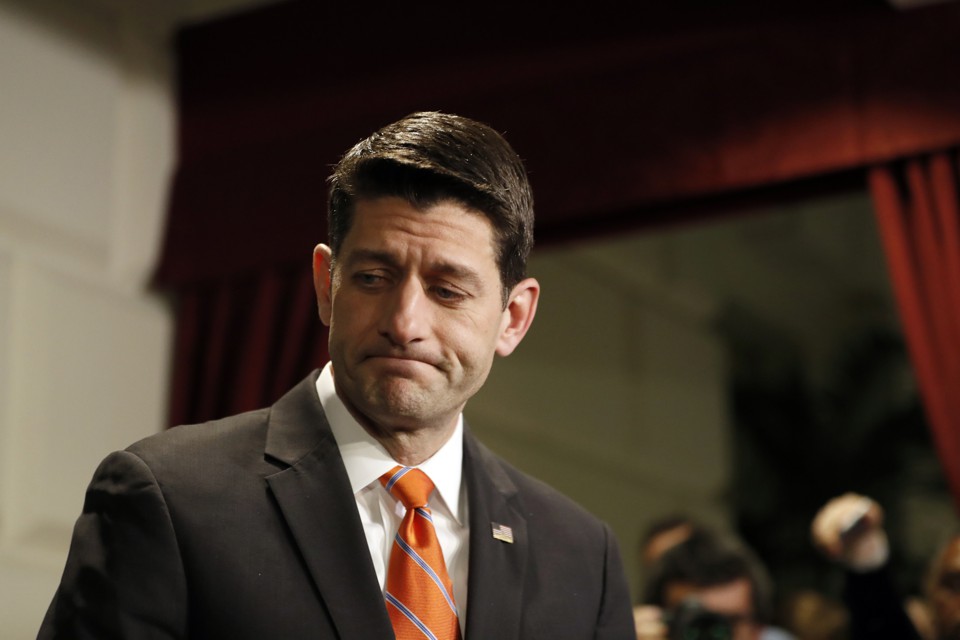
On Friday, those lawmakers abandoned that effort, conceding that the Republican Party’s core campaign pledge of the last seven years will go unfulfilled. “I will not sugarcoat this: This is a disappointing day for us,” House Speaker Paul Ryan said at a press conference after he informed Republicans that he was ditching the American Health Care Act.“We did not have quite the votes to replace this law,” Ryan said. “And, so yeah, we’re going to be living with Obamacare for the foreseeable future.”Earlier in the afternoon, Ryan informed President Trump at the White House that the bill could not pass the House, as blocs of conservatives and moderates resisted a week of frenzied lobbying from the administration and were determined to vote no. The legislation had faced an avalanche of opposition from the outset. Democrats rejected any rollback of the Obama-era law, while conservative activists rebelled against a proposal that fell short of a full repeal. And as opposition mounted, Republicans representing swing districts and Democratic states began to pull their support, worried about cuts to Medicaid, a broader projected loss of insurance coverage, and a potential backlash from voters in the midterm elections next year. The nonpartisan Congressional Budget Office found that the proposal would increase the number of uninsured Americans by 24 million people over a decade, and a Quinnipiac University poll showed that just 17 percent of potential voters supported the plan, with 56 percent opposed.

Trump had initially insisted that Republicans hold a vote on the bill regardless of the outcome, wanting to see which members would defy him. He dispatched his top lieutenants to Capitol Hill on Wednesday night to urge rank-and-file lawmakers to fall in line, ending negotiations with the party’s right and left flank on further changes to the bill. But few members were persuaded, and by Friday, party leaders in the House wanted to spare their members from having to cast a vote in favor of an unpopular bill that would not become law. At a hastily arranged meeting in the Capitol basement, Ryan told Republicans he had called off the vote and said Trump was on board with the decision. Minutes later, stone-faced lawmakers left the meeting and prepared to head back to their districts for the weekend. One Republican staffer was in tears as she exited the room.

While conservative members of the Freedom Caucus withheld their support despite winning a last-minute amendment to broaden the repeal, it was the defection of more moderate and electorally vulnerable members that sealed its fate. Republicans could afford to lose no more than 22 votes to achieve a majority, and in a statement at the White House Friday, Trump estimated that they were 10 to 15 votes short. In perhaps the most ominous sign for the GOP leadership, the chairman of the powerful Appropriations Committee, Representative Rodney Frelinghuysen of New Jersey, announced he would oppose the bill on Thursday morning. In previous generations, it would be unheard of for a top committee chairman to oppose party leaders on such a major vote. Representatives Barbara Comstock of Virginia and David Joyce of Ohio followed suit about an hour later, sapping momentum from the effort less than a day after Trump delivered his ultimatum to Republicans to pass his bill or see Obamacare live on.

The White House and GOP leaders searched for votes wherever they could, but there were few lawmakers willing to suddenly support a bill they had already publicly denounced. Representative Walter Jones of North Carolina, a frequent dissenter in the party, said he waved off a last-minute call from the office of Representative Steve Scalise of Louisiana, the party whip. “I said, ‘Let me tell you: I don’t want to waste his time,’” Jones told reporters. “I don’t see anybody that was a no yesterday changing their vote.” He then ripped into the proposal and the leadership’s insistence that it pass. “This was absolutely a bad decision to move this type of bill this early,” Jones said.

Defeat on the floor dealt Trump a major blow early in his presidency, but its implications were far more serious for the Republican Party as a whole. Handed unified control of the federal government for only the third time since World War II, the modern GOP was unable to overcome its internecine fights to enact a key part of its policy agenda. The president now wants to move on to a comprehensive overhaul of the tax code, but insiders on Capitol Hill have long believed that project will be an even heavier lift than health care.

As the prospect of a loss became more real on Friday, the frustrations of GOP lawmakers loyal to the leadership began to boil over. “I’ve been in this job eight years, and I’m wracking my brain to think of one thing our party has done that’s been something positive, that’s been something other than stopping something else from happening,” Representative Tom Rooney of Florida said in an interview. “We need to start having victories as a party. And if we can’t, then it’s hard to justify why we should be back here.”Nothing has exemplified the party’s governing challenge quite like health care. For years, Republican leaders resisted pressure from Democrats and rank-and-file lawmakers to coalesce around a detailed legislative alternative to Obamacare. That failure didn’t prevent them from attaining power, but it forced them to start nearly from scratch after Trump’s surprising victory in November. At Ryan’s urging, the party had compiled a plan as part of the speaker’s “A Better Way” campaign agenda. Translating that into legislation, however, proved a much stiffer challenge; committee leaders needed to navigate a razor’s edge to satisfy conservatives demanding a full repeal of Obamacare and satisfy moderates who preferred to keep in place its more popular consumer protections and Medicaid expansion. They were further limited by the procedural rules of the Senate, which circumscribed how far Republicans could go while still avoiding a Democratic filibuster.
The legislation Republicans came up with would have eliminated Obamacare’s insurance mandates and most of its tax increases, but it left in place many of the consumer protections that the public broadly supported. Conservatives were unhappy that the proposal did not immediately end the law’s Medicaid expansion or scrap all of its regulations, while moderates worried that the bill ultimately would leave too many of their constituents uninsured or facing higher costs than they do under the current system.Both Trump and Ryan characterized Obamacare as a law in collapse, even as they acknowledged Republicans now were powerless to repeal it. But despite the challenges it still faces, Democrats rejoiced at an unexpected reprieve for an achievement that appeared to be doomed a few months ago. “Today is a great day for our country. It’s a victory,” declared Nancy Pelosi, the House minority leader who steered the Affordable Care Act to passage seven years ago this month. Hillary Clinton cheered the news on Twitter. “Today was a victory for the 24,000,000 people at risk of losing their health insurance, for seniors, for families battling the quiet epidemic of addiction, for new moms and women everywhere,” she said. “Most of all, it’s a victory for anyone who believes affordable health care is a human right.”With the leadership’s plan dead, Republicans said they would try to move on to other issues. But the party’s failure on health care will sting, and it will linger. On Friday, Ryan was asked what GOP lawmakers should say to their constituents after promising them for so long they would repeal and replace Obamacare. The speaker was stumped. “That’s a good question,” he replied. “I wish I had a better answer for you.”


Well, we have won this battle. Twenty four million will keep their health insurance. This is a huge win for these families and the future of America.

We must remember, however, that we have not run the war.  The Republicans still plan to pass a tax plan that will increase the burden of the middle class and decrease the taxes on the 1%.  Trump still plans to build at Wall – at tax payers’ expense – that will do nothing to make the country safer, but will undoubtedly make us foolish in the eyes of our allies and enemies.  The Republicans still plan to gut the EPA and the National Endowment of the Arts and Meals on Wheels.

We must still Resist.

But, just for today, we can celebrate.


Namaste,

Barbara

Mensensamenleving.me

Mensen maken de samenleving en nemen daarin een positie in. Deze website geeft toegang tot een diversiteit aan artikelen die gaan over 'samenleven', belicht vanuit verschillende perspectieven. De artikelen hebben gemeen dat er gezocht wordt naar wat 'mensen bindt, in plaats van wat hen scheidt'.

Best Photo Editing Service Provider

Enhance your photos with professional precision using our top-notch photo editing services

John Oliver Mason

Observations about my life and the world around me.

Opalescence

The Middle Miocene Play of Color

Elicafrank's Blog

We didn’t end when we said goodbye maybe because the promise was ETERNITY

Ranjith's shortreads

Wanderers in the world

The Wallager

The news. The dog. Dialectics.

The Lewis Mix

Husband from Utah, Wife from Hong Kong, Two Mix Babies

Walter Singleton

Walter Singleton's blog, dedicated to Aiden Singleton and Seth Singleton living near Chattanooga, TN.

Gentle Joss / Wisdom of the Crone

Mentor and Writing assistance for women

Pax Et Dolor Magazine

Peace and Pain

SurveyStud, LLC

SurveyStud: https://appsto.re/us/Ddj18.i

Levi House

Speak out, judge righteously, defend the rights of the poor and the needy

Present Minded

A MODERN PERSPECTIVE ON COGNITIVE SCIENCE AND MENTAL HEALTH

oats

welcome!