“The decision to speak out is the vocation and lifelong peril by which the intellectual must live.” —Kay Boyle

“I went for years not finishing anything. Because, of course, when you finish something you can be judged…I had poems which were rewritten so many times I suspect it was just a way of avoiding sending them out.” —Erica Jong
There are ordinary truths and eloquent truths. The ordinary truth is that some painters can garner six figures for their canvases while you probably can’t. The eloquent truth is that this abrasive fact need not alter your resolve to live an authentic life. The ordinary truth is that you will make mistakes and messes and fall short many times. The eloquent truth is that this need not defeat you, that you can keep trying and that you can keep kicking. When you marry these two ideas—willing yourself to matter and willing yourselves to reckon with the facts of existence—you truth becomes much more eloquent.
We should be reminded of Sisyphus, who was doomed to toil for all time rolling a stone up a mountain but who rebelled by asserting an essential freedom of attitude. They myth of Sisyphus and his stone is the story of a man reckoning with the facts of existence and not subcumbing to them. Had he succumbed to them, he would have been left with nothing but an eternity of pain. Here is how the myth ends, Sisyphus teaches the higher fidelity that negates the gods and raises rocks. He concludes that all is well. This universe henceforth without a master seems to him neither sterile nor futile. Each atom of the stone, each mineral flake of that night-filled mountain, in itself forms a world. The struggle toward the heights is enough to fill a man’s heart. One must imagine Sisyphus happy.
A creator’s task is to reckon with the facts of existence very much as Sisyphus reckons with his. Viewed one way, it is a cruel, harsh and punitive universe. A creator might come to the same conclusion about his/her situation, were he/she to tote up the facts of existence not to his/her liking. Sisyphus has decided to force his life to mean. He makes use of the freedom at his disposal and reckons that, as he is not dead, he still has meaning to make. It seems absurd to call him happy but if that is how he sees his life, then who can argue with him?
We all have the choice to decide what our life is worth and what we have to give to others to make the world a better place. Let each and every one of us make the decision that benefits their inner needs. I choose to give back. I choose to make a difference. You can make your choices.
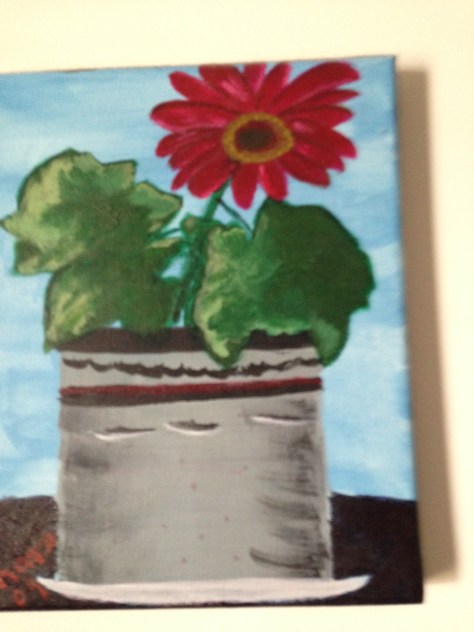
Gerber daisy. Acrylic paint
Painted by Barbara Mattio copyright 2009
“You have not lived a perfect day…unless you have done something for someone who will never be able to repay you. — Ruth Smeltzer





 idealisticrebel