THE HEALTH-CARE DEBACLE WAS A FAILURE OF CONSERVATISM
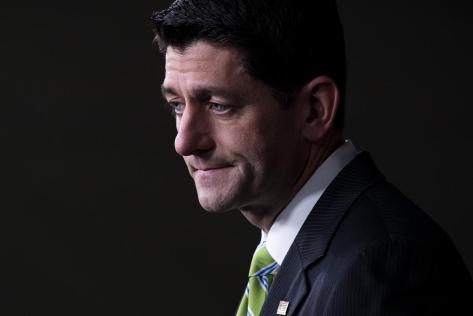
After seven years of fulminating against the Affordable Care Act, the House Republicans failed to come up with a workable and politically viable proposal.PHOTOGRAPH BY DREW ANGERER / GETTY
Let the recriminations begin! Actually, the health-care-failure finger-pointing got under way well before Friday, when Donald Trump and Paul Ryan cancelled a House vote on the American Health Care Act. A day earlier, aides to the President let it be known that he had come to regret going along with Ryan’s idea of making health care his first legislative priority.
In the coming days and weeks, there will be more of this blame shifting, and, in truth, there is plenty of blame to go around. Ryan failed to unify the House Republican caucus. Trump’s staff allowed him to endorse a bill that made a mockery of his campaign pledge to provide health insurance for everybody. And Trump himself blundered into a political fiasco, apparently believing he could win over recalcitrant Republican members of Congress simply by popping over to Capitol Hill.
But this is just politics. The larger lesson here is that conservatism failed and social democracy won. After seven years of fulminating against the Affordable Care Act and promising to replace it with a more free-market-oriented alternative, the House Republicans—who are in the vanguard of the modern conservative movement—failed to come up with a workable and politically viable proposal. Obamacare survived, and that shouldn’t be so surprising. When it comes to health-care policy, there is no workable or politically viable conservative alternative.
Of course, that isn’t how conservative lawmakers, pundits, and policy wonks will spin this. They will argue that Trump and Ryan betrayed free-market principles: if only they had proposed the outright repeal of Obamacare, and put forward a bill that genuinely liberated the health-care industry from federal intervention, everything would have worked out well. That will be the story—and it is a fairy tale.
The fact is that the health-care industry, which makes up about a sixth of the American economy, isn’t like the market for apples or iPhones. For a number of reasons (which economists understand pretty well), it is riven with problems. Serious illnesses can be enormously costly to treat; people don’t know when they will get ill; the buyers of health insurance know more about their health than the sellers; and insurers have a strong incentive to avoid providing their product to the sick people who need it the most.
Since the days of Otto von Bismarck, most developed countries have dealt with these problems by setting up a system in which the state provides medical insurance directly, or else mandates and subsidizes the purchase of private insurance, setting strict rules for what sorts of policies can be sold. Obamacare amounts to a hybrid model. It supplements employer-provided insurance, the traditional American way of obtaining health care, with a heavily regulated (and subsidized) individual insurance market and an expanded Medicaid system.
It is far from perfect. But, in combining mandates with subsidies, regulation, and access to a state-administered system for the poverty-stricken and low-paid, it is intellectually coherent. (Many of the problems it has encountered arose because the mandate to purchase insurance hasn’t been effectively enforced, and not enough young and healthy individuals have signed up.) Since it leaves in place the basic structure of private insurance and private provision, Obamacare is also conservative. As is well known, parts of it resemble a proposal that the Heritage Foundation put forward in 1992.
Today’s conservatives act as if they can simply wish away some of the problems that Obamacare was created to deal with. The original version of the American Health Care Act left in place many of the A.C.A.’s regulations but cut back the subsidies and gutted its Medicaid expansion. Had it been enacted, it would have led to higher premiums, at least in the short term, and a huge drop in coverage—twenty-four million people over ten years, according to the Congressional Budget Office. As these implications of the G.O.P. proposal became known to the public, the plan’s approval rating fell and fell. In the end, according to a Quinnipiac poll, only nineteen per cent of Americans supported it.
The Freedom Caucus, a group of right-wing conservatives in the House, wanted a bill that stripped away more regulations, which they claimed would enable insurers to offer cheaper and more flexible plans. On the eve of the vote, Ryan agreed to change a clause defining the “essential health benefits” that insurers are required to provide if they sell policies on the Obamacare exchanges—benefits including maternity and mental-health services. But this change would have created two insurmountable problems.
Once insurers were able to craft individual policies without adhering to any list of required benefits, buyers would self-select. Young, healthy people would choose cheap, crappy policies, and older, sicker people would choose more comprehensive policies. Insurers, knowing this, would raise the prices of the good policies. “Worthless policies would get really cheap, but comprehensive policies would get astronomically expensive,” Mother Jones’s Kevin Drum pointed out. “Virtually no one would be able to afford them.The other problem was political. Americans need maternity coverage, mental-health benefits, prescription drugs, pediatric services, lab tests, and the other things included on the list of essential health benefits. When moderate Republicans in places like New York, New Jersey, and Pennsylvania heard that these services might be eliminated under the amended legislation, they abandoned it in significant numbers. It was their desertion that ultimately killed the bill.
O.K., you might say: The American Health Care Act was a disaster, but what about all the other Republican health-care proposals that are out there? Maybe one of them provides a workable alternative to Obamacare. Let’s briefly look at a few of them.
When he was in Congress, Tom Price, the Secretary of Health and Human Services, who supported the A.H.C.A., put forward a bill of his own. But it was basically a less generous version of the bill that just died: in gutting Medicaid and strictly limiting federal funding for high-risk pools to insure sick people, it would surely lead to a big rise in the number of uninsured. Something similar applies to a bill put forward by Senator Orrin Hatch, who chairs the Senate Finance Committee.
There are a few other plans kicking around conservative think tanks, some of which, like Obamacare, tie the level of subsidies to income. But all of these plans have other serious problems. In eschewing purchasing mandates, they run into the issue of younger people being unlikely to sign up for coverage. In giving insurers more freedom to offer different plans and different pricing structures, they encourage self-selection and undermine the risk-pooling that is at the heart of successful insurance schemes. And in cutting federal support for Medicaid, they dismantle the element of Obamacare that has been the most successful at insuring more people at a reasonable cost.
Another Republican plan that may now attract some attention is the proposal put forward by Senators Bill Cassidy, of Louisiana, and Susan Collins, of Maine. But, far from dismantling Obamacare, the Cassidy-Collins plan would allow big, populous states like New York and California to keep the current system in place, including the Medicaid expansion and the surtaxes on high earners. Red states that don’t like Obamacare would be able to take federal money and design their own systems to provide basic, catastrophic coverage plans to everybody.
Because it retains so much of Obamacare, this proposal seems unlikely to receive majority support inside the G.O.P. In the coming weeks, Republicans in the Senate and the House will be trying anew to come up with an alternative that they can unite around, portray as a big break from the A.C.A., and sell to the American public. The lesson of the past few weeks is that they are likely to fail. As a novice to the subject noted recently, health care is complicated. Too complicated for ad-hoc policymaking and simplistic conservative nostrums.
The Republicans Fold on Health Care
The House abandoned its legislation to repeal and replace the Affordable Care Act, handing President Trump and Speaker Paul Ryan a major defeat.
To a man and woman, nearly every one of the 237 Republicans elected to the House last November made the same promise to voters: Give us control of Congress and the White House, and we will repeal and replace the Affordable Care Act.
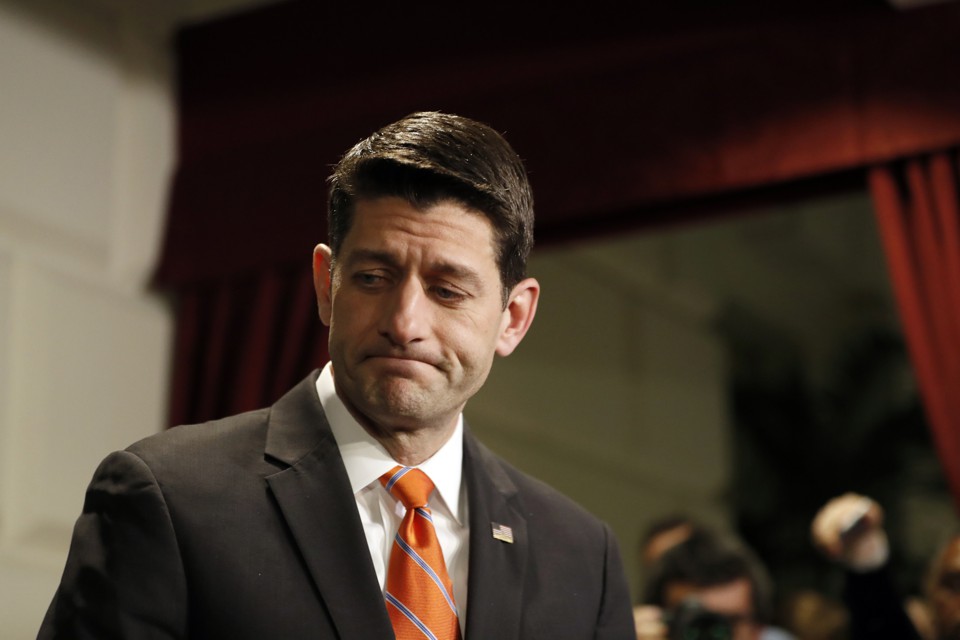
On Friday, those lawmakers abandoned that effort, conceding that the Republican Party’s core campaign pledge of the last seven years will go unfulfilled. “I will not sugarcoat this: This is a disappointing day for us,” House Speaker Paul Ryan said at a press conference after he informed Republicans that he was ditching the American Health Care Act.“We did not have quite the votes to replace this law,” Ryan said. “And, so yeah, we’re going to be living with Obamacare for the foreseeable future.”Earlier in the afternoon, Ryan informed President Trump at the White House that the bill could not pass the House, as blocs of conservatives and moderates resisted a week of frenzied lobbying from the administration and were determined to vote no. The legislation had faced an avalanche of opposition from the outset. Democrats rejected any rollback of the Obama-era law, while conservative activists rebelled against a proposal that fell short of a full repeal. And as opposition mounted, Republicans representing swing districts and Democratic states began to pull their support, worried about cuts to Medicaid, a broader projected loss of insurance coverage, and a potential backlash from voters in the midterm elections next year. The nonpartisan Congressional Budget Office found that the proposal would increase the number of uninsured Americans by 24 million people over a decade, and a Quinnipiac University poll showed that just 17 percent of potential voters supported the plan, with 56 percent opposed.
Trump had initially insisted that Republicans hold a vote on the bill regardless of the outcome, wanting to see which members would defy him. He dispatched his top lieutenants to Capitol Hill on Wednesday night to urge rank-and-file lawmakers to fall in line, ending negotiations with the party’s right and left flank on further changes to the bill. But few members were persuaded, and by Friday, party leaders in the House wanted to spare their members from having to cast a vote in favor of an unpopular bill that would not become law. At a hastily arranged meeting in the Capitol basement, Ryan told Republicans he had called off the vote and said Trump was on board with the decision. Minutes later, stone-faced lawmakers left the meeting and prepared to head back to their districts for the weekend. One Republican staffer was in tears as she exited the room.
While conservative members of the Freedom Caucus withheld their support despite winning a last-minute amendment to broaden the repeal, it was the defection of more moderate and electorally vulnerable members that sealed its fate. Republicans could afford to lose no more than 22 votes to achieve a majority, and in a statement at the White House Friday, Trump estimated that they were 10 to 15 votes short. In perhaps the most ominous sign for the GOP leadership, the chairman of the powerful Appropriations Committee, Representative Rodney Frelinghuysen of New Jersey, announced he would oppose the bill on Thursday morning. In previous generations, it would be unheard of for a top committee chairman to oppose party leaders on such a major vote. Representatives Barbara Comstock of Virginia and David Joyce of Ohio followed suit about an hour later, sapping momentum from the effort less than a day after Trump delivered his ultimatum to Republicans to pass his bill or see Obamacare live on.
The White House and GOP leaders searched for votes wherever they could, but there were few lawmakers willing to suddenly support a bill they had already publicly denounced. Representative Walter Jones of North Carolina, a frequent dissenter in the party, said he waved off a last-minute call from the office of Representative Steve Scalise of Louisiana, the party whip. “I said, ‘Let me tell you: I don’t want to waste his time,’” Jones told reporters. “I don’t see anybody that was a no yesterday changing their vote.” He then ripped into the proposal and the leadership’s insistence that it pass. “This was absolutely a bad decision to move this type of bill this early,” Jones said.
Defeat on the floor dealt Trump a major blow early in his presidency, but its implications were far more serious for the Republican Party as a whole. Handed unified control of the federal government for only the third time since World War II, the modern GOP was unable to overcome its internecine fights to enact a key part of its policy agenda. The president now wants to move on to a comprehensive overhaul of the tax code, but insiders on Capitol Hill have long believed that project will be an even heavier lift than health care.
As the prospect of a loss became more real on Friday, the frustrations of GOP lawmakers loyal to the leadership began to boil over. “I’ve been in this job eight years, and I’m wracking my brain to think of one thing our party has done that’s been something positive, that’s been something other than stopping something else from happening,” Representative Tom Rooney of Florida said in an interview. “We need to start having victories as a party. And if we can’t, then it’s hard to justify why we should be back here.”Nothing has exemplified the party’s governing challenge quite like health care. For years, Republican leaders resisted pressure from Democrats and rank-and-file lawmakers to coalesce around a detailed legislative alternative to Obamacare. That failure didn’t prevent them from attaining power, but it forced them to start nearly from scratch after Trump’s surprising victory in November. At Ryan’s urging, the party had compiled a plan as part of the speaker’s “A Better Way” campaign agenda. Translating that into legislation, however, proved a much stiffer challenge; committee leaders needed to navigate a razor’s edge to satisfy conservatives demanding a full repeal of Obamacare and satisfy moderates who preferred to keep in place its more popular consumer protections and Medicaid expansion. They were further limited by the procedural rules of the Senate, which circumscribed how far Republicans could go while still avoiding a Democratic filibuster.The legislation Republicans came up with would have eliminated Obamacare’s insurance mandates and most of its tax increases, but it left in place many of the consumer protections that the public broadly supported. Conservatives were unhappy that the proposal did not immediately end the law’s Medicaid expansion or scrap all of its regulations, while moderates worried that the bill ultimately would leave too many of their constituents uninsured or facing higher costs than they do under the current system.Both Trump and Ryan characterized Obamacare as a law in collapse, even as they acknowledged Republicans now were powerless to repeal it. But despite the challenges it still faces, Democrats rejoiced at an unexpected reprieve for an achievement that appeared to be doomed a few months ago. “Today is a great day for our country. It’s a victory,” declared Nancy Pelosi, the House minority leader who steered the Affordable Care Act to passage seven years ago this month. Hillary Clinton cheered the news on Twitter. “Today was a victory for the 24,000,000 people at risk of losing their health insurance, for seniors, for families battling the quiet epidemic of addiction, for new moms and women everywhere,” she said. “Most of all, it’s a victory for anyone who believes affordable health care is a human right.”With the leadership’s plan dead, Republicans said they would try to move on to other issues. But the party’s failure on health care will sting, and it will linger. On Friday, Ryan was asked what GOP lawmakers should say to their constituents after promising them for so long they would repeal and replace Obamacare. The speaker was stumped. “That’s a good question,” he replied. “I wish I had a better answer for you.”
Well, we have won this battle. Twenty four million will keep their health insurance. This is a huge win for these families and the future of America.
We must remember, however, that we have not run the war. The Republicans still plan to pass a tax plan that will increase the burden of the middle class and decrease the taxes on the 1%. Trump still plans to build at Wall – at tax payers’ expense – that will do nothing to make the country safer, but will undoubtedly make us foolish in the eyes of our allies and enemies. The Republicans still plan to gut the EPA and the National Endowment of the Arts and Meals on Wheels.
House Republicans released draft legislation Monday to replace former president Barack Obama’s signature health care law, proposing to phase out the Affordable Care Act’s Medicaid expansion and change the law’s subsidies for private insurance.
“It is Obamacare gone,” House Ways and Means Chairman Kevin Brady, R-Texas, told Fox News. “There’s nothing left there.”
The bill’s details released Monday do not say how many people would have coverage compared with Obamacare. But federal support would be reduced to allow Republicans to repeal the law’s tax increases on the wealthy, insurance companies, drugmakers and others.
The bill would also repeal the requirements that most people buy insurance and larger employers provide it.
It would still allow adult children to stay on their parents’ plans until age 26. And the bill would not repeal the popular provision barring insurance companies from denying coverage to people with pre-existing health problems. Instead, to keep people from buying coverage only when they need it, insurers could raise premiums 30% for those jumping back into the market.
The legislation is already under attack not only from Democrats but from some Republicans who have raised concerns about eliminating coverage for millions of people who got coverage under the bill’s expanded Medicaid eligibility. In addition, some of the most conservative Republicans have warned that the replacement tax credits the bill provided to help people buy insurance would be just another entitlement program.
House committees are expected to take up the legislation later this week.
“We deliver on President Trump’s promise to repeal and to begin replacing,” Brady said.
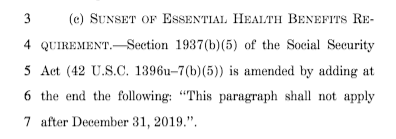
States that expanded Medicaid under the Affordable Care Act to people earning up to 138% of poverty could still get federal funding for those enrolled before January 2020. But if those beneficiaries left the program, the federal funding would disappear.
States would also no longer receive an open-ended federal match on the amount they spend on all Medicaid beneficiaries. Instead, they would be given a set amount based on the number of enrollees in different coverage categories, such as the disabled, aged and children.
“What we want to do is restore power to the states put Medicaid on a budget,” Oregon Republican Rep. Greg Walden, chairman of the House Energy and Commerce Committee, told Fox News.
Four Republican senators — Rob Portman of Ohio, Shelley Moore Capito of West Virginia, Cory Gardner of Colorado and Lisa Murkowski of Alaska — said Monday they were concerned that an early draft of the bill had not provided enough “stability and certainty” for families covered by the Medicaid expansion. They said any replacement plan offer a “stable transition period and the opportunity to gradually phase-in their populations to any new Medicaid financing structure.”
It was not immediately clear whether the bill unveiled Monday night would put those concerns to rest.
Some conservative Republicans have complained about the subsidies that would replace the tax credits the ACA provides to help people earning up to 400% of poverty buy private insurance if they’re not offered plans through a job.
The GOP alternative offers refundable credits that become more generous with age. Unlike an earlier draft, the credits phase out at higher income levels. But at lower income levels, recipients can still receive a larger credit than the amount of taxes they owe, which has raised concerns among some Republicans.
The tax credits would range from $2,000 to $14,000 a year.
Those receiving tax credits can use them to purchase any insurance plans, not just those sold on the exchanges created by the Affordable Care Act. That would include purchasing “catastrophic” plans that offer limited coverage. They could not use the credits for plans that cover abortion services.
Democrats across the board have promised to fight any changes to the law that would scale back health care coverage.
Oregon Sen. Ron Wyden, the top Democrat on the Senate Finance Committee, said Americans would pay more and get less coverage under the GOP bill.
“This bill sends a loud and clear message: tax cuts for special interests and the wealthy matter more than your health care,” he said in a statement. “Congressional Republicans are leading a desperate forced march to pass a dangerous bill written in secret which few members of Congress have seen, let alone read.”
The new version of the bill no longer includes a provision included in the draft to limit the existing tax exemption on employer-provided plans. As before the ACA passed, neither employers nor their workers are taxed on the value of health care coverage provided through a job. An earlier version of the bill would have imposed a tax on more generous plans. That was opposed by business groups and labor unions.
The ACA imposed a tax on high-cost plans, which has been delayed until 2020. The GOP bill would repeal that tax, but it would come back in 10 years in order to keep the bill within cost limits.
The bill increases the tax benefits for health savings accounts, raising the limits on how much people can put aside for health expenses.
Ron Pollack, executive director of the advocacy group Families USA, said the bill doesn’t deliver on Trump’s promise to offer “insurance for everybody” that is “much less expensive and much better.”
“This bill would strip coverage from millions of people and drive up consumer costs,” he said.
The House Republican Obamacare replacement package is finally out, and the two main health care committees — Ways and Means, and Energy and Commerce — are scheduled to start working on the bills on Wednesday. Here’s your speed read on what’s in them — summaries are available here and here:
In:
Pre-existing condition coverage
Continuous coverage — 30 percent penalty if people don’t keep themselves insured
Special fund to help states set up “high-risk” pools, fix their insurance markets, or help low-income patients
Enrollment in expanded Medicaid will be frozen
Current enrollees can stay until 2020, and keep getting extra federal funds, until they leave the program on their own
Medicaid will change to “per capita caps” (funding limits for each person) in fiscal year 2020
A new, refundable tax credit will be available in 2020 to help people buy health insurance
Covers five age groups — starts at $2,000 for people in their 20s, increases to $4,000 for people in their 60s
It’s not means tested, but phased out for upper-income people (starting at $75,000 for individuals, $150,000 for families)
Insurers can charge older customers five times as much as young adults
Out:
All Obamacare taxes
All Obamacare subsidies, including its premium tax credit
Individual, employer mandate penalties
“Cadillac tax” (until 2025)
No longer will limit the tax break for employer-sponsored health coverage
No payments to insurers for cost-sharing reductions
Selling insurance across state lines (can’t be done in the “reconciliation” bill)
Medical malpractice reform (can’t be done in the “reconciliation” bill)
Panel: Repeal of ObamaCare taxes would cost more than $500B
The Joint Committee on Taxation on Tuesday released estimates showing that the repeal and delay of many of ObamaCare’s taxes in the House Republicans’ legislation would result in more than $500 billion in lost federal revenue.
The GOP legislation would repeal most of ObamaCare’s taxes, with the notable exception of the “Cadillac tax” on high-cost health plans.
Under current law, the Cadillac tax is set to take effect in 2020, and the bill would delay the Cadillac tax until 2025. The committee, which provides official revenue estimates of tax legislation, estimated that delaying the tax would cost $48.7 billion over 10 years.
Several excise taxes on parts of the healthcare industry would also be repealed.
The committee estimated that over a 10-year period, repealing the 2.3 percent medical-device tax would reduce revenue by $19.6 billion over 10 years, repealing the tax on brand pharmaceutical companies would cost $24.8 billion and repealing the health-insurance tax would cost $144.7 billion. Repealing the 10-percent sales tax on indoor tanning services would cost $600 million.
Two of the ObamaCare taxes that would be repealed are targeted at people with high incomes. The committee estimated that repealing ObamaCare’s net investment tax on the wealthy would reduce revenue by $157.6 billion over 10 years, and repealing the Medicare surtax on high earners would reduce revenue by $117.3 billion.A provision to repeal the $500,000 cap on the deduction health insurance companies can take for an employee’s compensation would lower revenue by $400 million, the panel said.
The committee released revenue estimates of some parts of the GOP legislation, but a full “score” of the legislation remains unavailable.
The independent Congressional Budget Office (CBO) is preparing a thorough accounting of the bill’s projected impact.
Some revenue-related parts of the bill, such as repealing the individual and employer mandates and creating new refundable tax credits, will be included in the CBO’s estimates. The CBO score is also expected to include estimates about the number of people who would lose healthcare coverage under the bill.
Many Democratic lawmakers have blasted Republicans for scheduling committee markups of the legislation before the full CBO score is released.
“We don’t even know how large of a negative impact this bill would have yet because Republicans are irresponsibly rushing forward before this bill even receives a score from CBO,” Senate Minority Leader Charles Schumer (D-N.Y.) said Tuesday.
The estimates from the committee focus on the provisions that the House Ways and Means Committee will consider Wednesday. The House Energy and Commerce Committee is also slated to mark up their portion of the legislation that day.
Democrats and liberal groups have blasted the House GOP legislation as a tax cut for the wealthy.
“The bill is a winning lottery ticket for wealthy Americans,” Schumer said.
But Ways and Means Committee Chairman Kevin Brady (R-Texas) on Tuesday defended repealing the ObamaCare taxes.
“I look at the 20,000 jobs that have left America because of the irresponsible, medical-device tax, I look at the health insurance taxes and others that drove up healthcare costs on Americans, especially those who could least afford it,” Brady said.
“You run down tax increase after tax increase after tax increase, they hurt the economy, they hurt healthcare, they achieve nothing,” he said. “I don’t want Americans to continue to struggle under the ObamaCare taxes.”
In order for the GOP healthcare plan to pass the Senate with a simple majority, it can’t increase the deficit after 10 years. Brady said lawmakers would make sure the measure follows that rule.
The GOP is completely botching the rollout of its health care plan
Emily Singer
House Republicans unveiled their Affordable Care Act repeal bill Monday night, a long-awaited plan the GOP has promised since the ACA was first passed in 2010.
But the party is already botching the rollout, with confusion about everything from who the plan would impact, how much it would add to the federal deficit and even whether this is the GOP’s whole plan or if there’s more to come.
Even worse for Republicans is that members of their own party — who should be the easiest to convince to support their plan — are already threatening to block the legislation, saying it does not actually repeal the ACA and dubbing it “Obamacare 2.0” and “Obamacare Lite.”
Attacked by their own
Not even 24 hours after the release of the bill, Republicans have already started to revolt.
Americans for Prosperity, a conservative advocacy group funded by the Koch brothers, slammed the bill, telling the Washington Post that the group will pressure Republicans to pass a full repeal “both in Washington in a very vocal way” and “also back home in their districts.”
The Heritage Foundation, a think tank that sides with the most conservative wing of the Republican Party, came out with a statement railing against the bill.
“Many Americans seeking health insurance on the individual market will notice no significant difference between the Affordable Care Act (i.e., Obamacare) and the American Health Care Act,” Heritage Action CEO Michael A. Needham said in a statement. “That is bad politics and, more importantly, bad policy.”
The bill was even attacked on Fox News — the place Republicans go to sell plans to their base — with Trump-supporting media personality Laura Ingraham saying none of Trump’s health care promises are in the bill, including allowing for the sale of health care across state lines.
Ingraham’s comments clearly caught Trump’s eye, as he responded with a tweet to Fox & Friends, the show Ingraham appeared on, saying “Don’t worry, getting rid of state lines, which will promote competition, will be in phase 2 & 3 of healthcare rollout.”
No clear answers
While the GOP has railed against Democrats for years for passing Obamacare without knowing all of its impacts, House Republicans released their bill without knowing how many people could stand to lose their coverage under the plan, nor how it would impact the federal deficit.
Republican legislators pointed that out, including Sen. Mike Lee, a conservative GOP lawmaker from Utah, who said in a statement the plan amounted to “exactly the type of back-room dealing and rushed process that we criticized Democrats for.”
Multiple news outlets also published conflicting reports about whether “essential health benefits” like maternity coverage and addiction treatment — which were required under Obamacare — would be preserved in the GOP’s plan.
The messengers the GOP sent out to answer vital questions were of no help.
Office of Management and Budget Director Mick Mulvaney — who will be tasked with writing the president’s budget for things like health care spending — dodged questions on NBC’s Today about whether people would lose coverage under the GOP plan or how much it would impact the budget.
That information would be announced after a review by the Congressional Budget Office — a federal agency that provides “independent analyses of budgetary and economic issues” such as health care. But the CBO has yet to release their findings.
Rep. Jason Chaffetz (R-Utah) used his time on CNN discussing the bill to attack Americans for prioritizing buying iPhones rather than buying health insurance.
And Trump’s own comments that more phases to their ACA fix were coming only added to the confusion around the law.
Of course, health care policy is confusing and complicated.
Trump came to that realization late last month — long after folks like former President Barack Obama, who had said for years that health care reform is complicated. But the GOP had no messengers out Tuesday morning to end the confusion about the bill.
Generally, the rollout has left onlookers supremely confused about what’s in store for their health care.
Better luck in phase two?
Emily C. Singer, née Cahn, is a senior writer for Mic covering politics. She is based in New York and can be reached at esinger@mic.com
Let’s Agree Not To Lie About GOPCare
Bill Clark
Here is the simple secret of health insurance and health care provision policy: You can create efficiencies and savings by constructing functioning markets. But at the end of the day, more money equals more care. Or in the proxy we judge these things by, more money means more people are insured. If you see a plan that costs a lot less money than Obamacare, it means many fewer people will be covered. It’s as simple as that. You may have to look closely at the details to see just where the care reductions are made. But it’s there, just as certain as night follows day.
The hardcore conservatives in the so-called “Freedom Caucus” are right. The real way to do this is simply to repeal the Affordable Care Act root and branch – no pretending about making it better and “access” and other nostrums. Just set the clock back to 2009 and pretend the whole thing never happened. There are certain disruptions this will cause that go well beyond just setting back the clock. But there is at least an honesty and clarity to the exercise: the government, public policy has no interest in making sure people are insured.
The problem is that over the course of seven years Republicans have essentially accepted the premise of the ACA: which is to say, the people who got coverage under the ACA should have coverage. That’s what’s made ‘replace’ all but impossible. That’s why we’ve heard years of claims that the replacement would be even better. Even more people would be covered. The coverage would be better. The deductibles would be lower – even though a key element of GOP health insurance policy is that deductibles should be higher.
That’s coming apart now, now that we’re in the crunch. And we’re hearing talk of coverage replaced by ‘access’. ‘Access’ is the eatability of famine policy studies. There’s plenty of food to eat, as long as you have money to buy it. Access rather than food.
So long as we don’t have a universal system such as exists in various permutations in virtually every other wealthy industrialized country, the only real measure of policy success or failure is the number of people who have health care coverage – not theoretical access to coverage, coverage. Health savings accounts may have some marginal utility as they exist today. They don’t count as health care coverage. Democrats and everyone else who cares for the millions who are about to be tossed onto the chopping block need to force an honest setting of the terms of the debate now. The number of uninsured people has dropped dramatically over the last five years. It’s about to start going up again. It will go up even higher once the mid-term elections are past since the GOP plan is designed to push much of the bloodletting past the mid-term election. The current plan also starts the phaseout of Medicaid and preps for the phaseout of Medicare – a key policy goal for Paul Ryan.
The number of people with usable insurance is the only measure that counts. “Access” is bullshit. I’m sorry to put it in such a raw fashion but that is the fact. The number of people who lose their insurance is the only legitimate measure. And it doesn’t really matter whether they lose their care in 2017 or 2020. That’s just political gamesmanship.
This is the reality. The real issue is access to quality medical care. In our system, you only have true access to medical care when you have a health insurance policy. Access to health insurance is a meaningless concept. Coverage is all that matters.
I hope everyone is up to this political challenge. There are millions of people who are about to lose their health insurance coverage for a mix of ideology, political need and tax cuts.
What if there’s no affordable insurance to buy?
In this Sunday, March 5, 2017, photo, Leslie Kurtz, right, poses for a picture with her husband, Bart Bartram, daughter Rainey, and son Rio as she holds a print of an X-ray of her ankle, in Knoxville, Tenn. Leslie Kurtz needed three plates, eight screws and a big assist from her insurer after breaking every bone in her ankle during a whitewater rafting accident in 2015. Coverage she purchased through a public insurance exchange established by the federal health care law helped with her medical expenses, but that protection may not exist next year because insurers have abandoned her exchange. (AP Photo/Wade Payne)
Graphic shows county-level data for health insurance providers under the Affordable Care Act;
Leslie Kurtz needed three plates, eight screws and a big assist from her insurer after breaking every bone in her ankle while white water rafting.
Coverage she purchased through a public insurance exchange established by the federal health care law paid $65,000 toward surgery and the care she needed after the 2015 accident. But that protection may not exist next year because insurers have abandoned the Knoxville, Tennessee resident’s exchange. As of now, Kurtz has no future coverage options, and she is worried.
“I can’t afford to have everything I’ve worked for taken away because I fell down the steps,” Kurtz said.
Her county is one of 16 in Tennessee that lack even a single insurance company committed to offering coverage for 2018 on the exchange, after Humana announced last month plans to exit.
Exchanges set up by the Affordable Care Act were designed to give customers a chance to shop for coverage and then buy a plan, most with help from tax credits. The idea was that such a marketplace would push insurers to offer affordable plans to compete for customers.
But insurers in many markets have been pulling back from the exchanges after losing money. According to an analysis by the Associated Press and the health care firm Avalere Health, more than 1,000 counties, where about 2.8 million people are insured through the exchanges, are down to their last insurance carrier, according to the most recent data.
With less competition, that could mean sharply higher rates. And with more insurers still considering leaving other markets, customers around the country could be stuck like Kurtz with no affordable coverage options in 2018.
Insurers still have a few more weeks to decide to stay in their exchanges, and other insurers may jump into new markets, though that can be expensive and risky for them. The government recently announced several short-term fixes for the exchanges, and insurers have welcomed the moves. But they want to see the final version of the improvements before deciding on 2018.
“No insurer wants the negative public backlash from dropping insurance for lots of people, but the companies need to feel like the market is stable and that there’s a chance of making money,” said Larry Levitt, a health insurance expert with the nonprofit Kaiser Family Foundation.
Chief among undecided companies is the Blue Cross-Blue Shield carrier Anthem Inc. It is the lone insurer on exchanges in 300 counties in seven states, according to data compiled by the AP and Avalere.
Anthem CEO Joseph Swedish would not commit to participating on exchanges next year and said in a statement last month that the market is sliding toward “significant deterioration and requires changes to ensure future stability and affordability.”
Anthem and the many other companies that sell coverage under the Blue Cross-Blue Shield brand will be crucial to the fate of the exchanges because they often specialize in insurance for individuals, and many have a long-standing presence in their markets. They also are the only remaining option on exchanges in nearly a third of the nation’s 3,100 counties.
For instance, Blue Cross and Blue Shield of North Carolina is the lone exchange option in 95 counties, covering more than 500,000 people, according to the analysis by AP and Avalere. The North Carolina insurer, which is not owned by Anthem, declined to comment on its 2018 plans.
Insurers typically are still sorting out coverage plans at this time of year, so it’s not unusual for them to be undecided about 2018. But never before have insurers bluntly stated that they can’t commit until they see what the government does to improve the exchanges.
The Kaiser Family Foundation’s Levitt says insurers are worried about losses, but they also may be using the leverage their indecision gives them.
“Insurers kind of want the threat that they may pull out to be taken seriously now, so that they get some of the changes they are looking for,” he said.
Customers can buy coverage outside the exchanges, if insurers are selling individual plans in their market. But then they won’t be able to use tax credits to help pay the bills, which may be particularly painful since many markets have seen prices soar.
Customers won’t know for certain who is selling on their exchanges until next fall. While insurers have to apply to sell coverage on their exchanges generally by late spring or early summer, they can drop out later if claims turn out worse than expected, noted Dave Dillon, a fellow of the Society of Actuaries.
Last fall, Blue Cross and Blue Shield Nebraska announced a little more than a month before open enrollment started that it was shuttering its exchange business due to a loss of $140 million.
Insurance experts have said bigger metropolitan areas usually have more choice on their exchanges. But smaller cities or rural areas could be hurt most if more insurers pull back.
Customers who already lost exchange options for 2018 are concerned. Knoxville resident Melissa Nance bought her Humana plan on the exchange without a subsidy, but she’s worried that she won’t find an affordable replacement after that insurer leaves.
The 45-year-old is fighting an aggressive form of leukemia. She needs insurance to cover blood tests and CT scans to detect whether the cancer has returned.
“I’m a sick person now,” she said. “I am constantly having to go to the doctor.”
Fellow Knoxville resident Leslie Kurtz is thinking about moving. The self-employed television producer needs subsidies to afford coverage for her family of four.
Kurtz says she would have gone bankrupt if she had no insurance when she broke her ankle.
“I don’t have $65,000, I would have had to sell the house,” she said. “We need access to health care because (stuff) happens.”
Trump White House Sends Mixed Signals on House Health Bill
Monday night statement from Spicer was much more tepid than Trump’s tweet
President Donald Trump greets Speaker Paul Ryan, R-Wis., after addressing a joint session of Congress last week. The president appeared to embrace Ryan’s Obamacare-replacement plan in a morning tweet. (Photo By Tom Williams/CQ Roll Call)
Updated at 1:42 p.m. | With a single word — “our” — in a single tweet, President Donald Trump appeared to embrace a House GOP-crafted bill that would replace the 2010 health care law. But it also was the latest example of the administration’s mixed signals about the House measure.
Trump, as he often does, took to his preferred method of communication, during the 7 a.m. hour Tuesday. He started by taking another swipe at his predecessor, Barack Obama, tweeting that the 44th president returned 122 “vicious” Guantanamo Bay terrorism detainees back “to the battlefield,” dubbing it “just another terrible decision.”
But Trump wasn’t finished, and made news — and likely making some top House GOP leaders breathe a bit a easier — with his next tweet. The president wrote that “our wonderful” bill that would replace Obama’s signature domestic achievement has been released for “review and negotiation.”The White House, however, was less enthusiastic about the House measure in an official statement released shortly after the bill was unveiled Monday evening.
“Obamacare has proven to be a disaster with fewer options, inferior care, and skyrocketing costs that are crushing small business and families across America,” press secretary Sean Spicer said in the statement, oddly released to that day’s press pool rather than blasted out via the White House’s media email list.
“Today marks an important step toward restoring healthcare choices and affordability back to the American people,” Spicer said. “President Trump looks forward to working with both Chambers of Congress to repeal and replace Obamacare.”
With the bill already received skeptically by Republicans in the Senate and many conservatives in the House, White House officials could be seeking to keep a little distance between the president and what is not yet a sure-to-pass measure that is riling up town hall participants and not polling that well.
Health and Human Services Secretary Tom Price weighed in supporting the House bill, and made his way over to the Senate Tuesday for Republicans’ policy lunch. In a letter to House Ways and Means Chairman Kevin Brady and Energy and Commerce Chairman Greg Walden, Price wrote “On behalf of the Trump administration, I am writing in support of the reconciliation recommendations recently for consideration by your committees.”
The differing tones marked the latest vacillation on the House bill by the administration, which at times has been eager to attach itself to what Speaker Paul D. Ryan, R-Wis., and Co. have been working on while at other times signaling the president might release his own Affordable Care Act replacement plan.
For instance, on Monday, Spicer, during an off-camera “gaggle,” told reporters the Republican health care push has been a “joint effort.” But on Feb. 22, Trump’s top spokesman left the door open for Trump to roll out his own plan — no matter what lawmakers do. That day, Spicer even referred to “the president’s plan” when discussing how the administration intends to achieve one of its top campaign goals.
Meantime, the new president also tipped his hand about his next move on health care, later tweeting that later measures will tear down walls between which policies are available in different states.
Mensen maken de samenleving en nemen daarin een positie in. Deze website geeft toegang tot een diversiteit aan artikelen die gaan over 'samenleven', belicht vanuit verschillende perspectieven. De artikelen hebben gemeen dat er gezocht wordt naar wat 'mensen bindt, in plaats van wat hen scheidt'.






 idealisticrebel