The Dangers of Flying When Handicapped


A Florida woman suffers from a condition that periodically flares and lands her in a wheelchair. She was just trying to get from her Broward County, FL, home to Denver, CO. 24-year-old Gaby Assouline booked her flight on Southwest Airlines, but never arrived in Denver. Instead, she ended up in the hospital and on a feeding tube, paralyzed from the neck down, because employees of Southwest Airlines refused to push her wheelchair down the jet bridge corridor, according to the New York Post. She tried to navigate the jet bridge herself, but in the process was “thrown” from her chair. She landed on her head, and cracked her vertebrae.

When I saw this story, I was horrified, as I’m sure you are. I am certain your horror is based on empathy, but my horror comes from a different place. My horror is based in one thought: it could have been me.

In fact, on several occasions, it almost was.

I don’t know how many of you are aware, but I, myself, am one of the 1.4 million Americans who are handicapped. I am not in a wheelchair, but I must use a cane to get anywhere, and I cannot take stairs, nor walk long distances. As you can image, this causes some issues when I travel.

I have never, since I got the cane, traveled Southwest, but I have had my own experiences with other airlines.

I used to live in Cleveland, OH, while my daughters and grandchildren were living in North Carolina, or Arkansas, or Texas. I used to fly to see my children and grandchildren regularly, a few times a year. And I used to have to fly alone, like Gaby Assouline.

Because I cannot take stairs, and I cannot walk long distances even with my cane, I require a wheelchair when I am in an airport.

Airports all over the country have personnel who help people like me get around, pushing us through the airport, and down the jet way. By and large, they are helpful and kind.

However, the experiences I have had have not always been pleasant. And the unpleasant experiences are not what I would call rare. Part of the difficulty is that the flights I end up on are frequently smaller planes which cannot accept a jet bridge — or a plane is directed to a gate where a jet bridge is not available. Often, entering or exiting these planes requires the use of stairs that are either built into the plane, or rolled up to the door.

There was the time I was returning from North Carolina to Cleveland, after a lovely visit with my family. I arrived back in Cleveland to a snowy night. As usual, there was no jet bridge, but stairs were rolled up to the side of the plane. As usual, I was the last one off the plane. When the flight attendant brought the wheelchair on board for me, they began to take me off the plane, carrying the chair with me in it — head first. Thankfully, the co-pilot put a stop to that, as the blood was rushing to my head, and I was getting dizzy, in addition to being — I think understandably — terrified that they would drop me.

Getting (feet first) to the tarmac in the chair wasn’t the end of that particular ordeal, however. The attendant wanted me to walk, on my own, across the ice-covered tarmac to the terminal. I finally was able to explain that, no, I can NOT walk, and they did — eventually — push me to the terminal.

Another incident occurred when I arrived at the airport in Charlotte, NC, to visit my best friend in Asheville — and look for a place to live. I was already in the wheelchair provided by the airport, and my sister had asked at least 3 times for a ramp to brought out for my use, long before the plane arrived. The ramp did not arrive, and they expected me to walk up the stairs. When my sister and I both explained multiple times (and with, I admit, increasing volume) that I absolutely needed the ramp, and reminded them that we had requested the ramp hours before the plane had arrived, they left me outside in a rainstorm, at night. I was soaked to the skin before they finally brought up the requested ramp. I ended up spending the first week of my three week visit sick in bed after that.

I see the looks I get in the airport when I’m in a wheelchair. There are three of them, really.

The first is pity. That one is hard for me. I am not a person who takes pity easily. I don’t need pity — no handicapped person needs pity. They — and I — need empathy and understanding.

The second look is, believe it or not, envy. Because everyone who flies knows that the handicapped, elderly, and those with small children board the plane first, and people think that getting on the plane before everyone else is a great perk. Yes, we are the first people on the plane — which, while it sounds great, is really not a good thing, because until the plane is taxiing, there is no heat or air conditioning — but we are the last people out as well. Anyone who requires a wheelchair or assistance is asked to remain on the plane until the able-bodied passengers deplane, so as not to hold up the line. Again we are sitting for at least the 10-15 minutes it takes for everyone else to get off. We also cannot leave until the wheelchair or other assistance required arrives from the airport. My record is 45 minutes of waiting. I have nearly missed connecting flights waiting to get off the plane more than once.

The third look is not a look at all. Rather, people look away. So often, the able bodied want to pretend that those of us who are differently abled do not exist. I’ve never understood why. Whatever is wrong with the differently abled, it’s not contagious. You can’t get it by being nice to us, certainly not by catching our eye. Perhaps there is a bit of “there, but for the grace of god, go I,” and that thought makes people uncomfortable. Often, I think that people look away because, like the homeless, the handicapped are viewed as not just a different sort of person but, all too often, as not a real person at all.

Because of these issues, and the increasingly hostile environment for those of us who are different — and, yes, because I am now 72 — I no longer travel alone. Because my usual travel companion, my sister, works full time and has limited vacation time, I rarely travel at all. It has been years since I have seen my children and grandchildren who reside in Texas or Ohio.

All of this is to say that those of us who are handicapped don’t ask for much. We — I — just want to be treated with decency and consideration. This is especially true when we travel, when we are at our most vulnerable. It’s not much to ask, one human to another. Is it?

Namaste,

Idealisticrebel

Gaby Assouline in the hospital after her accident

Amedeo Modigliani “Madame Pompadour”


Madame Pompadour Oil on canvas • Expressionism • 61,1 x 50,2 cm • 1915 • Art Institute of Chicago, Chicago, IL, US Self-Portrait Amedeo Clemente …

Amedeo Modigliani “Madame Pompadour”

Wisdom of the Medicine wheel…


Wisdom of the Medicine wheel…  I have been  lucky.  Many kind Native Americans took me under their wing and taught me how to find peace. At the Mall …

Wisdom of the Medicine wheel…

A river of images


Today, Top Tweet Tuesday is hosting a review fest for independent poetry reviews. For a while now, Amazon has refused to let me post reviews, …

A river of images

Woman on the edge


It has been a long time, particularly since I have updated Mindlovemisery’s Menagerie. As some of you know my life has undergone some pretty …

Woman on the edge

way out.


The first publicly released image from the James Webb Space Telescope, showing countless galaxies and multiple arcs where the combined gravity of …

way out.

Book People


There are two kinds of people: Book People and Not-Book People.

Book People always have something to talk about. They are happy to talk about genres, characters, favorite authors. They are happy to talk about quotes, even if you have not read the book the quote came from. Book People will talk to you about it anyway.

They are rarely bored, Book People. They don’t mind being alone, because their world is full of at least a million people. Some of them are villians, some are just quirky, funny people. Much like the Book Person themself.

Many Book People are hooked on the experience of going to a bookstore, looking….looking. Walking up and down the aisles. Seeing a catchy name on the spine of a book, always checking out the table of New Arrivals. Always checking out the table of Clearance Books.

When a Book Person finds the book that they want to purchase and take home, it’s like falling in love. It’s an emotional, as well as an intellectual experience. So they take it home, and they go through whatever ritual they have for Starting a New Book.

For example, I hold it up and I smell it. My hands caress the cover. I gently open the cover, and begin to open the pages, stopping to visit on the Title Page, gleaning information from there; moving on to the dedication page, perhaps pausing to wonder — if the author hasn’t clearly stated — who the person of dedication was, and what they had done to earn such a lofty place; and I am finally at Page One, be it Prologue or the actual start of the story.

I’m not quite sure what Non-Book People do. This has caused the occasional social problem for me.

I remember asking a gentleman, as one does, “So what are your hobbies, what do you do?” And he asked me about mine. I told him I liked to do this and that “…and Read.”

“You read?”

“Oh, yes! Everything, history, novels, nonfiction of all kinds, really. What do you like to read?”

“I don’t read.”

Silence. I found myself saying the well-worn Book Person response: “well you must read something. Do you read the newspaper?”

“I read the sports section.”

“Do you read….”

“I’ll make this easy. I really Do Not Read. Not novels, or history, not the telephone book, or the newspaper — but I do occasionally flip through Field and Stream.”

I realized right then that this first date was not going any further. I pled a terrible headache, left and went home, to get out the book I was reading at the time.

I spent a lovely evening with my good friends in the book, and quite forgot about Mr. Does Not Read. The friends in my book were much more interesting.

When I got the idea to write this blog, it occurred to me that I truly don’t understand Not-Book People. They have the right not to read. And they seem to be of at least average intelligence, and happy, good people — the few I have met. I just don’t understand how you can do that. Or, Not do that.

Along the journey of my life as a Book Person, I then discovered Kindle. When I was first introduced to Kindle my initial reaction was: there’s no smell. There’s nothing to really hold or caress. How will you remember what you read, without a real cover, without real pages to touch? I said, “No, not for me, thank you.”

About a year later, a friend — a Book Person, certainly — was over visiting, and she was going on and on about Kindle and how wonderful it was. So I asked her to introduce me to this newfangled Reading Friend, Kindle. And she proceeded to open her Kindle, show me a little about how it worked; how easy it is to read, because you can control the Font Type and Size, and you can read it sitting in a darkened room, because it is backlit. You can read it anywhere, anytime, and not bother people. Better yet, you can take it anywhere, and no matter how long the book is, how many pages, how many chapters, the Kindle always weighs the same.

This was big for me, because I have a problem with my left shoulder, and sometimes holding a regular book caused me pain. At night when I read — I can read all night, when I’m being my insomniac self — my shoulder and hands would get tired. But maybe, not with a Kindle.

I purchased one. Then Book People — My People — started to give me a hard time for reading a Kindle instead of a “real” book. I wasn’t — couldn’t be — really a book person, after all. I was shocked at those responses, but thought to myself, “they can do what they want to do, I will do what I want to do.”

There are so many features on the Kindle that, for the money, it is so worth it. And I won’t belabour the point, but because I don’t like unorganized things, I now have categories of books within the Kindle. One for art, one for history, one for general nonfiction, biographies. I have one for spirituality, and of course, fiction.

The bane of the lives of every Book Person is that there are only so many bookcases you put in your home. Even in a mansion, there are only so many books you can put on the shelves. Kindle can hold thousands.

I have six bookcases, all packed with books I love, but I read on the Kindle most, I think. (If nothing else, Kindle makes it easy to find related books, or the next book in the series. And you don’t have to go to the bookstore in terrible weather, or wait until it opens the next morning. And you don’t have to carry a dictionary with you.)

So, I am a Book Person, and I have a Kindle. I love my Kindle. But, you ask, do I still go to bookstores?

Every. Single. Chance. I get. As often as possible. Because, as much as I appreciate all the Kindle does and helps me do, there is still nothing like picking that book up for the first time; smelling it; caressing the cover; and starting to turn the pages into another land.

Namaste,

Idealisticrebel

The problem with Pro-Choice v Pro-Life


A guest blog

Recent events, starting with the SCOTUS decision to overturn the “accepted law” of Roe v. Wade, have again brought to the fore not just access to abortion (mostly for lower income and BIPOC women), but also a debate on what life actually is and what life isn’t – and how that is determined.

From the Pro-Life side, the argument is that a soul is created at the moment of conception. The problem with that viewpoint is that it can only be attributed to a religious belief in, not only a soul, but when a soul is recognized as coming into being. For many Christians, as previously mentioned, this is the moment of conception, and that’s fine for them to believe, and for them to define the ways they live their lives based on that belief. That is their right under the Constitution of the United States, according to the First Amendment (“Congress shall make no law on establishment of religion, or prohibiting the free exercise thereof…”)

Many Jews, however, believe that a soul is recognized in a body only after the first breath, and there are numerous Jewish scriptures which specifically state the welfare of the mother (including mental wellbeing), in all cases, takes precedence over the welfare, and even the life, of the fetus inside her. That is fine for them to believe, and for them to define the ways they live their lives based on that belief. That belief, too, is protected under the First Amendment to the Constitution.

Atheists and agnostics may believe that there is no soul granted, or that a soul is unproven. That non-belief is also protected by the First Amendment to the Constitution.

The argument that an embryo — defined as the beginning stages of a fetus, which is where many Pro-Life supporters start protecting the “child” — is a fully fledged human being is difficult to rationalize scientifically. Take, for instance, the freezing of embryos, which can be done within five-six days of conception. The embryo would still be viable, potentially decades from now. An actual infant, by contrast — whether the child was actually delivered as a live birth, or at any stage after what medical science considers viability(approximately 24 weeks) — would die if frozen.

What it really comes down to, and what a Jewish congregation in Boynton Beach, Florida is currently suing the State over, is that there is no scientific basis for determining that the health, life or welfare of a fetus should take precedence over that of the mother caring it.

The ONLY basis for prioritizing the fetus over the mother — or prioritizing the mother over the fetus, I am not saying otherwise — is RELIGIOUS IN NATURE.

Therefore, any argument which prioritizes the fetus over the mother, if set into law, must therefore either create a de facto establishment of religion, or will prohibit the free exercise of a religion by another with different beliefs.

And, to be clear, the same is NOT true for the opposite argument, that the mother is prioritized over the fetus, because, if someone disagrees with that, and feels the fetus actually is more important, they have an easy, legal option: Don’t Have an Abortion. By contrast, saying that, because one religious group feels abortion is wrong, and it is therefore illegal to obtain an abortion, those with the opposite — and equally valid, in the eyes of the Constitution — view will have no legal recourse.

Roe v. Wade was originally decided as a Right to Privacy issue. But it was always — and still is, today more than ever — a Freedom of Religion issue, also.

The Possible Fate of Putin


Putin’s War has sparked speculation about his eventual demise. Theories abound concerning how the Big Shot in the Kremlin could be toppled from his throne. Since the Russians have invaded Ukraine in February, heavy Russian losses on the battlefield have made the war increasingly unpalatable for the Man in the Kremlin. His original plan for his War isn’t working out the way he intended — or expected. The Ukrainian people have proven to be tougher, stronger, braver than he ever gave them credit for being.

I am sure Putin assured his inner circle and the Russian people that this was going to be a quick and simple takeover of the Ukraine, easily toppling their government and being welcomed by their citizens.

What Putin is actually facing now is growing decent within his inner circle over his leadership. This has promoted claims that he could face a coup or even an assassination by those who are closest to him. Those in his government, his friends and possibly those in his family, are all contenders for said coup or assassination. One such attempt may, according to the Chief Directorate of Intelligence of the the Ministry of Defence of Ukraine, be a plot to poison Putin and replace him with the FSB Director.

The CIA’s Moscow Station Chief has been quoted by the Daily Beast as saying the assassination may be a simple as a hammer to the head.

According to one expert, Putin could meet an even more gruesome end by “suffering the same fate” as his fellow dictators Colonel Gaddaffi and Saddam Hussein.

The Iraqi President Hussein was sentenced to death by hanging, and was taunted by his executioners as he was sent to the gallows. This came after he was convicted of crimes against humanity.

Gaddaffi was the de facto leader of Libya after a military coup. Rebels shot him dead and paraded his body through the streets.

Last year, the Russian who has invaded Ukraine signed off on legislation that would allow him to remain in power until 2036. This gives him two additional six-year terms of power; his current term is set to end in 2024.

We must get him out of power before he has more time to murder more Ukrainian men, women and children; before he has more time to destroy Ukraine.

Namaste,

Idealisticrebel

Next in line: Putin warned could go Gaddafi's way

Next in line: Putin warned could go Gaddafi’s way (Image: GETTY)

Putin facing grisly end as 'could suffer same fate as Gaddafi or Saddam Hussein’

Putin facing grisly end as ‘could suffer same fate as Gaddafi or Saddam Hussein’ (Image: GETTY

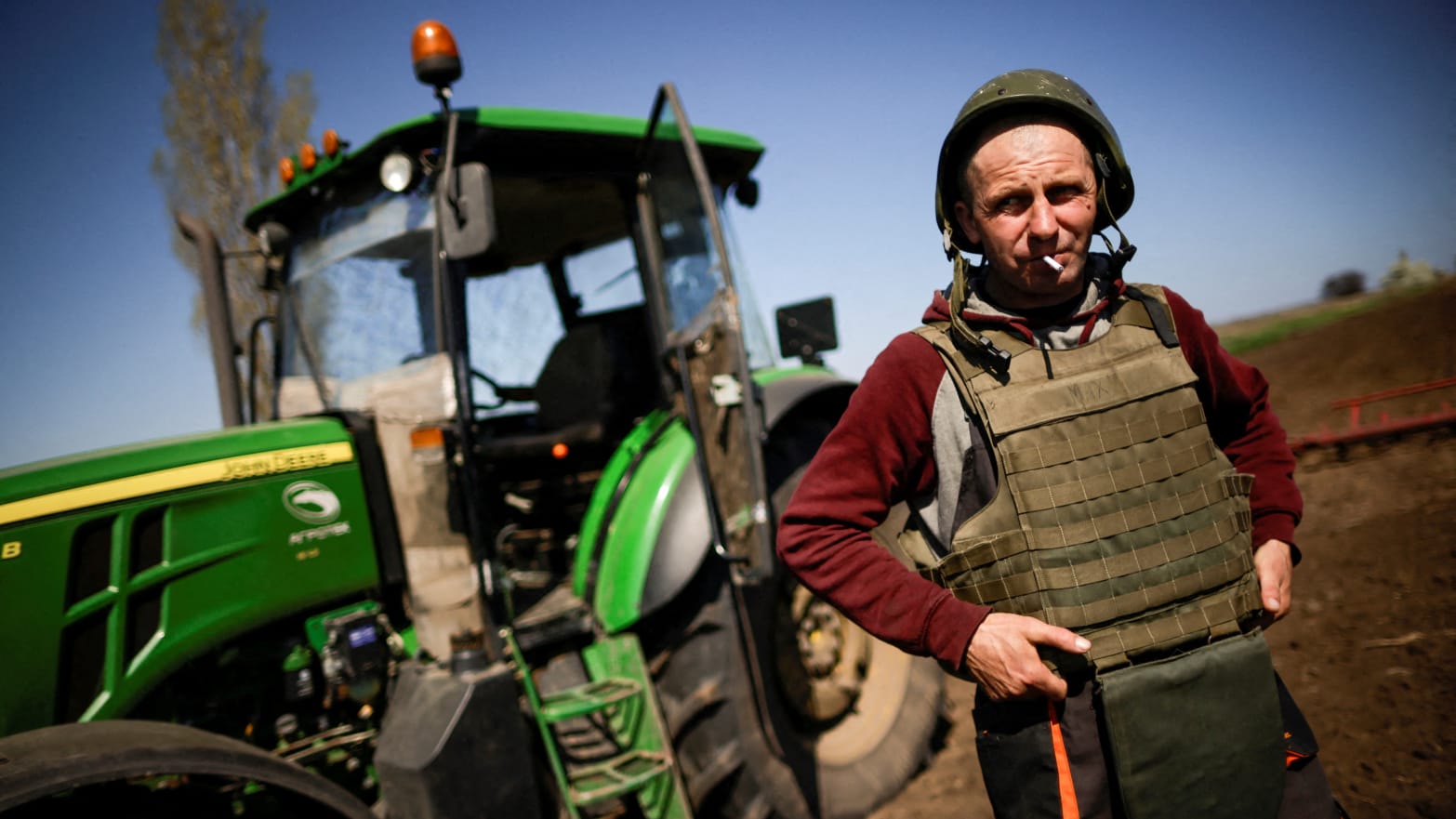
Ukrainian Farmers Strike Back


(excerpted from Daily Beast article by Allison Quinn)

Russian authorities have gone all out to tighten their grip on cities taken over by Putin’s troops in east Ukraine.

Ordinary Ukranians are fighting back with arson attacks and poison fruit. That’s not a typo. Actual Poisoned Fruit. (No word on Snow White’s involvement at this time.)

The latest surprise for Russian troops came in Melitopol, where Mayor Ivan Fyodorov said local farmers had caused “mass illness” among Russians by poisoning cherries.

“Our farmers prepared another gift for the Russians: recently treated sweet cherries which caused mass illness among those who stole them from the farmer. It’s the latest kind of partisan resistance on the territory of Melitopol,” Fyodorov told reporters on Thursday.

He said pro-Ukrainian sentiment remains strong in the city, despite Russian authorities portraying themselves as saviors who “rescued” citizens from Ukraine. There is a very big difference between rescued and being forcibly torn away from your country and your lives. It’s like saying that the Jews in World War II concentration camps were “rescued” by the Nazis.

“Melitopol residence fully ignored the celebration of Russian Day. The whole country of Ukraine saw only 15 people of the 70,000 residents who stayed in the temporarily occupied city stood in line for Russian passports,” he said.

Even Russian troops in the Kherson region appeared to be keenly aware of the Ukrainian resistance, according to audio released Thursday by Ukraine’s Security Service. In a nearly two-minute recording as what Ukrainian Intelligence describes as an intercepted call between Putin’s troops, a man identified as a soldier, tells his friends “the guys on the front line there are going crazy. “

“Where they are located…no one is sure about the locals: who they are, what they are doing. Maybe they are f****** with us at night, while they are peaceful people in the day. No one can be trusted. An old woman walking around with pies, might be a f****** Colonel acting as an artillery spotter at night”

Russian authorities have begun opening up passport processing centers in the occupied territories, and in Kherson, residents were informed this week that any babies born after February 21, would be given Russian passports, Russia’s Ria-Novosti news agency reported.

But Ukrainian residents are not letting the Russians get off easy for the forced “Russification”. A new report by the Institute for the Study of War this week listed a series of recent guerilla style attacks by Ukrainian partisans in cities including Berdyansk and Mariupol.

UESLEI MARCELINO

“Russian authorities are continuing to face difficulties implementing their occupation agendas due to pro-Ukrainian pressure in occupied areas,” the report noted, describing teachers refusing to teach under Russian curricula in Berdyansk, and unidentified Ukrainian partisans targeting staffers of Russian’s emergency ministry in Mariupol.

Petro Andriushchenko, an aid to the Mariupol mayor described the latter incident in a post on Telegram on Wednesday. He said two tractors and three large truck trailers parked outside the Russian’s Emergency Ministry headquarters “suddenly” went up in flames on June 9, due to an arson attack. Two days later, he said, on the even of the city’s “Day of Russia” celebration, a staffer for the same ministry was stabbed in the back while standing in a crowd.

“The injury turned out to be fatal,” he said. “We’re talking to you, scum. Start looking behind you. Retribution is already near.”

Namaste,

Idealisticrebel