Let us begin with the obvious. For many women, 2016 was a deflating nightmare of epic proportions.
It was singular in terms of shittiness, really. One of the top news stories was the unearthing of decade-old footage of Donald Trump boasting that he likes to grab women by the pussy ― and he went on to be elected as America’s 45th president. The glass ceiling stands. Reproductive rights are under attack. It’s… not great.
But! Last year was also filled with some pretty solid moments for women in the worlds of sports, entertainment and yes, politics and reproductive rights. We swear.
In the spirit of kicking off 2017 on a more positive note, we rounded up 18 of the brightest spots for women from the last year. Onwards and (hopefully?!) upwards.
1When Hillary Clinton won the Democratic nomination.
Alex Wong via Getty Images
Yes, we know how it ended. She lost. But in July, Clinton became the first woman in this country’s history to be nominated for president by a major political party. And it was historic.
Clinton ultimately lost the electoral college, but she took the popular vote by more than 2 million votes — another first for women — and that margin continues to grow.
2When the Supreme Court served a huge victory for abortion rights.
Pete Marovich via Getty Images
In late June, the Supreme Court struck down a Texas abortion law that required abortion providers have admitting privileges at local hospitals, and that clinics meet the standards of ambulatory surgical centers — restrictions that led to the closure of roughly half of the state’s abortion clinics.
But in a 5-3 decision, the Court concluded the law placed an “undue burden” on women and their ability to access care. In doing so, they offered up the most significant legal victory for abortion rights in the United States in decades. The ruling establishes legal precedent that will make it that much harder for anti-choice legislators to chip away at women’s reproductive rights (despite their constant efforts to do so).
3When Simone Biles was complete and utter perfection.
TOSHIFUMI KITAMURA via Getty Images
Simone Biles went into the 2016 Olympics with an enormous amount of pressure on her to be, basically, perfect — and she was. She won four gold medals (the first U.S. gymnast ever to do so) and one bronze.
Biles also perfectly shut down any attempts to describe her remarkable achievements by likening her to male superstars. “I’m not the next Usain Bolt or Michael Phelps,” she told Sporting News. “I’m the first Simone Biles.”
4When Simone Manuel became the first African-American woman to win an individual gold in swimming.
ODD ANDERSEN via Getty Images
At 20 years old, Manuel made Olympic history when she became the first black woman to win an individual gold medal in swimming in the 100-meter freestyle. And she embraced the milestone.
“The gold medal wasn’t just for me,” Manuel said during the games. “It was for people who came before me and inspired me to stay in this sport, and for people who believe that they can’t do it.”
Manuel left the 2016 Olympics with a whopping four medals and has been hailed as the future of swimming.
5When the number of women of color in the Senate quadrupled.
Barbara Davidson via Getty Images
Election night was a blow to women in one rather obvious way, but there was at least one bright spot: The number of women of color in the United States Senate quadrupled, as Vox reports, from one to four. Mazie Hirono of Hawaii (who is Japanese-American) had been the Senate’s only woman of color, but she is now joined by Kamala Harris of California (who is African- and Indian-American), Catherine Cortez Masto of Nevada (who is Latina), and Tammy Duckworth of Illinois (who is Asian-American). Four women is by no means a lot, but it’s something.
6When a sexual assault survivor gave voice to millions.
The Huffington Post
In June, BuzzFeed first published the stunning impact statement of a 23-year-old who had been raped by former Stanford University student Brock Turner, and it instantly went viral.
The 7,000 word letter — arguably one of the most powerful statements on sexual assault ever — offered an uncompromising look at the many ways in which sexual assault can upend a life, and how the legal system can fall terribly short.
As Emily Doe wrote to other survivors of sexual assault: “I am with you. On nights when you feel alone, I am with you. When people doubt you or dismiss you, I am with you. I fought everyday for you. So never stop fighting, I believe you.”
7When women took back the word “nasty.”
Rainmaker Photo/MediaPunch/MediaPunch/IPx
In arguably the most memorable moment of the presidential debates, Trump interrupted Clinton — who was answering a question about social security — to call her “a nasty woman.”
Almost immediately, #NastyWoman began trending on Twitter. Signs and swag sprung up everywhere, embraced by Clinton fans as the feminist rally cry they’d been waiting for.
8When thousands donated to Planned Parenthood — in Vice President-elect Mike Pence’s name.
The donations were part of an even broader post-election surge in donations to organizations promoting social justice policies that run counter a Trump/Pence agenda. For example, the ACLU received millions of dollars in donations, and immediately after the election, its website traffic increased by 7,000 percent.
9When Samantha Bee’s show premiered — and saved us all.
John Sciulli via Getty Images
In February, “Full Frontal” premiered, making Bee the only female to currently host a late-night show. Her sharp humor was essential during a brutal campaign season — and in October, she also became the first female late-night host to interview a U.S. president.
10When Ibtihaj Muhammad became the first U.S. Olympian to compete in a hijab.
11When swimmer Fu Yuanhui acknowledged that, yes, sometimes, women get their period.
NurPhoto via Getty Images
Period talk is still woefully taboo, but that didn’t stop Yuanhu — an Olympian from China — from being frank about what it’s like to be an elite athlete who also — gasp! — menstruates. “My period came last night and I’m really tired right now,” Fu told a reporter. “But this isn’t an excuse, I still did not swim as well as I should have.” The comment generated a lot of media headlines simply for being such a straightforward acknowledgment of one of the realities for many women who compete at high levels in sports.
12When Beyoncé released “Lemonade,” a powerful ode to black women.
Larry Busacca/PW via Getty Images
In April, Beyoncé released Lemonade, a 12-track visual album that put black feminism front and center. It included lines from Malcolm X (“The most disrespected woman in America is the black woman. The most unprotected person in America is the black woman”) and generated a whole lot of discussion (and debate) among feminist scholars and writers. It was, as The Hollywood Reporter put it, “a masterwork by a black woman for black women” — and in December, Beyoncé was nominated for nine Grammys.
13When Issa Rae’s “Insecure” premiered.
Paul Archuleta via Getty Images
In October, Rae’s HBO comedy “Inescure” premiered, putting the life of a modern black woman — with the highs and lows of navigating dating, friendship, work — front and center.
In many ways, it was remarkable simply for being unremarkable. “I say that black people don’t really get a chance to just be regular and boring and go through everyday things and this is very much a slice of life show,” Rae said during a live conversation with The Huffington Post.
14When Jennifer Aniston stood up against the relentless scrutiny women face in (and out of) Hollywood.
Matt Winkelmeyer via Getty Images
Over the summer, Aniston wrote an open letter on The Huffington Post pushing back against the seemingly never-ending speculation that she is currently gestating (“For the record, I am not pregnant. What I am is fed up,“ she wrote) and calling out the media’s obsession with critiquing women’s appearances. Aniston wasn’t necessarily breaking new ground, but her stand was clear and assertive — and it struck a chord.
“We are complete with or without a mate, with or without a child,” Aniston wrote. “We get to decide for ourselves what is beautiful when it comes to our bodies. That decision is ours and ours alone.”
15When emojis finally included hijabs, breastfeeding and women M.D.s.
16When Ilhan Omar became the Somali-American Muslim woman to hold public office.
STEPHEN MATUREN via Getty Images
The 33-year-old former refugee won a decisive victory in Minnesota where she was elected to the state’s House of Representatives. She was born in Somalia and lived for several years in a refugee camp in Kenya before immigrating to this country when she was 12.
“Oftentimes, you are told to be everything but bold, but I think that was important for me in running as a young person and running as someone who is Muslim, a refugee, an immigrant,” told The Huffington Post in an interview last fall.
17When women in Poland demanded control over their own bodies — and won.
NurPhoto via Getty Images
In the fall, Polish legislators attempted to push on a total abortion ban within the country — but thousands of women took to the streets to push back. In sweeping protests, women from across 60 cities participated in a nationwide strike — and in early October the ruling government party rejected the abortion ban.
18When President Obama reminded us that all men should be feminists.
“It is absolutely men’s responsibility to fight sexism too,” he wrote. “And as spouses and partners and boyfriends, we need to work hard and be deliberate about creating truly equal relationships.” To which we say, hell yes.
To all my readers who are feminists, I acknowledge it has been a rough year. Now we face 4 years of Trump in the U.S., and all he hates including women. We will make it. Women down through history have survived one tragedy after another and we will survive this. We will remember to continue the work locally and on the state level. Volunteer at your local Domestic Violence Shelter, Rape Crisis, Food Bank, Big Brothers/Big Sisters or the local ACLU. You will be needed more than ever.
If you see a person in trouble being harassed by people, walk over to them like you know them and haven’t seen them in a long while. Take them by the arm and just chat with them until you are away from the troublemakers. They aren’t going to want witnesses. They will move along to easier victims.
We are not victims. We are women and we will have gender equality. We will get the ERA passed. We will have control over our own bodies. We will not live in fear and violence. Ladies, don’t let anyone make you feel that you are less than or not good enough. Don’t listen to the emotional abuse. Contact your local shelter and if there isn’t one, start one with other women in your community.
Pipeline Spills 176,000 Gallons of Oil Into Creek 150 Miles From Dakota Access Protests
byTOM DICHRISTOPHER, CNBC
A pipeline leak has spilled tens of thousands of gallons of crude oil into a North Dakota creek roughly two and a half hours from Cannon Ball, where protesters are camped out in opposition to the Dakota Access pipeline.
Members of the Standing Rock Sioux and other tribes, as well as environmentalists from around the country, have fought the pipeline project on the grounds that it crosses beneath a lake that provides drinking water to native Americans. They say the route beneath Lake Oahe puts the water source in jeopardy and would destroy sacred land.
North Dakota officials estimate more than 176,000 gallons of crude oil leaked from the Belle Fourche Pipeline into the Ash Coulee Creek. State environmental scientist Bill Suess says a landowner discovered the spill on Dec. 5 near the city of Belfield, which is roughly 150 miles from the epicenter of the Dakota Access pipeline protest camps
The leak was contained within hours of the its discovery, Wendy Owen, a spokeswoman for Casper, Wyoming-based True Cos., which operates the Belle Fourche pipeline, told CNBC.
It’s not yet clear why electronic monitoring equipment didn’t detect the leak, Owen told the Asssociated Press.
Owen said the pipeline was shut down immediately after the leak was discovered. The pipeline is buried on a hill near Ash Coulee creek, and the “hillside sloughed,” which may have ruptured the line, she said.
“That is our number one theory, but nothing is definitive,” Owen said. “We have several working theories and the investigation is ongoing.”
Last week, the Army Corp of Engineers said it would deny Dallas-based Energy Transfer Partners the easement it needs to complete the final stretch of the $3.7 billion Dakota Access pipeline. United States Assistant Secretary of the Army Jo-Ellen Darcy said the best path forward was to explore alternative routes for the pipeline, something Energy Transfer Partners says it will not do.
Energy Transfer Partners says the Dakota Access pipeline would include safeguards such as leak detection equipment and that workers monitoring the pipeline remotely in Texas could close valves within three minutes if a breach is detected.
Republican President-elect Donald Trump has voiced support for the Dakota Access Pipeline. About 5,000 people are still occupying land near the planned construction site.
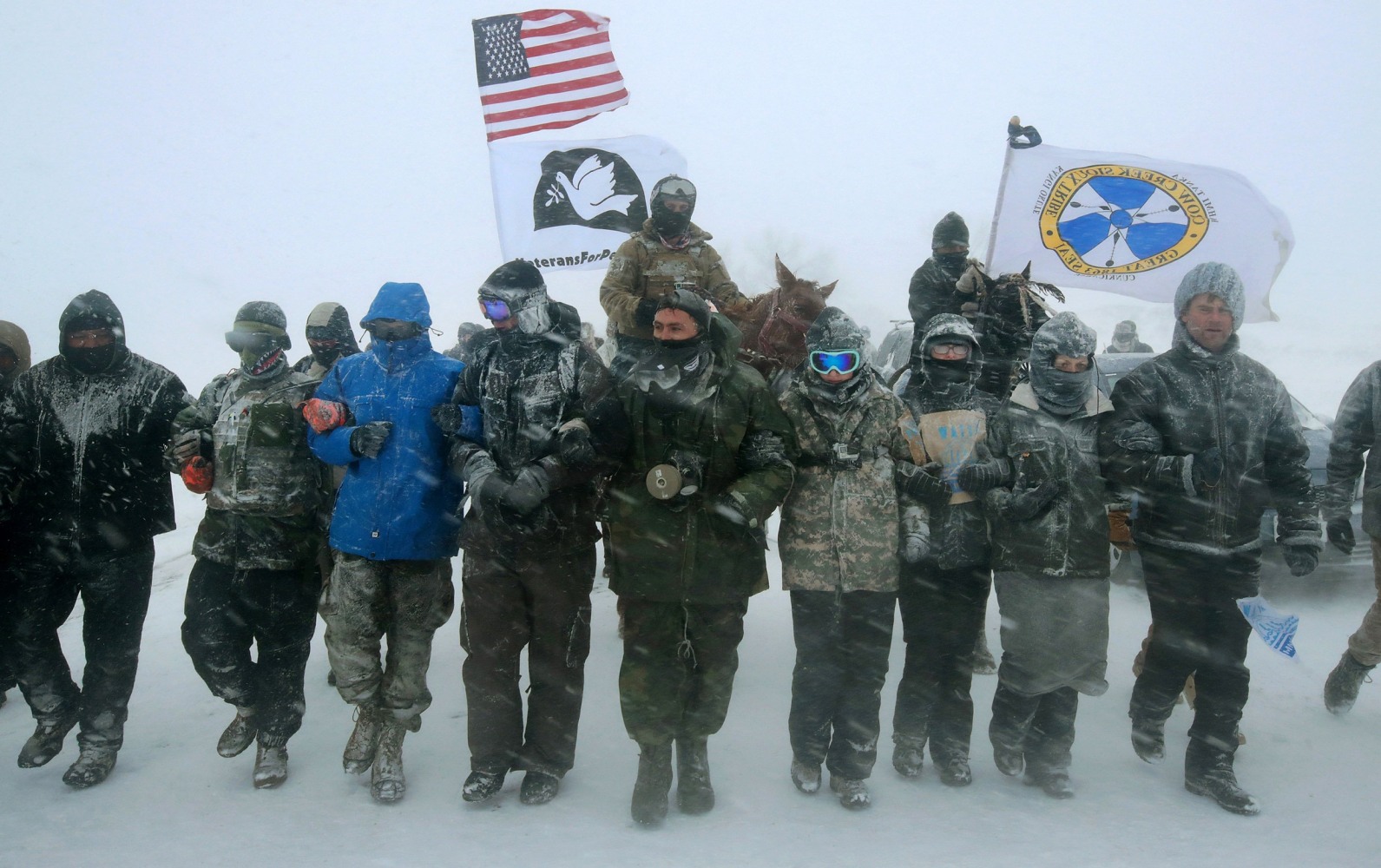
Military veterans march in support of the “water protectors” at Oceti Sakowin Camp on the edge of the Standing Rock Sioux Reservation on December 5 outside Cannon Ball, North Dakota. Scott Olson / Getty Images
The 6-inch steel Belle Fourche pipeline is mostly underground but was built above ground where it crosses Ash Coulee Creek, Suess said. Owen said the pipeline was built in the 1980s and is used to gather oil from nearby oil wells to a collection point.
Suess said the spill migrated almost 6 miles from the spill site along Ash Coulee Creek, and it fouled an unknown amount of private and U.S. Forest Service land along the waterway. The creek feeds into the Little Missouri River, but Seuss said it appears no oil got that far and that no drinking water sources were threatened. The creek was free-flowing when the spill occurred but has since frozen over.
About 60 workers were on site Monday, and crews have been averaging about 100 yards daily in their cleanup efforts, he said. Some of the oil remains trapped beneath the frozen creek.
Suess says about 37,000 gallons of oil have been recovered.
“It’s going to take some time,” Suess said of the cleanup. “Obviously there will be some component of the cleanup that will go toward spring.”
True Cos. has a history of oil field-related spills in North Dakota and Montana, including a January 2015 pipeline break into the Yellowstone River. The 32,000-gallon spill temporarily shut down water supplies in the downstream community of Glendive, Montana, after oil was detected in the city’s water treatment system.
True Cos. operates at least three pipeline companies with a combined 1,648 miles of line in Montana, North Dakota and Wyoming, according to information the companies submitted to federal regulators. Since 2006, the companies have reported 36 spills totaling 320,000 gallons of petroleum products, most of which was never recovered.
Dakota Protesters Say Belle Fourche Oil Spill ‘Validates Struggle’
byDANIEL A. MEDINA
A man takes part in a march with veterans to Backwater Bridge just outside of the Oceti Sakowin camp during a snow fall near Cannon Ball, North Dakota, U.S., December 5, 2016.(C) Lucas Jackson / Reuters / REUTERS
A major oil spill just 150 miles from the Dakota Access Pipeline protests in North Dakota has validated the concerns of those who spoke out against the project for months, activists said.
State officials estimate that more than 176,000 gallons of crude oil has leakedfrom the Belle Fourche Pipeline over the past week into the Ash Coulee Creek in western North Dakota. A landowner discovered the spill near the town of Belfield on Dec. 5, according to Bill Suess, an environmental scientist with the North Dakota Health Department.
The leak was contained within hours of its discovery, Wendy Owen, a spokeswoman for Casper, Wyoming-based True Cos., which operates the Belle Fourche pipeline, told CNBC.
But when news of the spill reached the Oceti Sakowin Camp — where thousands have protested the controversial Dakota Access Pipeline for months — activists said they felt vindicated.
One of the protesters’ central arguments for months has been that, despite assurances from Energy Transfer Partners — the Dallas-based company funding the $3.7 billion project — an oil spill would be inevitable.
And the Standing Rock Sioux Tribe believes that a spill would devastate the Missouri River, which is the main water source for the tribe.
For Tara Houska, a Native American environmental activist who has resided at the camp since August, the oil spill was “yet another example of what happens when you have lax regulations written by oil companies and their patrons.”
“The spill gives further credence to our position that pipelines are not safe,” said Houska, National Campaigns Director for Honor the Earth, a nonprofit organization focused on raising awareness and financial support for indigenous environmental justice. “Oil companies’ interest is on their profit margins, not public safety.”
In an interview last month, Energy Transfer Partners CEO Kelcy Warren told NBC News that he could not assure the tribe that an oil spill could not potentially occur. Warren would only say that the Dakota Access Pipeline was prepared to withstand such an event.
Warren said the pipeline would cross 90-115 feet below Lake Oahe, a large Missouri River reservoir, with double walled and remote-controlled shutoff valves on each side of the crossing.
A spokesperson for Energy Transfer Partners declined to comment for this article.
“They can say they have all the latest technologies to safeguard against a leak,” Standing Rock Sioux Chairman Dave Archambault II told NBC News. “But when that leak happens, and it will, all those safeguards will go out the window.”
Archambault said he relayed his concerns to North Dakota Gov. Jack Dalrymple on Monday night, their first one-on-one meeting since the protests began last summer.
Dallas Goldtooth, a member of the Dakota Nation who has been at the camp off-and-on since August, told NBC News that the pipeline spill upstream “shows everyone the necessity to examine not only the Dakota Access Pipeline but all fossil-fuel energy infrastructure development.”
“This should spur us to act,” said Goldtooth. “This should encourage everyone who believes in protecting Mother Earth that we need to examine and critique every fossil fuel project that’s being put on the table.”
Allison Renville, an activist from the Lakota nation, was less circumspect. “We’re winning,” she told NBC News.
“The spill at Bel Fourche, again, is proof that we’re right,” said Renville. “It validates our struggle.”
For all of the naysayers who have ridiculed the native people and their concern about the water, here is just what they have been trying to avoid. Another pipeline leak and one near their camp. A couple of months ago there was one in Alabama. After the initial announcement, we didn’t hear any more about it.
What about our water in both of these situations? Talking to the EPA and finding out about about your water may be something you want to do before the Inauguration. Trump will probably destroy the agency. We are at a serious impasse with our environment here on our planet and here in America. Here it is made more dangerous by Trump and his denying of science. Yet we have the entire city of Flint, Michigan that has not had clean drinking water for at least the last two years. Congress is just now appropriating money for Flint.
We need to continue to give the native people our support and prayers that this stand off at Standing Rock comes to an appropriate end for the people and the land. I stand with Standing Rock.
Congress don’t wait until next year to begin the investigation. Start now. The American people want to know if Trump sold America out to Putin. This is important. Hugs, Barbara
Following last week’s decision by the Department of the Army to not grant the easement under Lake Oahe, we are all focused on important actions that must be undertaken in the coming weeks. The announcement cited need for further examination of key issues, including treaty rights. It was suggestive of a reroute, and indicated that there will be an Environmental Impact Statement initiated to review the crossing. We look forward to this process getting underway.
This past Friday, we had a status conference in federal district court to handle scheduling and procedural matters. The day after the decision was announced Dakota Access filed a motion for summary judgment, arguing that they already have all necessary permissions to cross under the Lake. This argument is legally flawed and we believe that the motion will be denied upon appropriate review. Judge Boasberg made it clear that the issue raised by Dakota Access will not be decided at least for many weeks. In the meantime, Dakota Access does not have permission to drill under Lake Oahe.
In addition, there was also a meeting with federal officials regarding the initiation of the EIS. When the process is initiated, it will be published in the Federal Register as a Notice of Intent to Prepare a Draft Environmental Impact Statement. We will then enter a period of determining both the scope of the EIS and who the cooperating agencies will be—federal, tribal, and state parties with an interest in the project. It is extremely important that the EIS process begin immediately and I ask that all of our supporters are attentive to the proceedings. We must have confidence but ensure that this time around, the process works for us instead of against us.
I continue to welcome a meeting with President-elect Trump and his Interior nominee, Rep. Cathy McMorris Rodgers. Nevertheless, it is imperative that we push through as much as we can under the current administration. We cannot afford to lose momentum and continue to be on edge due to the Dakota Access presence at the drill pad. We also urge you to contact the banks investing in this risky and unsafe project to make them aware of the terrible acts this company has committed and reconsider their financing. Also, I ask all water protectors to make plans to return safely home when the weather permits, avoid conflict, and pivot your advocacy to holding the government accountable with respect to the EIS and our court battles. This is far from over.
The sun sets behind the Jefferson Memorial in Washington.
America died on Nov. 8, 2016, not with a bang or a whimper, but at its own hand via electoral suicide. We the people chose a man who has shredded our values, our morals, our compassion, our tolerance, our decency, our sense of common purpose, our very identity — all the things that, however tenuously, made a nation out of a country.
Whatever place we now live in is not the same place it was on Nov. 7. No matter how the rest of the world looked at us on Nov. 7, they will now look at us differently. We are likely to be a pariah country. And we are lost for it. As I surveyed the ruin of that country this gray Wednesday morning, I found weary consolation in W.H. Auden’s poem, September 1, 1939, which concludes:
“Defenseless under the night
Our world in stupor lies;
Yet, dotted everywhere,
Ironic points of light
Flash out wherever the Just
Exchange their messages:
May I, composed like them
Of Eros and of dust,
Beleaguered by the same
Negation and despair,
Show an affirming flame.”
I hunt for that affirming flame.
This generally has been called the “hate election” because everyone professed to hate both candidates. It turned out to be the hate election because, and let’s not mince words, of the hatefulness of the electorate. In the years to come, we will brace for the violence, the anger, the racism, the misogyny, the xenophobia, the nativism, the white sense of grievance that will undoubtedly be unleashed now that we have destroyed the values that have bound us.
We all knew these hatreds lurked under the thinnest veneer of civility. That civility finally is gone. In its absence, we may realize just how imperative that politesse was. It is the way we managed to coexist.
If there is a single sentence that characterizes the election, it is this: “He says the things I’m thinking.” That may be what is so terrifying. Who knew that so many tens of millions of white Americans were thinking unconscionable things about their fellow Americans? Who knew that tens of millions of white men felt so emasculated by women and challenged by minorities? Who knew that after years of seeming progress on race and gender, tens of millions of white Americans lived in seething resentment, waiting for a demagogue to arrive who would legitimize their worst selves and channel them into political power? Perhaps we had been living in a fool’s paradise. Now we aren’t.
This country has survived a civil war, two world wars and a Great Depression. There are many who say we will survive this, too. Maybe we will, but we won’t survive unscathed. We know too much about each other to heal. No more can we pretend that we are exceptional or good or progressive or united. We are none of those things. Nor can we pretend that democracy works and that elections have more-or-less happy endings. Democracy only functions when its participants abide by certain conventions, certain codes of conduct and a respect for the process.
The virus that kills democracy is extremism because extremism disables those codes. Republicans have disrespected the process for decades. They have regarded any Democratic president as illegitimate. They have proudly boasted of preventing popularly elected Democrats from effecting policy and have asserted that only Republicans have the right to determine the nation’s course. They have worked tirelessly to make sure that the government cannot govern and to redefine the purpose of government as prevention rather than effectuation. In short, they haven’t believed in democracy for a long time, and the media never called them out on it.
Democracy can’t cope with extremism. Only violence and time can defeat it. The first is unacceptable, the second takes too long. Though Trump is an extremist, I have a feeling that he will be a very popular president and one likely to be re-elected by a substantial margin, no matter what he does or fails to do. That’s because ever since the days of Ronald Reagan, rhetoric has obviated action, speechifying has superseded governing.
Trump was absolutely correct when he bragged that he could shoot someone in the middle of Fifth Avenue and his supporters wouldn’t care. It was a dictator’s ugly vaunt, but one that recognized this election never was about policy or economics or the “right path/wrong path,” or even values. It was about venting. So long as Trump vented their grievances, his all-white supporters didn’t care about anything else. He is smart enough to know that won’t change in the presidency. In fact, it is only likely to intensify. White America, Trump’s America, just wants to hear its anger bellowed. This is one time when the Bully Pulpit will be literal.
The media can’t be let off the hook for enabling an authoritarian to get to the White House. Long before he considered a presidential run, he was a media creation — a regular in the gossip pages, a photo on magazine covers, the bankrupt (morally and otherwise) mogul who hired and fired on The Apprentice. When he ran, the media treated him not as a candidate, but as a celebrity, and so treated him differently from ordinary pols. The media gave him free publicity, trumpeted his shenanigans, blasted out his tweets, allowed him to phone in his interviews, fell into his traps and generally kowtowed until they suddenly discovered that this joke could actually become president.
Just as Trump has shredded our values, our nation and our democracy, he has shredded the media. In this, as in his politics, he is only the latest avatar of a process that began long before his candidacy. Just as the sainted Ronald Reagan created an unbridgeable chasm between rich and poor that the Republicans would later exploit against Democrats, conservatives delegitimized mainstream journalism so they could fill the vacuum.
Retiring conservative talk show host Charlie Sykes complained that after years of bashing from the right wing, the mainstream media no longer could perform their function as reporters, observers, fact dispensers, and even truth tellers, and he said we needed them. Like Goebbels before them, conservatives understood they had to create their own facts, their own truths, their own reality. They have done so, and in so doing effectively destroyed the very idea of objectivity. Trump can lie constantly only because white America has accepted an Orwellian sense of truth — the truth pulled inside out.
With Trump’s election, I think that the ideal of an objective, truthful journalism is dead, never to be revived. Like Nixon and Sarah Palin before him, Trump ran against the media, boomeranging off the public’s contempt for the press. He ran against what he regarded as media elitism and bias, and he ran on the idea that the press disdained working-class white America. Among the many now-widening divides in the country, this is a big one, the divide between the media and working-class whites, because it creates a Wild West of information — a media ecology in which nothing can be believed except what you already believe.
With the mainstream media so delegitimized — a delegitimization for which they bear a good deal of blame, not having had the courage to take on lies and expose false equivalencies — they have very little role to play going forward in our politics. I suspect most of them will surrender to Trumpism — if they were able to normalize Trump as a candidate, they will no doubt normalize him as president. Cable news may even welcome him as a continuous entertainment and ratings booster. And in any case, like Reagan, he is bulletproof. The media cannot touch him, even if they wanted to. Presumably, there will be some courageous guerillas in the mainstream press, a kind of Resistance, who will try to fact-check him. But there will be few of them, and they will be whistling in the wind. Trump, like all dictators, is his own truth.
What’s more, Trump already has promised to take his war on the press into courtrooms and the halls of Congress. He wants to loosen libel protections, and he has threatened Washington Post owner Jeff Bezos of Amazon with an antitrust suit. Individual journalists have reason to fear him as well. He has already singled out NBC’s Katy Tur, perhaps the best of the television reporters, so that she needed the Secret Service to escort her from one of his rallies. Jewish journalists who have criticized Trump have been subjected to vicious anti-Semitism and intimidation from the white nationalist “alt-right.” For the press, this is likely to be the new normal in an America in which white supremacists, neo-Nazi militias, racists, sexists, homophobes and anti-Semites have been legitimized by a new president who “says what I’m thinking.” It will be open season.
This converts the media from reporters to targets, and they have little recourse. Still, if anyone points the way forward, it may be New York Times columnist David Brooks. Brooks is no paragon. He always had seemed to willfully neglect modern Republicanism’s incipient fascism (now no longer incipient), and he was an apologist for conservative self-enrichment and bigotry. But this campaign season, Brooks pretty much dispensed with politics. He seemed to have arrived at the conclusion that no good could possibly come of any of this and retreated into spirituality. What Brooks promoted were values of mutual respect, a bolder sense of civic engagement, an emphasis on community and neighborhood, and overall a belief in trickle-up decency rather than trickle-down economics. He is not hopeful, but he hasn’t lost all hope.
For those of us now languishing in despair, this may be a prescription for rejuvenation. We have lost the country, but by refocusing, we may have gained our own little patch of the world and, more granularly, our own family. For journalists, Brooks may show how political reporting, which, as I said, is likely to be irrelevant in the Trump age, might yield to a broader moral context in which one considers the effect that policy, strategy and governance have not only on our physical and economic well-being but also on our spiritual well-being. In a society that is likely to be fractious and odious, we need a national conversation on values. The media could help start it.
But the disempowered media may have one more role to fill: They must bear witness. Many years from now, future generations will need to know what happened to us and how it happened. They will need to know how disgruntled white Americans, full of self-righteous indignation, found a way to take back a country they felt they were entitled to and which they believed had been lost. They will need to know about the ugliness and evil that destroyed us as a nation after great men like Lincoln and Roosevelt guided us through previous crises and kept our values intact. They will need to know, and they will need a vigorous, engaged, moral media to tell them. They will also need us.
We are not living for ourselves anymore in this country. Now we are living for history.
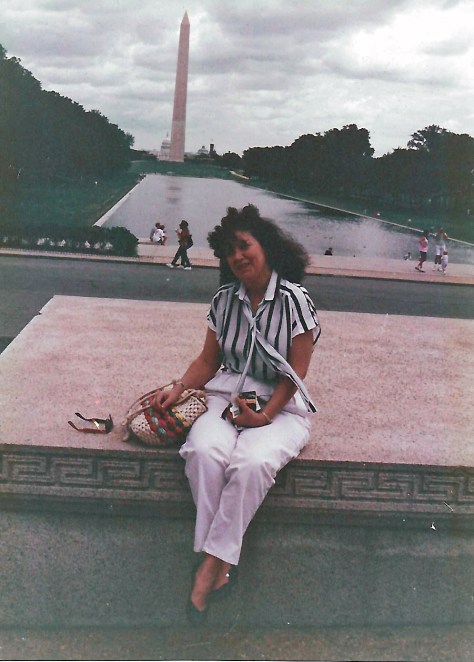
Me, in Washington D. C. for art exhibit circa 1980’s.
I often went to Washington for art and protests.
I believe that Progressives and Liberals all had independent wakes for our country beginning the morning after the election. I remember my mind all a-swirl with thoughts about what had just happened to the country I loved so much. I flashed back to 1976 and my dad grilling in the backyard with his red, white and blue apron on, that said 1776-1976. Hot dogs and hamburgers were coming off of the grill. America was not a perfect country then but we let our voices, me and the rest of the young people, be heard and the government was beginning to listen about Vietnam and Civil Rights for black people. We were doing new things like reading Betty Friedan’s The Feminine Mystique. It changed my life as it did the lives of millions of other women, young and old.
I helped to start a Domestic Violence shelter in Pennsylvania. It was a journey in faith, but it is still there and helping women and children. There are still women who are in violent relationships today; but more about that another day.
I became a feminist and devoted myself to helping women and children to lead better lives. It was important to me that they would be able to access the justice they needed and would not suffer because someone looked at them and decided they should have acted different or been different.
Over the years, I watched as racism raised its ugly head when a Mom had kids who were several different shades. That didn’t bother me. Once I fought Children’s Services when they tried to take the aforementioned children away from the Mother. I won and this good mother whose only “crime” was to have been beaten by a man kept her kids. They were beautiful and smart and sweet.
When I counseled for Rape Crisis, I often had to protect the victims from the misogyny of the police and even their fathers and brothers. It was no easy task but we educated people and they learned that the important thing was that the woman who was their baby girl or sister or wife had been hurt in a brutal way and we could stop it happening to other women.
We were able to stop back alley abortions and I lobbied in Harrisburg to convince legislators of the importance of keeping teen girls and young women out of the hands of questionable doctors who would perform these abortions for a lot of money with no guarantees that the woman would survive. Women were still having to cross state lines at that point.
I remember a 10 year old girl who came to an abortion clinic with her Mom. Counseling was required before all abortions and this case was no exception. The girl was seen by a counselor first and then her Mother joined them. Her Father had molested her and gotten her pregnant with his child. He was in jail, which was where he belonged. This 10 year old had been through enough. It was cruel to ask her to now ask her to remain pregnant for the entire nine months and go through labor and delivery. She carried her Mickey Mouse doll into surgery and held a nurse’s hand. She came through very well and was up and around quickly. There are so many stories where abortion is a blessing and not a convenience.
I have friends everywhere. They don’t look like me. We don’t all have the same religious beliefs. We are from both genders. Some are musicians, some are retired business people, some are artists and activists like I am. We all look different although now that some of us are aging, we do have that similarity in our looks.
What I am trying to say is that the America I am grieving is lost. It is lost as if a conquering army came and destroyed it and all we can do is look around and shake our heads. Well, I have been shaking my head for over a month now and I have begun to strengthen my resolve. The election was a disaster. The History books will discuss how this all happened. Your great-grandchildren and mine will study it in school and will feel wise because they understand.
What Progressives and Liberals must do now, whether we understand or not, is to give ourselves a good shake. We need to tell ourselves that American life isn’t over. It is different now. It includes mega racism, misogyny, anti-Muslim feelings, anti-Semitism, a distaste for both the poor and for higher education, and blatant bigotry. We have to promise ourselves, our friends, the people we go to school with, the people in our churches and synagogues and mosques that we will stand with them. We will find a lot of hassle and bigotry at work, so prepare yourselves. The people who feel they were voiceless will now want to spew their hatred over everyone frequently and in the direction of the rest of us. Don’t take the bait. Try the rubber band on your wrist if necessary; snap it when you are angry or need to stop yourself from speaking. Live your lives in the caring, helpful ways you have always done. Read what will fill you up and prepare you for the future. Keep your spiritual life healthy and filled with positive energy. Remember we are all children of the Universe. We have a responsibility to be there for each other until the nightmare is over.
Judge to consider completion of Dakota pipeline in February
WASHINGTON — A federal judge Friday set a tentative court hearing for February in the Dakota Access pipeline’s bid to force the government to approve finishing the contested project.
Citing losses of $20 million a week, David Debold, an attorney for pipeline company Energy Transfer Partners, said that without a expedited decision the matter could “drag out forever” after construction was halted Sunday by the Obama administration.
U.S. District Judge James Boasberg acknowledged that the company’s challenge could be rendered moot following next month’s inauguration of President-elect Donald Trump, whose incoming administration has expressed support for the fraught project, which for months has been shadowed by protests involving the Standing Rock Sioux reservation.
Last weekend, the Army Corps of Engineers said it would not approve an easement for the pipeline to cross a reservoir on the Missouri River in North Dakota at the Standing Rock reservation, where protesters have been camped. The contested portion represents the final section of the 1,172-mile line.
“None of us have any idea of whether the incoming administration will make this matter moot,” Boasberg told a packed courtroom, which included a number of protesters who traveled to D.C. for the hearing and a demonstration scheduled for Saturday.
“They are desperate to get this pipeline under the river,” said DiDi Banerji, 51, who serves as a nurse at the protest camp. “We are worried about what a change in administration could do. If Trump approves this, the (protest) actions are going to start again.”
Demonstrators greet each other near the entrance of the Oceti Sakowin camp as “water protectors” continue demonstrations against plans to pass the Dakota Access pipeline continue near the Standing Rock Indian Reservation, near Cannon Ball, North Dakota, U.S., December 2, 2016. REUTERS/Lucas Jackson
While our native people decide whether to stay or leave the Standing Rock, the courts are looking at what they will decide after the New Year and Trump is inaugurated. Can and will the court be and/or remain neutral after Trump is in office, we can only guess. It is my hope that the insanity that surrounds Trump will not reach into the judicial branch.
My heart goes out to the native people because they have all worked so hard and have endured so much from weather, to water canons, to rubber bullets and law enforcement making rude comments. They have had to leave their homes and comforts. I am sure in a moment of complete honesty they would miss their beds, showers and kitchens. Would they conduct the protests again? I am sure they would and I am sure that if they leave, they will return to protest.
They are America’s water protectors and their sacred land is of utmost important to them. I think that the rest of America needs to really think about this and the importance of water to the life and health of all Americans. Think about what has happened to the city of Flint, Michigan and its residents. For two years, children and adults have become ill and were hospitalized and have suffered unnecessarily. Suffered because they didn’t have access to safe clean water. Here in America.
The native people are Americas’ water protectors and they are mine and I hope your heroes. They took a stand and they put their actions where their words were. There was no hypocrisy. These descendents of the original people, that we murdered and put on reservations have shown us how to be authentic Americans. I will always stand with them in pride.
Stay or go? Tribe gives conflicting messages to protest camp
Stay or go? Tribe gives conflicting messages to protest camp
Campers shovel out an exit ramp at the Oceti Sakowin camp where people have gathered to protest the Dakota Access oil pipeline in Cannon Ball, N.D., Tuesday, Dec. 6, 2016. Many Dakota Access oil pipeline opponents who’ve gathered for months in the camp are committed to staying despite wintry weather and demands that they leave. An overnight storm brought several inches of snow, winds gusting to 50 mph and temperatures that felt as cold as 10 degrees below zero. (AP Photo/David Goldman)
Pipeline opponents ride out storm in shelters, casino
Ray Franks, of New York, carries a case of water into a mess hall at the Oceti Sakowin camp where people have gathered to protest the Dakota Access oil pipeline in Cannon Ball, N.D., Tuesday, Dec. 6, 2016. An overnight storm brought several inches of snow, winds gusting to 50 mph and temperatures that felt as cold as 10 degrees below zero. (AP Photo/David Goldman)
Pipeline opponents ride out storm in shelters, casino
A motorist checks the condition of an exit ramp before attempting to drive out of the Oceti Sakowin camp where people have gathered to protest the Dakota Access oil pipeline in Cannon Ball, N.D., Tuesday, Dec. 6, 2016. An overnight storm brought several inches of snow, winds gusting to 50 mph and temperatures that felt as cold as 10 degrees below zero. (AP Photo/David Goldman)
For protesters fighting the Dakota Access pipeline, the messages from the Standing Rock Sioux reservation are confusing: The tribal chairman tells demonstrators that it’s time to leave their camp and go home. Another leader implores them to stay through the bitter North Dakota winter.
The conflicting requests show how the camp’s purpose has widened beyond the original intent of protecting the tribe’s drinking water and cultural sites into a broader stand for Native American rights.
Camp occupants are working through the confusion, said Jade Begay, an organizer with the Indigenous Environmental Network. “The rest of the world just needs to hold tight and be patient,” he said.
Since August, the camp on federal land near the reservation and the pipeline route has been home to thousands of people protesting the four-state $3.8 billion pipeline designed to carry oil to a shipping point in Illinois.
After the camp endured two recent severe storms, Standing Rock Chairman Dave Archambault declared this week that it’s time for the demonstrators to disband.
Archambault said there’s no reason for people to put their lives at risk because no additional pipeline work is expected for months. The company building the project, Energy Transfer Partners, and the Army Corps of Engineers are battling in court over permission to dig under the Missouri River reservoir that provides the tribe’s drinking water. It’s the last big unfinished segment of the 1,200-mile pipeline.
“We understand this fight is not over,” Archambault said. “But the fight is not here, at this moment.”
Native American rights activist Chase Iron Eyes, an enrolled Standing Rock tribe member who made an unsuccessful bid for Congress this fall, implored pipeline opponents to stay in a social media post this week.
The camp rejoiced Sunday when the Army announced that it would not issue an easement for the pipeline to cross under Lake Oahe, but it’s unclear what might happen when pipeline supporter Donald Trump enters the White House in January. The dispute also could be decided by a federal judge.
“We are not in the clear by any means whatsoever,” Iron Eyes said. “This is not a time for celebration. If it’s a time for anything … it’s a time to honor all the sacrifices that have been made” by camp occupants. More than 500 have been arrested since August.
The camp began as a peaceful, prayerful protest of the pipeline. It has since drawn in people who believe the dispute represents an overall stand for American Indian rights.
Iron Eyes said protesters need to stand up for other tribes and treaty rights. “We don’t stand in a place to tell people to leave,” he said.
State Emergency Services spokeswoman Cecily Fong said the state isn’t surprised by the competing messages, noting the “different agendas” of people in camp.
Camp occupants are “working on finding a middle ground and some sort of compromise” through informal discussions, according to Begay, who lives in Tesuque, New Mexico.
“These kinds of decisions don’t happen in just a day or two,” she said. “We need to consider everybody’s safety, everybody’s goals, the different points of view.”
The Corps recently declared the camp area closed to public access and said those who remain are trespassing, but the agency is not issuing citations. North Dakota Gov. Jack Dalrymple has also called on camp occupants to leave, and Sen. John Hoeven issued a similar plea Wednesday from the floor of the Senate.
Iron Eyes said he believes the calls for people to leave the camp are aimed at limiting liability, and he said those who stay do so at their own risk. But he implored people “who understand the inherent risks of staying in a North Dakota winter to stand with us, because this pipeline is not finished, and we have to stand strong and stay vigilant.”
Archambault acknowledged the efforts of people who came from around the world to support the tribe. But, he said, “their purpose has been served.”
The native people have a huge decision to make. They have a huge and difficult decision and must consider everyone’s opinion as well as the big picture. Our opinion doesn’t count because we are not there living in the winter conditions and being freezing cold. We aren’t trying to decide if we can trust the federal government. I am very proud of them for standing by their principles. They have had more integrity than many white people have.
The European whites who came to America and killed them and robbed them and marched them to reservations proved they could not be trusted. I stand with the native people but I am here in my warm house. I respect them tremendously and will be the first to say they have accomplished a great deal.
Whatever, the people decide, they have shown the rest of America that they are the kind of Americans that we should be. I hope they begin to be proud of themselves and to take good care of each other. They are the real heroes of America.
Kennedy Family Writes Anti-Trump Op-Ed In Washington Post That EVERYONE Should Read
If there is one family in America that is qualified to speak on the issue of hatred and violence, it is the Kennedys. John F. Kennedy was shot and killed in 1963 followed by Robert F. Kennedy in 1968.
Written by William Kennedy Smith and Jean Kennedy Smith
On April 4, 1968, the day the Rev. Martin Luther King Jr. was shot and killed, Robert Kennedy was campaigning for the presidency in Indianapolis. Bobby conveyed the news of King’s death to a shattered, mostly black audience. He took pains to remind those whose first instinct may have been toward violence that President John F. Kennedy had also been shot and killed. Bobby went on, “What we need in the United States is not division; what we need in the United States is not hatred; what we need in the United States is not violence and lawlessness, but is love, and wisdom, and compassion toward one another, and a feeling of justice toward those who still suffer within our country, whether they be white or whether they be black.”
That speech has crystallized into the single most enduring portrait of Bobby’s candidacy. Because it was extemporaneous, it conveyed directly, and with raw emotion, his own vulnerability, his aspirations for his country, and a deep compassion for the suffering of others. Bobby concluded his remarks that night by urging those listening to return home and say a prayer for our country and for our people. Those words mattered. While there were riots in cities across the nation that night, Indianapolis did not burn.
Today, almost 50 years later, words still matter. They shape who we are as a people and who we wish to be as a nation. In the white-hot cauldron of a presidential campaign, it is still the words delivered extemporaneously, off the cuff, in the raw pressure of the moment that matter most. They say most directly what is in a candidate’s heart. So it was with a real sense of sadness and revulsion that we listened to Donald Trump, the Republican nominee for president, as he referred to the options available to “Second Amendment people,” a remark widely, and we believe correctly, interpreted as a thinly veiled reference or “joke” about the possibility of political assassination.
Political violence is a terrible inherent risk to any free society. Dictators and strongmen like Vladimir Putin have an answer. They are surrounded and shielded by force at all times. They do not brook dissent. In democracies, we expect our leaders to be accessible and, by and large, they want to be. Inevitably, that makes them vulnerable and the loss of a leader at a crucial time impacts family, country, and even the world, for generations. Anyone who loves politics, the open competition of ideas and public participation in a free society, knows that political violence is the greatest of all civic sins. It is not to be encouraged. It is not funny. It is not a joke.
By now, we have heard enough dark and offensive rhetoric from Trump to know that it reflects something fundamentally troubled, and troubling, about his candidacy. Trump’s remarks frequently, if not inevitably, spark outrage, which is followed by a clarification that, in lieu of an apology, seeks to attribute the dark undertones of his words to the listener’s twisted psyche. This fools no one. Whether you like what he is saying or, like a growing segment of the electorate, you reject it, it is easy to grasp Trump’s meaning from his words. But what to make of a candidate who directly appeals to violence, smears his opponents and publicly bullies a Gold Star family, a decorated prisoner of war, and a reporter with a disability, among others? To borrow the words of Army Counsel Joseph Welch, directed at another dangerous demagogue: “Have you no sense of decency, sir, at long last? Have you left no sense of decency?”
The truth remains that words do matter, especially when it comes to presidential candidates. On that basis alone, Donald Trump is not qualified to be president of the United States.
I wish the Kennedy family had written their opinion piece before the election. It might have prevented Trump from being elected. I still believe in the Kennedys despite the traumas and scandals they have gone through. Losing John and Bobby to assassination was not an easy experience for a family to survive. It left scars and trauma that took tolls on the children of both men and their Kennedy cousins.
It took tolls on the rest of America. I remember being in school when the student body president got on the PA system and told us President Kennedy had been killed in Dallas. I had worked for his campaign. I had worked to “Get out the Vote.” Now he was dead. Later, at home, I watched the news and Walter Cronkite over and over and could not grasp how a good man could be lost like this. Years later in Dallas, I went to the Grassy Knoll and the book repository and tried to make sense of it all. Two innocuous spots in the great state of Texas that will remain in infamy the site of horrible and unnecessary carnage.
I knew then that Kennedy wasn’t perfect and know it now. But you hold up a John Kennedy or a Robert Kennedy against a Donald Trump and the comparison is like weak tea. They wanted to change America by building her up and bring a better life to all her people black or white. They believed in equality. They believed in giving less fortunate people a hand up and the entire family has done that.
If both had lived, America today would be an entirely different country. They would have accomplished all of their platforms and the black people would be much better off. We would have gotten out of Vietnam sooner. The middle class would have been shored up and vocational training and /or college would have been promoted. If one or the other had survived, they would have carried on. I watched Bobby die on TV. I heard him give his speech and walk off stage. They decided to take him out through the hotel kitchens. As I sat there, a bullet cut down his life. A scream died on the lips of liberal America and our tears flowed like the great Mississippi.
Donald Trump cannot stand up against these beloved icons. He wants to tear America apart with hate and so far he has done a pretty good job. He is trying to take America from being the home of the brave to being a playground for the ultra rich. One where each of the rest of us will have to kiss their boots and kowtow to their wants. I refuse to do that. Many will refuse. In what is supposed to be my golden years, I will do everything I am capable of to ruin Trump’s plans and to help Americans see what an infantile loser he really is.
So, I stand with the UCLA and with black people, women, refugees, Muslims, the disabled, the disenfranchised, the unwashed masses that came to America when my grandparents came and began a new life with hard work and a stubborn drive to succeed in this great land of America. I stand up to Trump for my grandparents who traveled here in steerage for a new life, learned English and became citizens. Who taught us to work hard and to be proud of who we are. We, the first and second generations born here from those immigrants, must fight Trump and all he and his cronies stand for. I look forward to the coming years, after this administration is gone, beginning in 2020.
Thanks to the efforts of Standing Rock protesters, the controversial Dakota Access Pipeline has been diverted. Photographer Celine Guiout went to Standing Rock to shoot the women who made it happen.
Over the weekend, the US Army Corps of Engineers finally delivered some good news to the thousands of protesters camped out at the Standing Rock Sioux Reservation: Construction of the Dakota Access Pipeline would be halted.
The proposed pipeline would have carried crude oil underneath Lake Oahe, a dammed-up part of Missouri River and the main water source for the reservation. The Sioux tribe has repeatedly expressed concerns that the pipeline could lead to contamination of their water supply and threaten its water and treaty rights.
After months of the stand-off involving protesters (who call themselves Water Protectors) and police, the Army Corps announced on Sunday that it would not grant permission for Dakota Access LLC (DPL) to drill under the river. In a statement, it said that it would instead “explore alternate routes for the pipeline crossing.”
For the thousands of protesters—comprising of members of the Sioux Tribe, indigenous people from across America, non-indigenous allies, and veterans—camped out at the Standing Rock Indian Reservation, the news came as welcome relief in the biting cold. It was the culmination of an intense struggle that involved shocking levels of police brutality.
Photographer Celine Guiout photographed and interviewed the women of Standing Rock a week before the Water Protectors were told that their months-long test of endurance and activism had paid off. “Women are definitely a driving force in this massive gathering,” she tells Broadly. “All the women I had the chance to meet throughout my stay were incredibly optimistic about the outcome and peaceful resolution of the current situation. These women were completely unmovable in their faith.”
All photos and interviews by Celine Guiout
Beatrice Menasekwe Jackson from the Tsimshian tribe in Ketchikan, Alaska, now living in Michigan
We are here because as women, we are caretakers of the water and caretakers of the earth. We want the Earth to be in good condition so the water that goes through our bodies helps our children to be healthy and grow up strong in mind, body, and spirit. We want them to have the balance that they need here in creation, so they won’t be torn apart by political parties by color, race, or gender. We’re going to make a more beautiful world for them.
I’m here also because my children can’t be here. I’m going to go home and tell them everything I’ve seen, so that when my time of not-travelling comes they will be able to go out and do that for me. Even though I’m a great grandmother, I took my own pension [from being a] retired teacher and made the journey. It’s all worth it, being here and sharing with the women our songs and the water prayers.
Bibi, from the Juaneño tribe in San Juan Capistrano, California
Why am I here? Oh my gosh, it starts way back when I was a little girl—it was born in me. You can’t take what’s in you away, and that’s your spirit, [knowing] your ancestors and your families have suffered enough. I have suffered enough. Natives are not going to take it anymore because you can’t take from us no more. You take away our land, you take away our pride, you try to take away everything. They have stripped us of everything, [but] not no more. We’re here till the end, and I have hope that we’re going to beat this. Ever since I was a little girl I knew I had a big important purpose in life and when it came time for this I knew it was it. Ever since I’ve been here there hasn’t been [anything] but good things happening. Miracles are happening at Standing Rock, and it’s not going to stop.
Cortney Collia from Kalamazoo, Michigan
For my personal experience in Kalamazoo, we’ve had the largest inland oil spill in the United States. It was years ago, in 2010, and that water still isn’t clean. They said they cleaned [it], but I work right along that river teaching kids and they aren’t allowed to go into the water anymore. If they do, they end up with a rash, and you can see a sheen on the surface still—the grass is dying and so are the trees. I work at a nature center and for education purposes I take the kids canoeing down the river, [but] I can’t let them splash around or swim like kids should in water. We are trying to teach them about the importance of taking care of nature and resources. Our bodies are 70 percent made of water and it keeps us alive, and having warnings [telling kids] not to touch the water is heartbreaking. I can’t let that happen to anybody else. So I made my journey here multiple times, to make sure it doesn’t happen again.
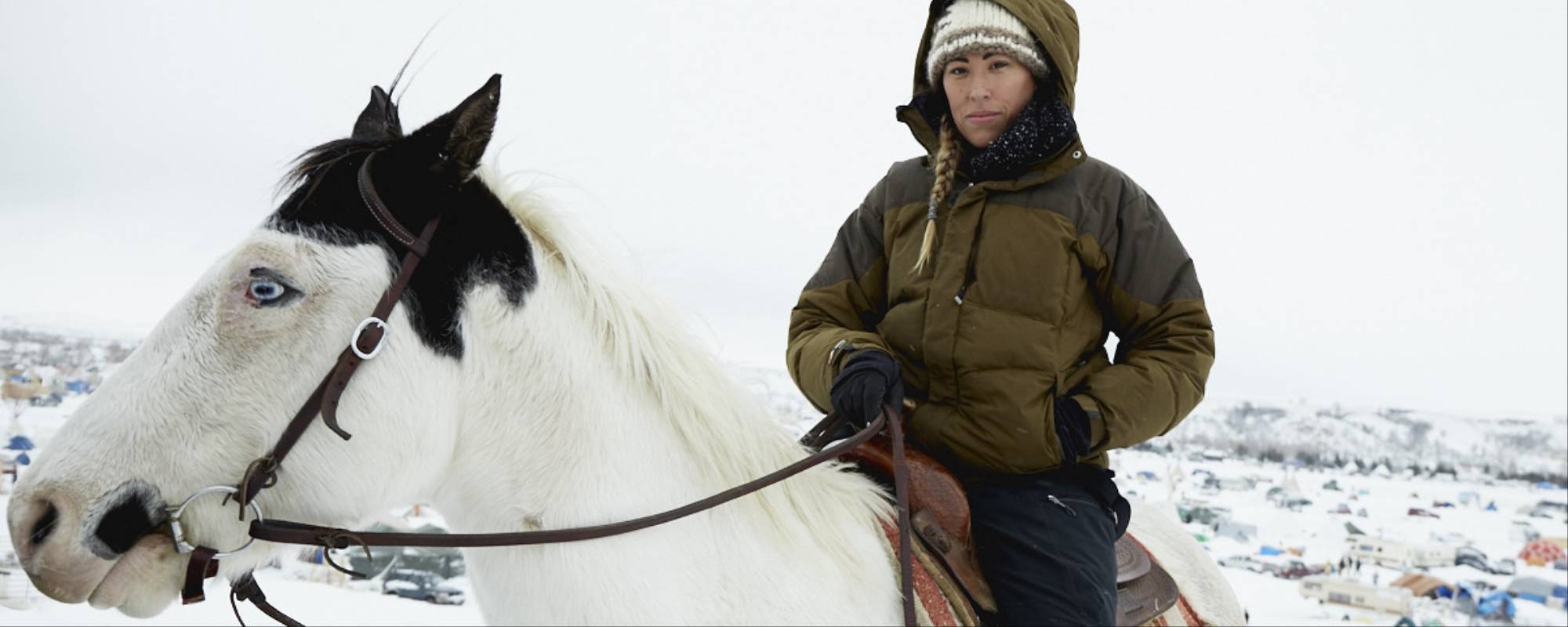
Vanessa Castle and her horse, Medicine Hat, from the Lower Elwha Klallam Tribe in Port Angeles, Washington
I got here over a month ago—drove out here for nine hours by myself. I came out here for mine and the future generations; to protect the water and also to stand up for the rights of our tribes. As indigenous peoples, we are constantly battling with prejudice and injustice, and as a woman without any children in my family it was my turn to come and stand for what we believe in. I’m here to protect the resources that we have rights to.
Melaine Stoneman, from the Sicangu Lakota (Burnt Thigh Nation) tribe in Pine Ridge Reservation, South Dakota
I have been here since day one. I run the women’s group that we have here, and my main point is to provide the women, children, and elderly [with] safety as an essential part here at Oceti Sakowin [Camp]. One of our great emphases now is to create all unity between all indigenous and non-indigenous women, and to unify in prayer to help stop the pipeline.
Faith Spotted Eagle and her daughter, Brook, from the Yankton Sioux (Ihanktonwan Dakota Oyate) tribe in Yanktown Reservation, South Dakota
Faith Spotted Eagle: I’ve been here on and off since April. I grew up along the river, I always jokingly say, “This is my river, so I’m sharing it with you.” The river has so much to teach and it has its own spirit and so we’ve been drawn to that spirit of the river water. I think that all of us had this dreams of doing what we can and we’ve been called to it in our lifetime, so the river and the land are helping us fulfill those dreams.
It really is bigger than us; it’s not even about us sometimes, it’s about my grandson’s grandchildren’s grandchildren—that’s what it comes down to. It’s so marvelous to watch him, because I think that’s my DNA, my blood, and that’s going to live on for generations. And it has to, because if we don’t stop all the oil industries and the climate change that’s going on… I can’t even imagine my grandchildren not being protected. So that’s why I’m here.
Brook: As indigenous people, we’re always thinking forward [to the next] seventh generation. The way that we understand it is that we protect our people—we’re indigenous, we’re tribal—and part of that indigeneity is that our relatives are not just human. They are also non-human. These are our rivers that have a spirit and are part of our nation, and our original mother that we all belong to. So I’m part of a women’s society. My role as a women in a women’s society I’m here to support in any way that I can with my elders. They are the original freedom fighters and they’ve always been freedom fighters, so right now we’re in training. We’re also fighting alongside them, so I’m here in service of my people.
Courtney and Amber McCornack, from Albert Lea, Minnesota
Courtney McCornack: We’ve been back and forth for months. I brought my daughter here and we have been building teepees with other women and donating them to the people that need them. I want her to stay connected to her intuitive side, which is what the Native American communities have been doing since the beginning. The sense of community here is truly amazing—true respect for each other and the most powerful prayers I have heard in my entire life from sundown to sunrise.
Urtema Dolphin, from London
I’ve arrived a couple of days ago from London—I arrived in the storm. I came because I’ve been following this issue for many months, and become more and more involved watching videos on social media. I just felt that I had to be here, and so I’m representing lots of people from all over the world. I’m bringing their prayers with me [and] spiritually they are all travelling with me. So here I am, ready to help.
Anonymous aunt and her niece, with tribal affiliations from the Desert Southwest, Apache, and Mexican tribes
We are here because Native people have been fighting for sovereignty on this land for over 500 years. This is a monumental event; unprecedented. We want to show corporate America that many people are not supportive of mineral extractions and we’re all about clean water and being healthy people. The only way to maintain that is standing up for what’s right. We have the kind of technologies to be able to have cleaner energy sources but that power is being held by the leaders and the privileged, so the rest of us get screwed in the end.
We are here to change that and support the people. It’s not only for our kids, but it’s also for the future generations. Even for the cops at the bridge, the water in me recognizes the water in them. Even if we’re on opposing sides, we still have the same communality which is our bodies are made of water. So I’m just going to keep praying and appealing to that.
Tosha Luger from the Hunkpapa tribe of the Seven Council Fires of the Lakota Sioux in Standing Rock
I was born and raised in these lands. I lost my husband and my father a year ago, very close to each other, and I was broken. I live on a ranch just south of here and I would go down to the river every day. It healed me—really, truly healed me. Being here is a very humbling experience and we must remain focused. This river goes all the way out to the Missouri River and all the way down to the ocean. That’s what we are protecting.
I was crushed when that girl’s arm got blown off… I myself ended up with a concussion, got tear-gassed and maced and stood in the freezing cold whilst they were spraying us with water cannons. They are telling us to go home, but they don’t understand that we are already home.
In order to change things, we must remain in prayer and peace. I feel so honored for all these people who have heard our prayers and have joined us in this, and I hope they will bring our healing and teachings back to where they are from and start changing the world, empower Mother Earth, and be more compassionate, kind, and empathetic.
On the road to Standing Rock.
Vanessa Castle and her horse, with other Water Protectors.
Beatrice Menasekwe Jackson leads a water ceremony.
Oceti Sakowin Camp at Standing Rock.
A furry security guard at the entrance of the camp.
Makeshift directions for the camp.
Cannonball River, a tributary of the Missouri River.
Mensen maken de samenleving en nemen daarin een positie in. Deze website geeft toegang tot een diversiteit aan artikelen die gaan over 'samenleven', belicht vanuit verschillende perspectieven. De artikelen hebben gemeen dat er gezocht wordt naar wat 'mensen bindt, in plaats van wat hen scheidt'.















 idealisticrebel